Showing posts with label Graphic Heroes. Show all posts

Wednesday, June 9, 2010

Graphic Heroes, Magic Monsters March Toward the Sunset

Sunday June 13th is the last chance to be speared, spooked and spirited away by Utagawa Kuniyoshi’s ukiyo-e imagination at Japan Society Gallery's Graphic Heroes, Magic Monsters. Featuring over 130 of Kuniyoshi’s sly and enthralling woodblock prints, the show has been one of Japan Society’s most well-attended traditional art exhibitions of all time. And no wonder: the art is cool. From the first rooms, featuring epic battles with supernatural beasties, through rooms where portraits of beautiful ladies, effete avengers and strapping warriors tantalize from the walls, all the way to the surreal quirky comics in the final room (cats mimicking the 53 stations of the Tōkaidō!), walking through the exhibition was like peeling the curtain back and peering into a world just to the left of real.

As Arthur Lubow wrote in New York magazine, Kuniyoshi’s art wasn’t just witty and fun to look at; he was something of a pioneer as well:
“In an almost 50-year career, spanning the first half of the nineteenth century, Kuniyoshi pushed across boundaries. He uses every part of the frame, deploying strong colors and powerful forms. He also works many genres: landscapes, beautiful women, actors, cats, and mythical animals, not to mention the battles of samurai and legendary heroes for which he is best known. Formally, he is brilliantly innovative: His three-panel compositions revolutionized Japanese art by spreading one image over an entire triptych.”

Kuniyoshi’s prints got rave reviews from local New York press: The New Yorker said his "eye for the fantastic and ghoulish remains unparalleled," CityArts found it "impressive," and Thrillist called them "Psychedelic" and "the venerable origins of bad-ass Japanese art." The New York Times commented on Kuniyoshi's erotic inclinations, featured briefly in the catalogue, but not in the physical exhibition.

After June 13th Japan Society’s mangaka-in-residence, Hiroki Otsuka, will bid us adieu, too, having worked since the exhibition's opening. In the meantime, he’ll be finishing up his original Kuniyoshi-based manga, Samurai Beam. Check out the final pages as they get posted online!

Too busy or geographically miss-located to catch the show before it closes? There are two ways it can live with you forever. Check out curator Timothy Clark's 300+ page, full color, gorgeously illustrated catalogue published by our co-presenters at London's Royal Academy of Arts. Or take home one of 36 high-quality Kuniyoshi reproductions, lovingly digitized and sized by our friends at the Museum of Fine Arts.

Japan Society Gallery is open this Thursday 11 am-6 pm, Friday 11 am-9 pm, and Saturday and Sunday 11 am-5 pm. Admission is free all the time for children under 16, Japan Society members, and,  thanks to the NEA's Blue Star Museums initiative, active duty military service members and their families. It is also free to everyone on Friday, 6-9 pm.

Catch the exhibition before it’s too late!


N.O.

Photo caption: TOP, Utagawa Kuniyoshi, Kabuki Actor Onoe Kikugorō III as the Spirit of the Cat Stone, c. 1835, olor woodblock print, R: 14 1/2 x 10 1/8 in., C: 14 5/8 x 10 in., L: 14 1/2 x 10 1/8 in, American Friends of The British Museum (The Arthur R. Miller Collection) 19408, photo © Trustees of The British Museum. BOTTOM, details of the exhibition catalogue Kuniyoshi: From the Arthur R. Miller Collection by Timothy Clark.

Friday, May 28, 2010

America's Heroes: Meet Graphic Heroes


Starting Memorial Day, the National Endowment for the Arts and Blue Star Families have echeloned over 700 museums and galleries across America for the Blue Star Museums initiative.

Japan Society is honored to be taking part, inviting active duty military personnel and their families to enjoy Graphic Heroes, Magic Monsters for FREE through the exhibition's June 13 closing. With New York City's Fleet Week in full swing, we'll start the Blue Star Museums action a bit early on Saturday, May 29.

Graphic Heroes, Magic Monsters' 1850s pacific overtures are filled with selfless samurai, tattooed tough guys, lovely ladies, ghastly ghosts, cozy cats, and rockin' octopi. The critics have noted Kuniyoshi's "eye for the fantastic and the ghoulish remains unmatched," and his "greatest prints represent turbulent, epic visions" that are "as fresh as this morning’s manga."

Blue Star Museums lasts through Labor Day. Though Japan Society Gallery closes June 13 until fall, other New York City organizations taking part include: American Folk Art Museum, Asia Society, Brooklyn Museum, Brooklyn Children's Museum, Bronx Museum, Guggenheim, The Jewish Museum, The Met, MoMA, Museum of Arts and Design, Museum of Jewish Heritage, Museum of the City of New York, New York Botanical Garden, New York City Fire Museum, New York Transit Museum, Noguchi Museum, Staten Island Children's Museum,  Wave Hill, and the Whitney.

This Memorial Day Weekend, Japan Society Gallery is open Friday until 9 pm, and Saturday & Sunday from 11 am to 5 pm. The Gallery is closed Monday. As always, members and children under 16 are free anytime.

Have a safe holiday!

(NO, SJ)

Friday, March 12, 2010

Maybe The Manga Ate Your Baby

Interview with Hiroki Otsuka, Japan Society's First-ever Mangaka-in-Residence

Sometime in the late 70s around the age of 4, little Hiroki Otsuka was bitten by the drawing bug and simultaneously consumed by Japanese manga—comics that have long been a popular form of literature in Japan, and have only recently become staples in Western bookstores, libraries and the secret compartments of adolescents across America.

In a story befitting a comic book hero, Hiroki's prodigious talent and lifelong obsession led to a professional illustration career in 1994. After 10 grueling years crafting 20 pages every week, he landed in New York and almost instantaneously began making his mark in the art world. After his first solo exhibition in 2005, he appeared in major U.S. galleries, art fairs in Japan and Europe, and group shows at venues such as The Museum of Contemporary Art, Los Angeles and Japan Society. Most recently he had a large retrospective at Berlin's Kunstraum Richard Sorge.

Hiroki was drawn into the Japan Society family in 2007 when curator Eric C. Shiner included him among 33 artists in the Society's centennial exhibition Making a Home: Contemporary Japanese Artist in New York. In 2009, he created the illustrations for a Japan Society-commissioned multimedia dance by award-winning choreographer Jeremy Wade.


Whether a manga panel or massive mural, Hiroki's lithe black ink concoctions are alternate worlds—evocative, dark, playful, intricate, irreverent and intoxicating. The compositions are psychologically complex, the lines compelling, often cut with a single use of bold color. His characters' eyes glisten with piercing vacuity, yet their bodies emote powerfully through subtle tilts and gentle gestures. For every fluid stroke of sadness, there is dry dash of wit. Regardless of the image or scene, the depth of Hiroki's work can be attributed to his mastery of storytelling.

On the eve of Japan Society's spring exhibition Graphic Heroes: Magic Monsters: Japanese Prints by Utagawa Kuniyoshi from the Arthur R. Miller Collection, we sat down with Hiroki  to discuss life as an artist, the power of manga, and the host of activities he will be engaged in as Japan Society first-ever mangaka (comic book illustrator) artist-in-residence. Humble, easy-going and even easier to laugh, it was no surprise to discover that Hiroki still wholeheartedly embraces the childhood manga monster within.

Interview after the jump.

Wednesday, March 10, 2010

Brutes, Beauties & Beasts


Calling all manga lovers!

Sign up for one or more two-hour sessions with internationally acclaimed artist, Hiroki Otsuka, Japan Society’s Mangaka-in-Residence. Start your visit by seeing our exhibition: Graphic Heroes, Magic Monsters: Japanese Prints by Utagawa Kuniyoshi from the Arthur R. Miller Collection.

Choose one or more of the five themes from the show as the inspiration for your character: Warriors, Beautiful Women, Theater, Landscapes, and Humor. Workshops take place on the first floor in the Murase room amidst a bamboo garden and an indoor waterfall.


The first residency of its kind in the United States in terms of content, scale and breadth of public engagement, Hiroki Otsuka will create an original full-length manga (Japanese style comic book) inspired by the work of Kuniyoshi—often working on site and visible to visitors. In addition, Otsuka lends his talents to an array of related activities, including the illustration workshops for the general public and New York City high school students (mentioned above), devising and judging an international manga competition, blogging about his work and experience at Japan Society, and creating original Kuniyoshi-inspired artwork to be made available to the public.

Otsuka will also participate in Japan Society's food-themed all-day festival j-CATION (April 10), and the Society's second annual cosplay event, Cosplay Party 2.0 (May 15), for which he will create promotional artwork.

"Kuniyoshi's love of complex narrative, his busy, frenetic style, his powerful characterization, his inventive use of space, and his mass-market appeal all mark him as a grandfather of contemporary manga," says Joe Earle, Director of Japan Society Gallery and organizer of Graphic Heroes, Magic Monsters. "We are underlining the parallels between Kuniyoshi’s work and contemporary manga by asking Hiroki Otsuka—an outstanding manga artist living in New York—to serve as our mangaka-in-residence, inspiring visitors by creating his own meta-narrative about Kuniyoshi and his work."

Otsuka's yet-to-be titled original manga, which begins production on the March 12 opening of Graphic Heroes Magic Monsters, centers on a teenager who comes to Japan Society's exhibition as part of a school group. The student literally gets drawn into the artwork as a Kuniyoshi-inspired warrior and is called on to save New York City from the multitude of monsters marauding throughout Kuniyoshi's prints.

Kuniyoshi Mention in Time Out New York & The New Yorker


While The New Yorker is featuring Kuniyoshi's “Hatsuhana Prays Under a Waterfall” on their Goings On About Town page, Time Out New York noted that

"Nobody at Japan Society would blame you for confusing Utagawa Kuniyoshi’s richly hued paintings of muscular samurai warriors facing off against wild-eyed sea monsters and evil spiders with a graphic-novel illustration. In fact, in its new exhibit, the institution seeks to further emphasize the strong connection between the 19th-century Japanese artist—who created more than 10,000 works in his lifetime—and contemporary manga and anime...The exhibit is divided into subsections (“Warriors,” “Beautiful Women,” etc.) that highlight both the artist’s range (creepy skeleton prints might be mere steps from a quiet, serene portrait of Mount Fuji) and his marketability."

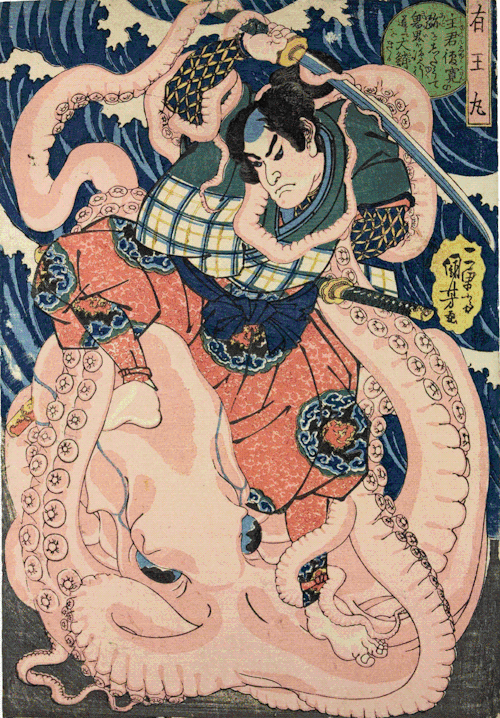
Above is Kuniyoshi's Ariōmaru Kills a Giant Octopus, circa 1833-1835. In Japanese medieval military chronicles Ariō was a servant of Priest Shunkan who gave particularly loyal service during Shunkan's banishment and death on Kikai island. The inscription in the top right of the picture tells how Ariō killed a giant octopus during his journey to Kikai island to join his master.

Monday, March 8, 2010

Japan Society in New York Mag


New York magazine featured our upcoming Utagawa Kuniyoshi exhibit in their Art section! Here's an excerpt from their attentive and generous review:

"In an almost 50-year career, spanning the first half of the nineteenth century, Kuniyoshi pushed across boundaries. He uses every part of the frame, deploying strong colors and powerful forms. He also works many genres: landscapes, beautiful women, actors, cats, and mythical animals, not to mention the battles of samurai and legendary heroes for which he is best known. Formally, he is brilliantly innovative: His three-panel compositions revolutionized Japanese art by spreading one image over an entire triptych. Less obviously (at least from our vantage point), he fought the censorship that was imposed in Japan in 1842, fashioning colorful scenes of monsters and demons that contain oblique symbols. They were subtle enough that the bureaucracy permitted his work to be published and widely distributed, while his knowledgeable audience could spot the subtext.

The immediacy of these prints helped attract crowds to last year’s Kuniyoshi retrospective at the Royal Academy of Arts in London, and it should do the same when the exhibition comes to the Japan Society on March 12. It’s nearly all drawn from the collection of Arthur R. Miller, who taught civil procedure at Harvard Law for 36 years, has moderated several acclaimed public-television series on the law, and is now a professor at NYU. “Power,” he said, when I asked what it was about Kuniyoshi that initially captivated him. “I’ve always liked military history, and I liked the images of the samurai and the warriors.” Over 30 years, Miller has acquired close to 2,000 of the 10,000 prints that the artist is thought to have produced."

Thursday, February 25, 2010

Tuesday, February 23, 2010

Notes from the Gallery

This is your second sneak peak of our upcoming exhibition: Graphic Heroes, Magic Monsters: Japanese Prints by Utagawa Kuniyoshi from the Arthur R. Miller Collection.

(Missed the first sneak peak? Find it here)

 
The New York Times gave us a shout-out with a short article featuring the new exhibit and they made sure to mention the special treat we have for you. Japan Society is selling prints of the originals showcased at the exhibit! Right now, they're available online in three sizes, framed (in black, gold or espresso wood frames) or unframed, for $75 to $500.
Here's a snippet from The Times:
"The show includes more than 130 works by Kuniyoshi (1797-1861), a master of color woodblock prints — among them, vivid images like that of a warrior stabbing himself in the mouth with a sword and a boy grappling with a giant carp. Thirty-six of those prints, including the one above of a Buddhist monk hiking on a snow-covered mountain, can be purchased as very high-quality digitalized prints, even before the show opens. Although, as Joe Earle, the director of the Japan Society Gallery, noted: “The prints you buy are not the actual size of the ones in the show — some are bigger than the original, and some are smaller. This is to prevent anyone from passing them off as original prints.”"