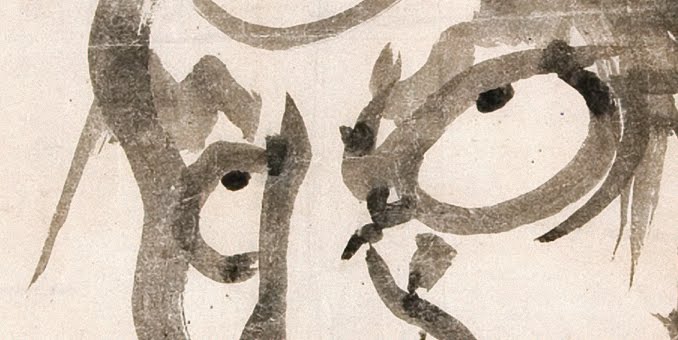
Showing posts with label Hakuin. Show all posts

Friday, December 10, 2010

Falls The Shadow


There is a scroll hanging in Japan Society’s Gallery for The Sound of One Hand called Nin. It is a simple calligraphic painting showcasing Hakuin's quick, fluid kanji stokes. In the middle is the distinct yet abstract impression of a person sitting in contemplation. The wall text simply gives the name of the scroll, its date of completion, and the translation: “Become the Master of your own Heart, and do not let it master you.”

This scroll has had profound meaning for and impact on me and the events around me, and I hasten to add that it goes perfectly with Japan Society's ongoing film series Zen & Its Opposite: Essential (&Turbulent) Japanese Art House, which explores the frailty of the human condition and the monstrosity that can manifest within our own hearts. The image also sings true for the latest film series Shadows of the Rising Sun: Cinema and Empire opening today through Sunday at Japan Society.

'Shadows' encompasses the full manifestation of a unmastered heart. Set in the particularly heinous Pacific campaign of World War II and told by keen eyes of filmmakers from Japan and China, the four films collide with Japan’s ambition for Empire and the harrowing descent. The films are not pretty, there is no honor, and no glory but madness. They show the truth of war, a particularly prickly subject to talk about and properly envision on film.

The four featured films are Kon Ichikawa’s Fire on the Plains (1959), Nagisa Oshima’s Merry Christmas Mr. Lawrence (1983),  Jiang Wen’s Devils on the Doorstep (2000), and the New York premiere of  Koji Wakamatsu’s Caterpillar (2010). Each film demonstrates the consequences of untamed ideals loose in an unforgiving world.  Some use dark humor, others use the bare and broken flesh as their medium, and others use the Greek tragedy formula to express when humanity falls into a shadow realm. Issues are dealt with utmost honesty, care and courtesy to all parties in these stories.

A resounding collection of anti-war war films, I'm reminded of the song "Our Solemn Hour" from the band Within Temptation and leave with the words:
Are they themselves to blame, the misery, the pain?
Didn't we let go, allowed it, let it grow?
If we can't restrain the beast which dwells inside
it will find it's way somehow, somewhere in time
Will we remember all of the suffering
Cause if we fail it will be in vain
S.H.

Thursday, November 18, 2010

Inside Your Zen Side

We think 60,000 thoughts per day, notes photographer Dana Lane. Via.

This season we've brought you Zen through art, food, films, writing, painting, theater, and literature.

Now we're bringing you to Zen.

Japan Society hosts its first-ever meditation workshops, Zen For Everyone, with renowned Buddhist scholar and priest, Roshi Pat Enkyo O’Hara. Enkyo Roshi currently serves as Co-Spiritual Director of the Zen Peacemaker Family, a spiritual, study and social action association. Her focus is on true self-expression, peacemaking and HIV/AIDS activism. She holds a Ph. D. in Media Ecology and taught Multi-media at my alma mater, New York University for over 20 years.

In three separate workshops on November 21, December 12 and January 8, Enkyo Roshi discusses the spiritual side of Japan Society's Hakuin exhibit, and instructs on proper zazen (sitting meditation) technique. According to Village Zendo, where she teaches, here are several key points to remember:
Whatever position you choose, sitting in a chair, full lotus, half-lotus, Burmese, or kneeling with a cushion or bench, choose a posture you can hold comfortably for 30 minutes.

Once seated, roll your hips slightly forward, allowing your belly to relax and your breath to move freely.

Center your spine by gently swaying from left to right in decreasing arcs.

Push the crown of your head toward the ceiling, straightening and extending your spine. Then relax your shoulders.
We've already discussed  the benefits of meditation in one’s daily life. It’s a great stress reliever, guides practitioners to a higher state of consciousness, and instills a greater sense of focus, which can be applied in any real world situation. But one question remains: how exactly does one truly meditate? Zen for Everyone is destined to enlighten all involved .

T.D.

Friday, November 12, 2010

Beyond The Cult Of Kawaii: Breaking The Otaku Effigy

Kitty-chan looms on Park Avenue... in protest? Photo via Shawnhoke.com.

Awareness of Japanese art is diametrically opposed. People tend to either appreciate reverent mediums like ukiyo-e paintings, uki-e, kano, kyoto, nanga, rinpa, tosa, etc., or relish the populist mass media production of anime and manga art. With this edification, what emerges is a culture that is either an idiom of traditionalism or predominantly an expression of a pubescent child that fetishizes the most mundane event as an oblique sexual manifestation masked by cute innocence.

Japan Society has covered the range, with the former represented by the current Hakuin exhibit and recent shows focusing on the art of Kuniyoshi and Zeshin. The latter phenomenon was sumptuously articulated in Japan Society's 2005 exhibition Little Boy: The Arts of Japan's Exploding Subculture  curated by Takashi Murakami.

Well, Japan Society is about to inject a new piece to the proverbial puzzle of Japanese art.

Opening spring 2012, Bye Bye Kitty!!! Between Heaven and Hell in Contemporary Japanese Art is a deliciously titled exhibit that goes far beyond stereotypes of the latest Japanese art and ideas. Curated by David Elliott, founding Director of Tokyo’s Mori Art Museum and hot off the 17th Biennale of Sydney, the show features 16 emerging and mid-career artists whose paintings, objects, photographs, videos, and installations meld traditional styles with challenging visions of Japan’s troubled present and uncertain future.

Japan Society Gallery Director Joe Earle notes the exhibit "celebrates the 'beyond cute' generation, introducing a group of younger artists whose work marks a clean break from the kawaii orthodoxy of the last decade. The show will offer a feast for the senses, demolishing preconceptions about contemporary Japan."

Why are we talking about this now, when there is plenty of time to catch the current exhibits The Sound of One Hand and oxherding? Joe Earle gives a sneak peek of Bye Bye Kitty!!! on November 16 at FIT’s Katie Murphy Amphitheatre. The lecture is part of an amazing range of programming concerning contemporary Japanese culture in conjunction with FIT’s exhibition Japan Fashion Now. Admission is FREE, though a reservation is required. Hope you can stop by and hope you are ready to get beyond cute!

S.H.

Thursday, November 11, 2010

Max Gimblett: The Pop Artist Of Sumi Painting

From Max Gimblett: The Language of Drawing.

Max Gimblett, a bespectacled, mild mannered New Zealander, walks over to his drawers of Asian paint brushes, lifts one and gently places it back into its resting place. He is in no hurry, and simply picks brushes up one by one, feels them and, it seems, silently communes with them. Once he has found the right one--a long instrument, with a careworn wooden handle and a  bulbous head--he walks over to his workbench, places a stark white sheet of handmade paper down and looks at it for a moment. With a sharp cry and one furious and fluid movement, he forms a perfectly imperfect black "O", ink splattering a wonderfully concise counterpoint design across the page. The act itself is what he calls "Poetics with meaning" ex nihilo. If you look closely there is a smile—not of satisfaction as one might imagine would follow such a masterful stroke, but a smile of clarity and peace.     

When Gimblett was interviewed for Japan Society's Nihon New York video series during the opening of his oxherding exhibit (running in conjunction with the Sound of One Hand Hakuin show), he laughed when he recalled, "Thomas McCelvey wrote if I had got to New York ten years earlier, ten years younger, I probably would have been a pop artist."

Well I am sorry to be contradictory to a master painter, draftsman and Rinzai lay monk, but Max Gimblett: you are the pop artist of the sumi ink painting world.

Think about the powerful, deceptively simple and accessible contemporary translation Gimblett achieves with oxherding, or the fusion of Western and Eastern thoughts, philosophies, desires and symbols. He takes these things out of context, isolates them, remixes them, and creates something completely new but steeped in the familiar for the individual to contemplate and enjoy. That is pop art in my book.

What can be affecting and transforming for the viewer can have a similar effect on the artist. When asked about how creating the oxherding paintings affected his life, personally and artistically, Gimblett recalls a time when he was stuck. He remembers telling one of his teachers that he was having trouble with drawing the later parables of the "Ten Ox Herding Pictures". Her response was "Anybody in their body will have trouble with seven through ten. They are not meant to be experienced alive. Act on good faith, and [when] you have done the first six, just proceed. Don’t expect to know the results."

That is what he exactly Gimblett achieves and welcomes the viewer to do the same. The point is not to know but to understand. In Gimblett’s words "You empty the mind and you have no mental activity. You operate out of your body, in the space, in relation to your soul where you are poetic and soulful…HRUMP! And you let it come."

Geared for painters of all levels, Gimblett offers three sumi painting workshops at Japan Society  November 13 [UPDATE: Sold Out], December 18, and January 9. The workshops begin with an exhibition talk and feature a studio session using traditional handmade paper, sumi ink and Asian brushes. The cost is $65/$60 Japan Society members, seniors & students and includes all materials.

S.H.

Friday, November 5, 2010

You Better Workshops: Manga & Anime In The Classroom + Some Hakuin Help

Manga and anime can color classroom doldrums. Via.

The influence of anime and manga (Japanese animated films and comic books respectively) in America has grown beyond its cult status of the last decades of the 20th century. Anime conventions in the U.S.  draw thousands of participants rocking out in costume and taking part in readings, demos, panels, collecting, workshops and screenings. Major chain book retailers like Borders and Barnes & Noble have shelves of manga, and our traditional comic book stores are filled to the brim with Japanese imports.The rise of manga and anime as entertainment in the U.S. is ever growing, but there’s another area where it increasingly brings people together and makes a difference:

The classroom.

When I attended Japanese high school, the only manga I saw in class was sneakily hidden behind my friend’s textbooks during the occasional boring lesson. These days manga serves as a teaching tool to provide a fun and interactive way to expose American students to art, social sciences and foreign culture.

"For teachers of Japanese Studies, Asian Studies, or any kind of diversity studies, the rising popularity of anime and manga among young North Americans seems an opportunity too good to miss," writes Toni Levi, in her excellent essay "Anime & Manga: It's Not All Make-Believe"  at our About Japan teachers website. Levi discusses introducing the material to students:
There are basically three ways to approach anime and manga in the classroom: 1) to focus on the content using approaches drawn from the social sciences, 2) to focus on the content using analytical methods drawn from literary and dramatic criticism, and 3) to focus on the anime or manga as a cultural document in its own right. Each of these has something different to offer and all in all, this is a great way to bring exciting, entertaining, and culturally relevant works into the American classroom.
Various manga and anime have Japanese cultural references that can enlighten American children about foreign customs. For example, the classic Hayao Miyazaki children’s film, My Neighbor Totoro has a scene where the father takes a bath at night with his two children illustrating the importance of bath culture in Japan. Much manga and anime contains great coming-of-age stories suitable for young adults or teenagers. English teachers may like to know that there are also many references to old forms of Japanese storytelling such as kamishibai, bunraku and kabuki, whose influence is clearly seen in modern works literature.

On November 8 & 10, the Japan Society Education Program  presents the two-session workshop What’s With Japanese Comics?: Bringing Manga Into the Classroom, introducing educators to the art of manga and anime and how to utilize them as powerful teaching tools.

The November 8 session features Brian Camp, Programming Manager for CUNY TV and co-author of Anime Classics Zettai! 100 Must-See Japanese Animation Masterpieces. He introduces seminal works and themes as well as Japanese concepts of storytelling with special attention to popular animated cartoon shows that have sprung from manga. He'll discuss sources of manga’s appeal to American readers today, showing how trends in the comic book genre in the U.S. from the 60s-90s reflects what's happening today with manga, using the recent explosion of shoujo (girls’) manga as an example.

November 10 features artist and professional mangaka (comic book illustrator) Hiroki Otsuaka, who created the original manga Samurai Beam for our spring 2010 Kuniyoshi exhibit. Otsuka introduces manga from the creative side, and shows participants how to turn themselves into a manga character and create a manga-esque storyline from their life.

Because the classics are as valuable as modern fare to inspire learning, the Education Program recently wrapped up a sister-workshop called Integrating Art and Social Studies Using Paintings by Zen Master Hakuin, showing how Hakuin's lessons towards enlightenment can enrich a child’s educational experience. K-12 educators took a guided tour of The Sound of One Hand: Paintings and Calligraphy by Zen Master Hakuin and collaborated to create teaching ideas and materials to bring back to their classrooms.

According to Education Program staff, the workshop cleared up a number of misconceptions about Zen (a Google search for “zen” brings up an insane amount confusion), outlining three basic characteristics: the master/disciple relationship; opposition to the use of idols; and meditation on koans, "verbal paradoxes with no answers aimed at encouraging unorthodox approaches to self-reflection by the Zen believer," according to presenter Frank Felten. They discussed the simple formula of the "3 Hakuins": the playful Hakuin + the serious Hakuin = Hakuin the Zen monk, and Felton outlined Hakuin's major themes:
Hakuin chose themes that were in some way or another directly related to himself.  Supreme deities (Kannon/Avalokitesvara), sages that he admired or that interested him (Hotei, Yen t’ou), everyday objects as an important part of religious practice, elements of folk belief that he was accustomed to and that he considered an important part in life, calligraphy.
Concluding the workshop, Linda Mulhauser led a sumi ink painting lesson, where participants had a lot of fun working the brush and discovering that bamboo looks deceptively simple to paint. We're lucky to have Linda return November 21, to lead a sumi ink painting workshop for children ages 8-12.

T.D.

Thursday, October 7, 2010

From No-Self To Knowing Yourself: The Psychology Of Zen Buddhism And Its Real-World Applications

The unexamined ox is not worth training. Art by Max Gimblett.
Celebrities do it, Oprah endorses it, and we’ve already mentioned it: making a Zen escape to calm the nerves and unwind after a stress-filled day. But how does Buddhist philosophy and its mediational practices actually relieve stress and enable us to get in better mental shape? And how can we incorporate it our overly examined lives?

One of the world's most regarded experts on the subject, psychiatrist and author Mark Epstein (Thoughts Without a Thinker, Going to Pieces Without Falling Apart, Psychotherapy Without the Self), addresses these questions and more in Mindful Living, an intimate evening talk with oxherding contributor and author Lewis Hyde .

In the discussion Epstein and Hyde examine the connection between Zen teachings and psychology with an emphasis on awareness of the self and compassion for those around us and the world we live in. Both Zen philosophy and psychology deal with an examination of the self (or no-self, as the case may be), recognizing that if we understand ourselves we'll be better able to control our senses and emotions rather than being controlled by them. Zen meditation is a centering practice, allowing practitioners to achieve an increased sense of alertness and presence in their lives. Epstein shows how people can be more present, more tolerant, more generous, and more loving in daily life by incorporating meditation techniques into their routines. 

With the oxherding connection, the discussion also touches on how art and poetry can best express one’s feelings by providing an outlet for the senses. Hyde demonstrates how reading poetry, especially in multiple translations, enables readers to obtain new perspectives on the world and take solace in the mutability of language. He also shows how inspiration and compassion pour from paintings by classic artists such as 18th century Zen master Hakuin and contemporary artists such as Max Gimblett, Hyde's oxherding co-creator.

In addition to this one-time discussion, Japan Society offers a series of related workshops, from freeing the written word with Lewis Hyde and freeing the image from a sumi ink-soaked brush with Max Gimblett in October, to Zen for Everyone mediation workshops with Roshi Pat Enkyo O’Hara in November. Regardless of how you get to Japan Society, there's many paths to enlightenment once you arrive!

T.D.

Friday, October 1, 2010

Hear The Silence So Loud

Details of Hiroki Otsuka's reverent and iconoclastic Daruma 28.

New York City: high-paced, intense--a metropolis where walking a step too slow or too fast can set off a deafening barrage of profanity and car horns. Amongst the craziness there always exists the need for escape, tranquility, and dare I say, Zen. For a weary New Yorker, Japan Society is that escape with its relaxingly quiet atmosphere, calming waterfall garden, and host of intellectually stimulating programs.

The escape is multiplied by three with the Society's new exhibition The Sound of One Hand, featuring America's first ever exhibition encompassing the paintings of eighteenth century Zen Buddhist master, Hakuin Ekaku. Though his work comes from a time where reverence and adherence to ancient traditions were the norm, it has a truly modern, populist feel to it.

Riffing on the contemporary vibe of Hakuin's art, the Society also presents two fresh, contemporary remixes on reverent Buddhist subject matter. Downtown artist Max Gimblett and author Lewis Hyde’s  oxherding is a bold spin of 'proper' form--10 years of collaboration deconstructing and reconstructing precious texts and holy images. As Gimblett himself puts it, he would have been considered a pop artist had he arrived in New York 10 years earlier in the 60s. His fusion of pop art sensibilities and Japanese calligraphy along with his intensity as an artist proves that the art of Zen, with its emphasis on tranquility and simplicity, doesn’t have to be boring.

There's another shock to the religious system before entering the Hakuin exhibit proper. Hiroki Otsuka’s Daruma 28 depicts the master and founder of Zen Buddhism, Daruma, in 4 acrylic paintings that portray him in private moments of spiritual struggle as a strikingly manga-esque, Gen-Y monk.

The Sound of One Hand opens today. Admission is $12, $10 for students and seniors, and free for Japan Society members and anyone under 16. oxherding and Daruma 28 are free to all Japan Society visitors during the course of the exhibition.

T.D.

Thursday, September 9, 2010

Read "The Sound Of One Hand"

The Daruma that cannot be drawn. More drawings.

Our exhibition The Sound of One Hand: Paintings and Calligraphy by Zen Master Hakuin doesn’t open until October, but if you’re raring for a sneak peek and eager for context of Hakuin's life and work, the best primer is the official catalogue, released this week by Shambhala Publications. Co-authored by Audrey Yoshiko Seo and Stephen Addiss the 287-page, fully illustrated, hardbound color beauty is a comprehensive and wonderfully readable overview of the world's most influential Zen master.

Writing alternating chapters, Seo and Addiss explore Hakuin’s impact as both an artist and Zen monk. As explained in the introduction, Hakuin was a vital figure in the development of Zen Buddhism. He was a reformer of the major school of Rinzai Zen, establishing it as an open and inclusive alternative to some of the stodgier forms that preceded it. Maintaining the rigors of practice, Hakuin emphasized the study of koans (instructive riddles), which he called "poison words," in addition to silent zazen meditations and post-enlightenment training (because after enlightenment there’s still more to learn!)

Though his subject matter varied, Hakuin’s art reflects his teachings and inspirations from the everyday life: from the theatrical, such as Korean acrobats, to the somber and personal, such as other monks of his lineage. Many paintings accompanied his prolific writing on Zen philosophy and literature. Others depict goblins and other folk beasties, as well as major Zen figures, such as the founder, Daruma.

The formidable Daruma is most often depicted as large, hairy and homely man, with piercing eyes, wearing plain red or white robes, and earrings. Hakuin’s representations of him, however, varied widely over his career, and, even though they ascribed to the accepted format, it seemed he was getting at something beyond physical representation. Indeed, as the inscription on one work he did at the age of 44 says: "I have painted several thousand Daruma, yet have never depicted his face. This is only natural, for the moment I spread the paper to draw it, the original form disappears. All of you, what is this Daruma that cannot be drawn?"

Thursday, August 19, 2010

Zen Again & Again

Hakuin Ekaku, 1685-1768, Two Blind Men on a Bridge. Ink on paper, 11 x 33 in. Man’yo-an Collection.


October is Zen Month here at Japan Society! Starting on October 1st, and continuing until January, the new exhibit, The Sound of One Hand: Paintings and Calligraphy by Zen Master Hakuin, opens with a veritable onslaught of Zen-related events following. The "Here & Zen" series includes lectures on art and lifestyle, performances, film screenings, workshops, as well as a second, free-of-charge exhibition.

On Saturday October 2nd, Stephen Addiss heads the symposium Hear the Sound of One Hand: Reflections on the Art of Zen Master Hakuin about the influence of Zen on artistic expression in Japan. Addiss is a co-curator of the exhibition with his wife Audrey Yoshiko Seo. Both are respected and prolific writers on Zen and art, and they wrote the exhibition catalogue. They are joined by Matthew Welch, Curator of Japanese and Korean Art at the Minneapolis Institute of Arts and David Rosand, Meyer Schapiro Professor of Art History at Columbia University.

The next weekend, on October 8th and 9th, actor-director Yoshi Oida brings his one man show, Interrogations: Words of the Zen Masters to Japan Society. Interrogations is a comical play about a Zen master addressing several koans to a student to test him, and to see if he has reached enlightenment. The play is accompanied with live music by Berlin-based experimental musician Dieter Trüstedt. Interrogations premiered in 1979 and has been performed by Oida and Trüstedt throughout the world (this summer it stopped in Barcelona). It’s a true classic of the genre, and offers something for Zen novices, adepts, and masters alike!

On October 15th, Japan Society screens Masaki Kobayashi's epic ghost-film omnibus Kwaidan. It’s made up of four separate, thematically related, traditional Japanese ghost stories, and is by turns hypnotic, jarring, and meditative.

Field to Table: the Role of Vegetables in the Japanese Diet, is a lecture by Elizabeth Andoh, a Japanese food expert and cookbook author, as well as Masato Nishihara, head chef at Kijitsu Restaurant. Japanese cuisine boasts an impressive vegetarian tradition, because Buddhist doctrine limits, and sometimes prohibits, the consumption of meat.

In addition to the main gallery exhibit an additional show entitled oxherding features ink paintings by Max Gimblett and poems by Lewis Hyde. Together they examine similar themes to Hakuin, but from a contemporary perspective. As inspiration, the exhibition takes the famous Zen parable, "The Ten Ox Herding Pictures", about tending and maintaining discipline in the mind for gaining enlightenment. Hyde as well as psychiatrist and author Mark Epstein present a lecture as well: Mindful Living, examining the ox herding parable and describing ways to map its Zen ideas onto Western lives.

A number of workshops are held as well. oxherding artist Max Gimblett leads four sumi ink painting workshops from October to January, Lewis Hyde offers a writing workshop, and world-famous shakuhachi musician Akikazu Nakamura teaches missoku Zen breathing meditation in October.

Ticket sales for the lectures, performances and workshops have just been released online, so get them while they’re hot, and get ready to expand your minds!

This cow is maditating on the ancient koan, "nothingness" 

N.O.

Wednesday, July 21, 2010

Hark, The Sound Of One Hand!

The new poster for The Sound of One Hand, opening October 1.
Japan Society’s upcoming gallery exhibition, The Sound of One Hand: Paintings and Calligraphy by Zen Master Hakuin, approaches! Outside our main doors, the 2010 JAPAN CUTS poster was retired this week and replaced by the new Hakuin poster.

The exhibition opens on October 1, 2010 and runs until January 16, 2011. It promises to be a fascinating display of the finest paintings by Zen monk and artist extraordinaire Hakuin.

Hakuin’s exact dates are unknown, but historians generally agree that he was born circa 1685 and died in 1768. While Hakuin’s work as an artist is deservedly well known, he considered himself a religious figure above all. The classic Zen koan “What is the sound of one hand clapping?” actually originated with Hakuin, and was a big part of his revival of the major Rinzai school of Zen Buddhism. In fact, most of his art was not created for the marketplace, or commissioned for temples. They were meditative exercises or meant as gifts for other monks who needed encouragement or advice.

Hakuin Ekaku, Seated Daruma, Seen from the Side. Ink on paper, 42 1/2 x 14 6/8 in. Ginshu Collection. Photo: Maggie Nimkin.
Co-curators and Zen scholars Audrey Yoshiko Seo and Stephen L. Addiss have pulled together 69 of Hakuin’s most notable works for this exhibition. Hakuin’s work is fairly typical of many Zen painters’ in that they were executed quickly and spontaneously, with a variety of techniques including fluid, deft lines, rough dark strokes, ink washes, and delicate calligraphic marks.

Hakuin’s subject matter varied much wider than many of his contemporaries. His output includes portraits of great Zen thinkers like Bodhidharma (the semi-mythical founder of Zen Buddhism), flora and fauna, and whimsical illustrations for Zen parables. His style was also very fluid. Some works have a fine attention to detail, and are conservative in design and execution, while others have brutal, bold, intentionally inelegant brush-strokes. The latter was a style that Hakuin himself was instrumental in developing, and later became a major evolution in Zen art.

Hakuin Ekaku, Hotei Watching Mouse Sumo. Ink on paper, 14 5/8 x 20 5/8 in. Ginshu Collection. Photo: Maggie Nimkin.
Japan Society has a fine history of Buddhism-related exhibitions, most recently: Awakenings: Zen Figure Painting in Medieval Japan in 2007, and Transmitting the Forms of Divinity: Early Buddhist Art from Korea and Japan, which The New York Times called one of the best exhibits of 2003.

For this show, Japan Society offers a number of Zen-related programs. Also opening October1, the mini-exhibit oxherding is a series of contemporary ink paintings by Max Gimblett, in collaboration with poet Lewis Hyde, based on the famous Zen parable. Yoshi Oida, the great Japanese actor of stage and screen, performs his one-man show Interrogations about a Zen master’s test to determine his pupil’s enlightenment. In addition lectures abound and family events presented by our Education Program promise something for all ages.

Keep an eye out on this blog for more articles and more of Hakuin’s paintings leading up to the opening!

N.O.