Showing posts with label workshop. Show all posts

Tuesday, July 24, 2012

Japanese Language in Action: Summer Theater Workshop For High Schoolers

SPAC's Medea, performed at Japan Society in 2011. Photo by Takuma Uchida.

When we think theater we think of bright costumes and big sets, flashy musical numbers, tear-jerking soliloquys, black box realness or broad, bawdy comedy. On Broadway alone right now, it's spider men spinning impossible spectacle, invisible family-binding bunnies, all that jazz, music of the night and much more. But when you get down to it, theater is fundamentally story, which can be told through many different languages: movement, character, plot, design. And sometimes, in the best theater, the story unfolds simply in language itself (think Shakespeare).

This year’s Japan Society summer high school workshop teaches the most fundamental tool for storytelling, language (specifically Japanese) through theater and performance techniques. Although participants may be of any proficiency level, the program is recommended for beginner to intermediate level speakers.

Led by Mami Fujisaki, a high school Japanese teacher at Horace Mann School and a recipient of the Bellet Award for Teaching Excellence (2004), participants split their days between basic Japanese courses and purely theatrical workshops. In the morning Fujisaki teaches students dialogue and conversational skills. In the afternoon, guest instructors present an array of mini-workshops focusing on storytelling through acting, movement, and even traditional non-theater techniques and pop music, among other topics. Guest instructors include Jun Kim, Sonoko Kawahara and Kanako Hiyama, who participate as actors, directors or dancers in New York Japan-based theatre troupes; Alex York, a veteran Japan Society language student and New York based Japanese pop-rock singer; and Tara McGowan, a traditional storyteller and practitioner of kamishibai (storytelling through illustrated picture cards).

Over the course of the workshop, students learn two plays--Issun Boushi and John Manjiro--which they perform on the final day of the workshop, August 18. Though they will have a hand in creating costumes, set, and lighting, their primary focus will be bringing characters to life and understanding them from the mind of the author as well as the actor. Having polished performance skills, learned basic Japanese, and mastered lines and delivery, they will demonstrate a deeper understanding of the language, and ultimately connecting to people through storytelling.

--Sarah Anderson

Each summer Japan Society’s Education Program offers workshops for high school students aiming to help them connect with a particular facet of Japanese culture. In previous years, students have discovered tops topics such as anime, fashion and cooking. For more information on the Society’s education programming, visit http://www.japansociety.org/page/programs/education_family.

Monday, November 29, 2010

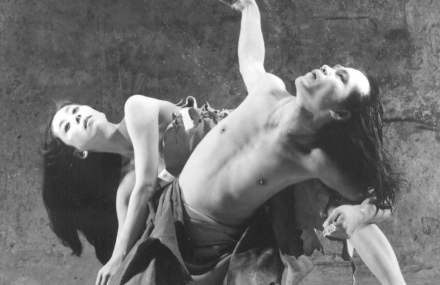
Dance Duo Bends Beyond Butoh, Makes Movement For Everybody


"You connect to their world not by watching, but by imagining that you are living inside their bodies."

Percussion pounds in the distance as identical, scantily clad figures with snow white faces move together through time in a slow, fluid motion—an odd combination of spiritual ritual and martial art. The slowness is gripping, the stillness is suffocating, and a sense of awe emerges from the twisting and tangling of limbs and faces.

Butoh, Japan's inimitable form of modern dance was founded in the post war period by Tatsumi Hijikata and Kazuo Ohno. Hijikata felt dance in Japan following World War II was merely a copy of Western dance and wanted to create a form uniquely Japanese. A sense of rebellion permeated butoh performances, which emerged from a backdrop of student riots and protests. The movements were incredibly raw, as though animal instinct and sexual desire governed the dancers. This was intentional, as Hijikata and Ohno sought to tackle taboo ideas regarding human sexuality and challenge authority by showcasing the human body’s untamed movements. 

Two contemporary artists who tamed the untamed are the legendary husband and wife choreography/dance team Eiko and Koma. Though they met at Hijikata's studio in 1971 and studied with Ohno, they don't consider their dance butoh out of respect to the masters. Nonetheless the influence manifests itself in their style. In her fantastic recent New York Times profile of the "king and queen of slow", Gia Kourlas describes Eiko and Koma's movement:
While the moving-painting quality of their choreography is profoundly arresting, both theatrically and visually — they find the beauty in ugly — there is another layer that gets to the essence of nature. You connect to their world not by watching, but by imagining that you are living inside their bodies.
Japan Society, which debuted Eiko and Koma in 1976 and has presented them many times to great acclaim, hosts Eiko & Koma: Delicious Movement Workshop. The venerable duo hopes that anyone who takes their workshop—no matter what level of dance experience—find a renewed sense of focus and coordination, as well as take a primal pleasure in the simple act of moving one’s body.

The one-day workshop is held on December 4. Tickets are $40 or $32 for Japan Society members.

Friday, November 19, 2010

Kids: Sumi For A Sunny Sunday

Beware the sumi-e dragons! Via.

There is an ancient story that a monk was working on a sumi-e painting of dragons. When he finished his painting, he went to the head monk to seek his approval. The head monk was very pleased with the young artist’s work but asked why there were no pupils in the dragons' eyes. The young artist shyly looked down and expressed that if he added pupils he feared the dragons would come alive. The head monk scoffed and asked him to put pupils in the dragons' eyes to prove he was wrong. The young monk walked over, lightly dipped his brush in the ink and placed the pupils in the two dragons' eyes. Once he finished and moved away from the paper, the two dragons blinked their eyes, slowly rose out of the paper and with one swift movement flew away. The head monk looked on astonished and then understood why the young monk was reluctant of placing the pupils in the dragon’s eyes. He did not just draw dragons but he captured their essence.

In Composition Arthur Wesley Dow describes the nature of sumi-e painting:
the painter…put upon the paper the fewest possible lines and tones; just enough to cause form, texture and effect to be felt. Every brush-touch must be full-charged with meaning, and useless detail eliminated. Put together all the good points in such a method and you have the qualities of the highest art...
A gorgeous description for adults but one wonders how this expression of sumi-e painting can mix with kids. Gather around and I will tell you sumi-e ink painting is very easy and fun for children. First off, the tools are only ink, a brush and a piece of paper. Secondly, the process is not painstaking reproduction of the subject, but rather a brisk and concentrated capturing of its essence.
Thirdly, sumi-e paintings have made their mark in contemporary culture through the Playstation 2 and Wii consules video game called Okami.  The action-adventure game allows the player to control the main character in an interactive storyline, accomplished through the unconventional use of animated sumi-e illustration with other traditional Japanese art forms. 

On November 21 Japan Society’s Education Program hosts Art Cart:  Sumi Ink Painting.  Led by a  Japan Society educator and artist Linda Malhauser, a member of the National Sumi-e Society of America,  children learn basic painting techniques, and create original works of art in reaction to the wonderful art in our current exhibitions, The Sound of One Hand: Paintings and Calligraphy by Zen Master Hakuin , which features an array of kid-friendly figures such as ghosts and demons, dragons, acrobats, dancing mice, and monkeys!


Hakuin's hanging monkey. Via.
S.H.

Thursday, November 11, 2010

Max Gimblett: The Pop Artist Of Sumi Painting

From Max Gimblett: The Language of Drawing.

Max Gimblett, a bespectacled, mild mannered New Zealander, walks over to his drawers of Asian paint brushes, lifts one and gently places it back into its resting place. He is in no hurry, and simply picks brushes up one by one, feels them and, it seems, silently communes with them. Once he has found the right one--a long instrument, with a careworn wooden handle and a  bulbous head--he walks over to his workbench, places a stark white sheet of handmade paper down and looks at it for a moment. With a sharp cry and one furious and fluid movement, he forms a perfectly imperfect black "O", ink splattering a wonderfully concise counterpoint design across the page. The act itself is what he calls "Poetics with meaning" ex nihilo. If you look closely there is a smile—not of satisfaction as one might imagine would follow such a masterful stroke, but a smile of clarity and peace.     

When Gimblett was interviewed for Japan Society's Nihon New York video series during the opening of his oxherding exhibit (running in conjunction with the Sound of One Hand Hakuin show), he laughed when he recalled, "Thomas McCelvey wrote if I had got to New York ten years earlier, ten years younger, I probably would have been a pop artist."

Well I am sorry to be contradictory to a master painter, draftsman and Rinzai lay monk, but Max Gimblett: you are the pop artist of the sumi ink painting world.

Think about the powerful, deceptively simple and accessible contemporary translation Gimblett achieves with oxherding, or the fusion of Western and Eastern thoughts, philosophies, desires and symbols. He takes these things out of context, isolates them, remixes them, and creates something completely new but steeped in the familiar for the individual to contemplate and enjoy. That is pop art in my book.

What can be affecting and transforming for the viewer can have a similar effect on the artist. When asked about how creating the oxherding paintings affected his life, personally and artistically, Gimblett recalls a time when he was stuck. He remembers telling one of his teachers that he was having trouble with drawing the later parables of the "Ten Ox Herding Pictures". Her response was "Anybody in their body will have trouble with seven through ten. They are not meant to be experienced alive. Act on good faith, and [when] you have done the first six, just proceed. Don’t expect to know the results."

That is what he exactly Gimblett achieves and welcomes the viewer to do the same. The point is not to know but to understand. In Gimblett’s words "You empty the mind and you have no mental activity. You operate out of your body, in the space, in relation to your soul where you are poetic and soulful…HRUMP! And you let it come."

Geared for painters of all levels, Gimblett offers three sumi painting workshops at Japan Society  November 13 [UPDATE: Sold Out], December 18, and January 9. The workshops begin with an exhibition talk and feature a studio session using traditional handmade paper, sumi ink and Asian brushes. The cost is $65/$60 Japan Society members, seniors & students and includes all materials.

S.H.

Friday, November 5, 2010

You Better Workshops: Manga & Anime In The Classroom + Some Hakuin Help

Manga and anime can color classroom doldrums. Via.

The influence of anime and manga (Japanese animated films and comic books respectively) in America has grown beyond its cult status of the last decades of the 20th century. Anime conventions in the U.S.  draw thousands of participants rocking out in costume and taking part in readings, demos, panels, collecting, workshops and screenings. Major chain book retailers like Borders and Barnes & Noble have shelves of manga, and our traditional comic book stores are filled to the brim with Japanese imports.The rise of manga and anime as entertainment in the U.S. is ever growing, but there’s another area where it increasingly brings people together and makes a difference:

The classroom.

When I attended Japanese high school, the only manga I saw in class was sneakily hidden behind my friend’s textbooks during the occasional boring lesson. These days manga serves as a teaching tool to provide a fun and interactive way to expose American students to art, social sciences and foreign culture.

"For teachers of Japanese Studies, Asian Studies, or any kind of diversity studies, the rising popularity of anime and manga among young North Americans seems an opportunity too good to miss," writes Toni Levi, in her excellent essay "Anime & Manga: It's Not All Make-Believe"  at our About Japan teachers website. Levi discusses introducing the material to students:
There are basically three ways to approach anime and manga in the classroom: 1) to focus on the content using approaches drawn from the social sciences, 2) to focus on the content using analytical methods drawn from literary and dramatic criticism, and 3) to focus on the anime or manga as a cultural document in its own right. Each of these has something different to offer and all in all, this is a great way to bring exciting, entertaining, and culturally relevant works into the American classroom.
Various manga and anime have Japanese cultural references that can enlighten American children about foreign customs. For example, the classic Hayao Miyazaki children’s film, My Neighbor Totoro has a scene where the father takes a bath at night with his two children illustrating the importance of bath culture in Japan. Much manga and anime contains great coming-of-age stories suitable for young adults or teenagers. English teachers may like to know that there are also many references to old forms of Japanese storytelling such as kamishibai, bunraku and kabuki, whose influence is clearly seen in modern works literature.

On November 8 & 10, the Japan Society Education Program  presents the two-session workshop What’s With Japanese Comics?: Bringing Manga Into the Classroom, introducing educators to the art of manga and anime and how to utilize them as powerful teaching tools.

The November 8 session features Brian Camp, Programming Manager for CUNY TV and co-author of Anime Classics Zettai! 100 Must-See Japanese Animation Masterpieces. He introduces seminal works and themes as well as Japanese concepts of storytelling with special attention to popular animated cartoon shows that have sprung from manga. He'll discuss sources of manga’s appeal to American readers today, showing how trends in the comic book genre in the U.S. from the 60s-90s reflects what's happening today with manga, using the recent explosion of shoujo (girls’) manga as an example.

November 10 features artist and professional mangaka (comic book illustrator) Hiroki Otsuaka, who created the original manga Samurai Beam for our spring 2010 Kuniyoshi exhibit. Otsuka introduces manga from the creative side, and shows participants how to turn themselves into a manga character and create a manga-esque storyline from their life.

Because the classics are as valuable as modern fare to inspire learning, the Education Program recently wrapped up a sister-workshop called Integrating Art and Social Studies Using Paintings by Zen Master Hakuin, showing how Hakuin's lessons towards enlightenment can enrich a child’s educational experience. K-12 educators took a guided tour of The Sound of One Hand: Paintings and Calligraphy by Zen Master Hakuin and collaborated to create teaching ideas and materials to bring back to their classrooms.

According to Education Program staff, the workshop cleared up a number of misconceptions about Zen (a Google search for “zen” brings up an insane amount confusion), outlining three basic characteristics: the master/disciple relationship; opposition to the use of idols; and meditation on koans, "verbal paradoxes with no answers aimed at encouraging unorthodox approaches to self-reflection by the Zen believer," according to presenter Frank Felten. They discussed the simple formula of the "3 Hakuins": the playful Hakuin + the serious Hakuin = Hakuin the Zen monk, and Felton outlined Hakuin's major themes:
Hakuin chose themes that were in some way or another directly related to himself.  Supreme deities (Kannon/Avalokitesvara), sages that he admired or that interested him (Hotei, Yen t’ou), everyday objects as an important part of religious practice, elements of folk belief that he was accustomed to and that he considered an important part in life, calligraphy.
Concluding the workshop, Linda Mulhauser led a sumi ink painting lesson, where participants had a lot of fun working the brush and discovering that bamboo looks deceptively simple to paint. We're lucky to have Linda return November 21, to lead a sumi ink painting workshop for children ages 8-12.

T.D.

Thursday, October 14, 2010

Creative Rights And Writing With Lewis Hyde

Lewis Hyde (r) gets messy with fellow ox herder Max Gimblett. Via.
Lewis Hyde is a renowned author, teacher, MacArthur Fellow and cultural critic known for his thought provoking and careful but lively debates about artistic body and the creative process. Notes NPR in a recent profile:
Hyde, whom David Foster Wallace once called "one of our true superstars of nonfiction," is an infectiously enthusiastic writer. He's able to jump from topic to topic while never losing sight of his thesis, and the side roads he takes the reader down — from Emily Dickinson to Bob Dylan, from Benjamin Franklin (whom Hyde calls the "founding pirate") to John Cage — are fascinating.
His books include The Gift, the classic treatise on creativity in society, and Trickster Makes This World, about the playful and disruptive side of human imagination. His latest tome, Common as Air  rethinks copyright and intellectual property for the 21 century. Here is a typically Hyde-ian section from NPR's lengthy excerpt:
"Intellectual property" is the phrase now used to denote ownership of art and ideas, but what exactly does it mean? Does it make sense, to begin with, to say that "intellect" is the source of the "properties" in question? A novel like Ulysses, the know-how for making antiviral drugs, Martin Luther King, Jr's "Dream" speech, the poems of Rimbaud, Andy Warhol screen prints, Mississippi Delta blues, the source code for electronic voting machines: who could name the range of human powers and historical conditions that attends such creations? All that we make and do is shaped by the communities and traditions that contain us, not to mention by money, power, politics, and luck. And even should the artist or scientist think she has extracted herself from the world to stand alone in the studio, a tremendous array of faculties and mind- states may well attend her creativity. 
There is intellect, of course, but also imagination, intuition, sagacity, persistence, prudence, fantasy, lust, humor, sympathy, serendipity, will, prayer, grief, courage, visual acuity, ambition, guesswork, mother wit, memory, delight, vitality, venality, kindness, generosity, fortitude, fear, awe, compassion, surrender, sincerity, humility, and the ability to integrate diametrically opposed states of mind into harmonious wholes . . . We would need quite a few new categories to fully map this territory — "dream property," "courage property," "grief property" — and even if we had that list, only half the problem would have been addressed.
Hyde champions the idea that art does not grow through strict adhesion to doctrine but instead takes the framework from past generations and uses it to bring forth new life--an ancient dialogue to find the perspective needed to contemplate our modern world. For Japan Society's oxherding exhibit, he translated and reinterpreted the ancient Chinese Buddhist parable "The Ten Oxherding Pictures"  concurrently with the creation of Max Gimblett's powerful ink-brush paintings. Discussing the process, he writes:
When it comes to the translations, the plan is to have each oxherding text appear in three different English versions: a “one word ox” which sticks slavishly to the Chinese (one word per character), a “spare sense ox,” which puts each Chinese syntactic unit into a simple English sentence, and an “American ox” (or “fat American ox”) which takes considerable liberties while trying to be faithful to my intuitions about the meaning of the series.
In conjunction with oxherding , Hyde gives a creative writing workshop at Japan Society on Saturday October 16 called The Personality of a Poem . A former director of creative writing at Harvard, and currently a creative writing teacher at Kenyon College, he will help writers of all levels discover methods of finding the "personal personality" of any written work of art, steering away from conventional thought and fostering instinct to travel down the unbeaten path and enjoy the wisdom it offers.

One of several workshops Japan Society's Zen season (including painting, breathing, and meditation),  this event is a good example of the opportunity the Society regularly affords that fulfills Hyde's call to action in his essay "Created Commons":
Let us begin by recognizing how deeply all creative enterprise needs to be fed by its larger community. Let us work to build the institutions that will make all talent prone to the happy accident of its fruition. Let us create a future that will be proud to name us as its ancestors.
S.H.

Thursday, October 7, 2010

From No-Self To Knowing Yourself: The Psychology Of Zen Buddhism And Its Real-World Applications

The unexamined ox is not worth training. Art by Max Gimblett.
Celebrities do it, Oprah endorses it, and we’ve already mentioned it: making a Zen escape to calm the nerves and unwind after a stress-filled day. But how does Buddhist philosophy and its mediational practices actually relieve stress and enable us to get in better mental shape? And how can we incorporate it our overly examined lives?

One of the world's most regarded experts on the subject, psychiatrist and author Mark Epstein (Thoughts Without a Thinker, Going to Pieces Without Falling Apart, Psychotherapy Without the Self), addresses these questions and more in Mindful Living, an intimate evening talk with oxherding contributor and author Lewis Hyde .

In the discussion Epstein and Hyde examine the connection between Zen teachings and psychology with an emphasis on awareness of the self and compassion for those around us and the world we live in. Both Zen philosophy and psychology deal with an examination of the self (or no-self, as the case may be), recognizing that if we understand ourselves we'll be better able to control our senses and emotions rather than being controlled by them. Zen meditation is a centering practice, allowing practitioners to achieve an increased sense of alertness and presence in their lives. Epstein shows how people can be more present, more tolerant, more generous, and more loving in daily life by incorporating meditation techniques into their routines. 

With the oxherding connection, the discussion also touches on how art and poetry can best express one’s feelings by providing an outlet for the senses. Hyde demonstrates how reading poetry, especially in multiple translations, enables readers to obtain new perspectives on the world and take solace in the mutability of language. He also shows how inspiration and compassion pour from paintings by classic artists such as 18th century Zen master Hakuin and contemporary artists such as Max Gimblett, Hyde's oxherding co-creator.

In addition to this one-time discussion, Japan Society offers a series of related workshops, from freeing the written word with Lewis Hyde and freeing the image from a sumi ink-soaked brush with Max Gimblett in October, to Zen for Everyone mediation workshops with Roshi Pat Enkyo O’Hara in November. Regardless of how you get to Japan Society, there's many paths to enlightenment once you arrive!

T.D.

Thursday, August 19, 2010

Washoku Update & Insider Interviews From Students

Chef Noriyuki Kobayashi teaches students the finer points of making sushi. Photo by Sara & Christina

The high school students participating in Washoku 101 are coming to the end of their two-week course in cooking Japanese-style. Some of the activities they’ve enjoyed are: learning how to make tsukemono (pickles), onigiri (rice balls), Japanese sweets, as well as visiting a Tofu factory, and participating in a tea ceremony.

You can keep up-to-date on their activities by checking out the students' blog. There are tons of great pictures, as well as interviews with the instructors, some of whom are well-known in their respective fields as masters of various Japanese culinary techniques.

In students Perdro and Tanner’s interview with Tofu manufacturer Yoko Difranica at House Foods, Ms. Difranica says that Tofu’s still a hard sell in the U.S.: “Tofu is an acquired taste and few people in the U.S. grow up with tofu. Another challenge is educating customers about tofu and not scaring them off by making them think that House Foods is trying push a healthy product and one with no taste.”

Some Japanese food has had a wider and warmer reception than tofu, though. The sushi chef at Megu Noriyuki Kobayashi experiences high demand for his specialty, he told students Sara and Christina. Maybe it’s because he’s trained with another master: “I didn’t really have the money for culinary school,” he said. “Actually, people didn’t use to go to culinary school, but would learn under a really good chef at real restaurants.”

All the classes, lectures, and demonstrations culminate in a private reception held at the Astor Center. Mr. Kobayashi will lead students in a demonstration of making and rolling sushi. Guests will be invited to join in and partake in the hand-made sushi feast. Additional demonstrations will also be held, as well as a meal at the end, of catered and student-made goodies.

N.O.

Zen Again & Again

Hakuin Ekaku, 1685-1768, Two Blind Men on a Bridge. Ink on paper, 11 x 33 in. Man’yo-an Collection.


October is Zen Month here at Japan Society! Starting on October 1st, and continuing until January, the new exhibit, The Sound of One Hand: Paintings and Calligraphy by Zen Master Hakuin, opens with a veritable onslaught of Zen-related events following. The "Here & Zen" series includes lectures on art and lifestyle, performances, film screenings, workshops, as well as a second, free-of-charge exhibition.

On Saturday October 2nd, Stephen Addiss heads the symposium Hear the Sound of One Hand: Reflections on the Art of Zen Master Hakuin about the influence of Zen on artistic expression in Japan. Addiss is a co-curator of the exhibition with his wife Audrey Yoshiko Seo. Both are respected and prolific writers on Zen and art, and they wrote the exhibition catalogue. They are joined by Matthew Welch, Curator of Japanese and Korean Art at the Minneapolis Institute of Arts and David Rosand, Meyer Schapiro Professor of Art History at Columbia University.

The next weekend, on October 8th and 9th, actor-director Yoshi Oida brings his one man show, Interrogations: Words of the Zen Masters to Japan Society. Interrogations is a comical play about a Zen master addressing several koans to a student to test him, and to see if he has reached enlightenment. The play is accompanied with live music by Berlin-based experimental musician Dieter Trüstedt. Interrogations premiered in 1979 and has been performed by Oida and Trüstedt throughout the world (this summer it stopped in Barcelona). It’s a true classic of the genre, and offers something for Zen novices, adepts, and masters alike!

On October 15th, Japan Society screens Masaki Kobayashi's epic ghost-film omnibus Kwaidan. It’s made up of four separate, thematically related, traditional Japanese ghost stories, and is by turns hypnotic, jarring, and meditative.

Field to Table: the Role of Vegetables in the Japanese Diet, is a lecture by Elizabeth Andoh, a Japanese food expert and cookbook author, as well as Masato Nishihara, head chef at Kijitsu Restaurant. Japanese cuisine boasts an impressive vegetarian tradition, because Buddhist doctrine limits, and sometimes prohibits, the consumption of meat.

In addition to the main gallery exhibit an additional show entitled oxherding features ink paintings by Max Gimblett and poems by Lewis Hyde. Together they examine similar themes to Hakuin, but from a contemporary perspective. As inspiration, the exhibition takes the famous Zen parable, "The Ten Ox Herding Pictures", about tending and maintaining discipline in the mind for gaining enlightenment. Hyde as well as psychiatrist and author Mark Epstein present a lecture as well: Mindful Living, examining the ox herding parable and describing ways to map its Zen ideas onto Western lives.

A number of workshops are held as well. oxherding artist Max Gimblett leads four sumi ink painting workshops from October to January, Lewis Hyde offers a writing workshop, and world-famous shakuhachi musician Akikazu Nakamura teaches missoku Zen breathing meditation in October.

Ticket sales for the lectures, performances and workshops have just been released online, so get them while they’re hot, and get ready to expand your minds!

This cow is maditating on the ancient koan, "nothingness" 

N.O.

Tuesday, May 25, 2010

Summertime and the Learning is Easy

Photo by Kenji Takigami
During July and August, the Corporate Program slows down and takes a well-deserved break but it's during these months that our teaching programs get jazzed up.

Our list of summer courses is extensive and covers all manner of ability levels and topics, including classes on mastering kanji and classes devoted solely to reading. What better way to escape the groggy summer heat than by sitting in a cool, air-conditioned classroom and sharpening your Japanese skills?

And we're not just offering lessons on language.

Nearly every year the Education Program invites high school students to participate in an 11-day immersion workshop on Japanese cuisine and culture, during which they examine the multifaceted history of Japanese cuisine in connection with health and wellness. And on the last day of the program, families and friends are invited to a Japanese-style reception where Japanese dishes and tea are served, including those prepared by chefs and participating students.

This is a great confidence booster for any high school student. For example, Josephine Ledda (grade 12) participated in the workshop in the summer of 2008 and remarked:

“The great thing about the Japan Society is that they know how to approach teenagers in a way that'll encourage them to learn. When we took this cooking workshop, we weren't just learning about Japanese food, we were learning about a very important part of their culture. And who wouldn't want to learn about a country through their food?”

You can find other participants' comments, photos, highlights, and activity descriptions of the program in 2008 on our website and if you're interested, don't hesitate to sign up for this summer's Japanese Cuisine 101.

And don't forget to check out the 2010 Course Catalog. I bet you'll find something whether you're just beginning, want to brush up your advanced skills, or need a quick conversation lesson.

みんなさん、がんばってね!

Monday, March 22, 2010

The Play Company in association with Japan Society presents…


The Play Company is producing the English-language premiere of Enjoy, a play by wunderkind playwright Toshiki Okada. The play will run on Tuesdays and Sundays from March 27 to April 25. Dan Rothenberg, Co-Artistic Director of Philadelphia’s Obie Award-winning Pig Iron Theater Company, directs a cast of American actors in this new English translation.

Following the lives and romances of 20 and 30-somethings who work part-time in a manga café in downtown Tokyo, this slacker comedy of manners reveals a portrait of Japanese youth culture adrift and illustrates the current socio-economic rifts in Japan that have widened the gap between generations.

Toshiki Okada, Japanese playwright/director/choreographer and founder of the red-hot theater company chelfitsch, is going to lead an intensive workshop for choreographers, dancers and physical theater artists at Japan Society on Monday, March 29 from 5:00 PM to 8:00 PM!


Okada, whose award-winning play Five Days in March was presented at Japan Society last year to much buzz, has become the most talked-about theater artist in Japan and Europe for his use of “super-real” dialogue accompanied by a choreography made up of exaggerated everyday gestures of fidgets and twitches. Okada’s workshop opens up the possibility of theater and dance vocabulary to include these quotidian movements, and to go beyond “real” to find the hyper-real.

Monday, February 8, 2010

j-CATION!


Hungry? Get ready...

Take your taste buds on a trip to Japan as the first-ever j-CATION digs into the theme of Japanese food. Feast your eyes on Edible Cinema, drool over innovative bento box creations, and enjoy how-tos, tastings, and unexpected pairings of speakers throughout the day. Authentic and unusual drinks and bites satisfy cravings of the curious. The evening explodes into a feeding frenzy of music as the delicious sounds of Asobi Seksu deliver the main course. A D.J.'s mouthwatering, sweet beats rock j-CATION into the night.