Showing posts with label United States. Show all posts

Tuesday, May 25, 2010

Japanese + American

From the California roll to hip hop to Zen gardens, the cultures of the United States and Japan have crisscrossed the Pacific, profoundly influencing one another.

As New York City starts warming up for summer, Japan Society is taking a look at some of the amalgamations of Japanese and American culture over the last 150 years.

First, our Film department is bringing you Toyo's Camera: Japanese American History during WWII on May 28th (this Friday).

Although World War II was a bleak period for Japanese-American fusions, it is a worthwhile topic to begin such a discussion with because knowledge of the internment of Japanese-Americans following the attack on Pearl Harbor remains surprisingly low in both the United States and Japan. To get a better grasp on the cultural exchanges of today, we should first learn about the history and the processes that brought us to the present.

Even though bringing in cameras to the internment camps was prohibited, one man managed to smuggle in his own camera lens and build a camera to document life behind barbed wires, with the help of other craftsmen in the camp. That man was Toyo Miyatake, a successful issei (first generation immigrant) photographer and owner of a photo-shop in the Los Angeles Little Tokyo district, and of one of the many Americans who was interned with his family against his will.

With his makeshift camera, Miyatake captured the dire conditions of life in the camps during World War II as well as the resilient spirit of his companions, many of whom were American citizens who went on to fight for their country overseas. Suzuki's documentary carries on the legacy of Miyatake's photography, addressing the historical context of the internment as well as the stories of other Japanese-Americans who were touched by this unfortunate chapter in American history.

The screening will be followed by a Q&A with special guests writer/director Junichi Suzuki and actor George Takei.

Although he is best known in the U.S. for his role as Hikaru Sulu in the television series Star Trek, Takei is also an outspoken proponent of gay rights and active in state and local politics. He has won several awards and accolades in his work on human rights and Japanese-American relations, including his work with the Japanese American National Museum.

Then prepare yourselves for a busy June!
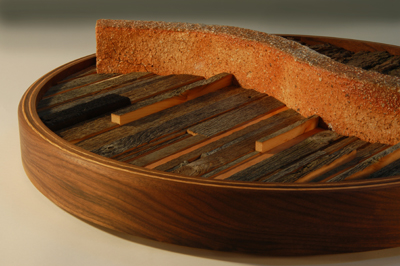
Marc Peter Keane, "SHINSO: Where Forest Meets Field"
On Thursday the 10th, in this commemorative 150th year of the first Japanese delegation to the U.S., a distinguished panel will examine the influence, modification and adaptations of food, music and landscape architecture in Fusion in Motion: 150 Years of Japan-America Integration. This panel will include Theodore C. Bestor, Professor and Chair of the Department of Anthropology at Harvard University, Ian Condry, Associate Director of Comparative Media Studies at MIT and Marc Peter Keane, landscape architect.

The above picture is actually an example of Marc Peter Keane's zen-inducing garden trays for the Portland Japanese Garden in the autumn of last year. You can sense the luxurious quality of the materials he chooses to work with.

And on Monday the 14th, Senator Daniel Inouye, Chairman of the Senate Appropriations Committee and of the Senate Defense Appropriations Subcommittee, is going to address Japan Society. Long a champion of Japanese-American issues, Senator Inouye has been outspoken in urging the Japanese government to accept the relocation of Futenma within Okinawa and thus conclude these recently contentious bilateral negotiations.

But where would the fun be if we told you every exciting summer event we've got planned?

Make sure you keep an eye out for as yet unannounced programs!

Thursday, April 15, 2010

The Japan – China – US Triangle

Considering the fact that East Asia Forum has been reporting almost obsessively over the relationship between China and the United States, the United States and Japan, or Japan and China, it's obvious that whatever the results of this tense triangle are, their influence will be global.

Left to right: Philip Berkowitz, Henry Liu, George Pierce, Timothy Wilkins.

Japan and the U.S. have enjoyed the closest of relationships, politically and economically, for the last sixty years. However, China’s emergence as a world economy in the past decade has made it a power to be reckoned with. Japan Society will host a breakfast panel discussion that focuses on the business experience of multinational companies -- and their counsel -- in navigating mergers and other alliances among China, Japan and the United States, nations with completely divergent cultures, histories, and legal systems.

We've got a great line up for this event.

Speakers:
Carl Cheng, Partner, Freshfields Bruckhaus Deringer LLP
Henry Liu
, Chairman and Managing Partner of China Practice, Nixon Peabody LLP
George Pierce, Senior Vice President and General Counsel, Toyota Tsusho America, Inc.
Timothy Wilkins, Partner, Freshfields Bruckhaus Deringer LLP

Moderator:
Philip Berkowitz
, Partner, Nixon Peabody LLP

Tuesday, March 23, 2010

Japan and Friends: Foreign Relations


"Last Wednesday at the Grand Prince Hotel, the Japan Institute for International Affairs convened a symposium on the East Asian Community. With the opening speech delivered by Hatoyama himself, and a promise to broadcast the entire proceedings both domestically within Japan and overseas, the event was quite high profile," writes Joel Rathus in his recent article Japan’s early moves on the East Asian Community. "The presenters themselves represented the cream of Asia’s Track II diplomacy. This was underlined by the fact that, in addition to handshakes with Prime Minister Hatoyama, Foreign Minister Okada met with the international guests over dinner at the Foreign Ministry’s official guest house that evening. The conclusions of the symposium will surely find a place (at least informally) in the policy-making process of Japan, and perhaps more broadly."

In his weekly editorial on East Asia Forum, Peter Drysdale adds, "A crucial question is whether the United States should be invited to join the enterprise. No step forward in consolidating East Asian regionalism can be taken without consideration of trans-Pacific economic and political security interests and the US interest is welcome. But the US is not a natural fit in the economic integration agenda that East Asia needs to work up in detail within EAS and US participation within EAS itself would be awkward logistically. Which is where Australian Prime Minister Rudd’s Asia Pacific Community idea comes into play. If, and as, EAC moves forward it makes good sense to tie its development in tandem with entrenching a comprehensive (Asia Pacific Community) dialogue between Asia and the United States (and probably Russia). And that is where there would seem to be a great deal of complementarity between Mr Hatoyama’s and Mr Rudd’s thinking about the evolution of regional architecture. In the coming weeks we shall post contributions from top analysts from across the region on these and related issues."