Showing posts with label catalogue. Show all posts

Wednesday, October 26, 2011

Stray Dog Homecoming: Daido Moriyama Returns To NYC


Black-and-white, high contrast, rough grains, askew, out of focus. Daido Moriyama’s thought-provoking photographic pieces--exhibited in Stray Dog at Japan Society in 1999--brought to light the dark, raw reality of Japanese city life when the nation struggled to reclaim its cultural identity in the midst of Western influences.

Moriyama was born in 1938 in the city of Osaka and started his photography career at 21, apprenticing with the famed Eikoh Hosoe, as Japan was still building from the occupation years. Some see in his work echoes of Japanese photographers Seiryu Inoue and Shomei Tomatsu as well as American artists such as Andy Warhol and William Klein, but for six decades his work has been quintessential Moriyama. From shadowy images of nude figures in the seedy underground to close-ups of seemingly random objects in Tokyo alleys, the work is an abstract of modernity taking hold of postwar Japan.

On November 4 & 5 Moriyama appears in Aperture Foundation’s PRINTING SHOW—TKY. Part of Performa 2011, this re-creation of his‘74 performance piece invites gallery patrons to suggest and arrange duplicates of Moriyama’s prints, photocopied onsite by the artist himself, to create a series of photobooks on display through November.

The day before the performances, Moriyama returns to Japan Society in An Evening with Daido Moriyama, discussing his many ventures into the photography world with a focus on his series 71 New York and PRINTING SHOW. Moderated by International Center of Photography curator Christopher Phillips, the evening offers fans and photographers alike insight into the life, work and high-contrast technique of the modern master.

--Sean Tomizawa

Friday, September 16, 2011

Japan’s Textile Pioneers: Weaving Threads Of The Past Into The Future


When visitors climb the stairs to Japan Society’s new exhibit Fiber Futures: Japan’s Textile Pioneers, they are greeted by Kyoko Ibe’s Requiem, created specifically for the show. The large, dark purple, net-like weave adds mystery to the Society’s typically calm lobby, and yet engulfs the garden pool from above in an almost protective manner. Japan Society gallery director, Joe Earle, notes that the piece is:
a memorial to victims of the earthquake and tsunami on March 11, 2011. The fluidity of water is one of the miracles of nature, yet all of us were shocked and saddened to see how it could destroy so many lives and livelihoods. Ibe created Requiem from ancient indigo-dyed paper, made in a pristine natural environment and originally used for Buddhist scriptures. Sensing that our uncertain times cry out for the qualities of peace and stability embodied in this lovingly preserved material, she has twisted and worked it night and day for many months as a prayer for divine protection.
The piece is just one of 35 featured textile artworks that combine the beauty of tradition with eye-popping experimentation. The use of color and incredible shapes are the first things that may strike visitors, but upon closer inspection, the impossible textures and intricate techniques stun the imagination. Each installation, ranging from soccer ball size to meters wide and tall, is imbued with personality and a story. Those that hang on the walls cast equally striking shadows, subtly adding to their mystique.

Fiber Futures runs through December 18th. You can view more photos from the exhibit here and here. Related programming includes an exhibition talk, a day with family activities, an evening with former Miyake creative director Dai Fujiwara, and individual workshops on weaving, dyeing and embroidery.

If you can’t make it to Japan Society, you can check out the gorgeous catalogue or download the free app for iPhone or Android, and wrap yourself with Fiber Futures wherever you are in the world.

--Sean Tomizawa

Thursday, September 9, 2010

Read "The Sound Of One Hand"

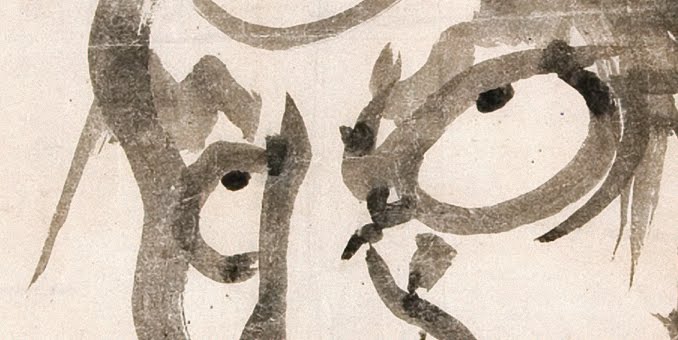
The Daruma that cannot be drawn. More drawings.

Our exhibition The Sound of One Hand: Paintings and Calligraphy by Zen Master Hakuin doesn’t open until October, but if you’re raring for a sneak peek and eager for context of Hakuin's life and work, the best primer is the official catalogue, released this week by Shambhala Publications. Co-authored by Audrey Yoshiko Seo and Stephen Addiss the 287-page, fully illustrated, hardbound color beauty is a comprehensive and wonderfully readable overview of the world's most influential Zen master.

Writing alternating chapters, Seo and Addiss explore Hakuin’s impact as both an artist and Zen monk. As explained in the introduction, Hakuin was a vital figure in the development of Zen Buddhism. He was a reformer of the major school of Rinzai Zen, establishing it as an open and inclusive alternative to some of the stodgier forms that preceded it. Maintaining the rigors of practice, Hakuin emphasized the study of koans (instructive riddles), which he called "poison words," in addition to silent zazen meditations and post-enlightenment training (because after enlightenment there’s still more to learn!)

Though his subject matter varied, Hakuin’s art reflects his teachings and inspirations from the everyday life: from the theatrical, such as Korean acrobats, to the somber and personal, such as other monks of his lineage. Many paintings accompanied his prolific writing on Zen philosophy and literature. Others depict goblins and other folk beasties, as well as major Zen figures, such as the founder, Daruma.

The formidable Daruma is most often depicted as large, hairy and homely man, with piercing eyes, wearing plain red or white robes, and earrings. Hakuin’s representations of him, however, varied widely over his career, and, even though they ascribed to the accepted format, it seemed he was getting at something beyond physical representation. Indeed, as the inscription on one work he did at the age of 44 says: "I have painted several thousand Daruma, yet have never depicted his face. This is only natural, for the moment I spread the paper to draw it, the original form disappears. All of you, what is this Daruma that cannot be drawn?"