Showing posts with label architecture. Show all posts

Wednesday, April 1, 2015

Rebuilding From The Rubble: Three Japanese Architects Construct Amidst Destruction

Tadao Ando's Benesse House Oval on the island of Naoshima. Via.

After years of toxic emissions from refineries built during Japan’s era of modernization, Naoshima, an island in Japan’s Kagawa Prefecture, had become a barren wasteland – a dumping ground for industrial waste. So when philanthropist Soichiro Fukutake approached Pritzker-winning architect Tadao Ando in 1988 to join him in his vision to revitalize the land, Ando’s initial response was, unsurprisingly, “No, that’s impossible.”

Fukutake had purchased the south side of the island two years earlier, aiming to use art as a catalyst for the island’s economic growth. He eventually managed to convince Ando to get on board, and in 1992, work began on Ando’s new building: the Bennesse House, a hotel and museum that provides guests with perhaps the most up-close-and-personal experience with art in the world.

Now, Naoshima has been transformed into a massive art project, and has become a major tourist attraction for art fanatics all over the world, due in no small part to Ando’s work on the many attractions situated on the island. It has since grown to include artists like Shinro Otake, the man responsible for creating a museum where you can bathe in an art environment - even the bath itself was designed by Otake.

Ando introduced his eighth work on Naoshima two years ago: the Ando Museum, a 100-year-old traditional wooden house with an interior that demonstrates his signature style, mixing past and present in a wood-and-concrete building.

But when it comes to rebuilding, the scope of Ando’s work extends far beyond Naoshima. In 1995, the Great Hanshin Earthquake struck Kobe, killing 6,434 people and destroying countless expressways, buildings, and homes in the process. Many of these buildings held cultural significance, and had just barely survived the bombings of World War II.

In response to this massive loss, Ando proposed an art museum and a waterfront plaza in Kobe that could serve as a shelter for refugees. Few could claim to be more qualified than Ando for the job, as he had designed 35 buildings in the Kobe area, and none of them suffered so much as a crack.

Today, the museum is a big tourist attraction in Kobe, which has since recovered from the disaster, and Ando continues to design buildings, his most recent project being the Visitor, Exhibition and Conference Center at the Clark Art Institute in Massachussetts.

Ando is the third of seven Japanese architects to win the Pritzker Prize (second only to America), the highest honor an architect can receive, since the award’s inception in 1979. Last year’s recipient, Shigeru Ban, is the most recent of the seven award winners.

Shigeru Ban's temporary churches serve as community centers as well as places of worship for disaster ravaged towns. Via. 

Ban, like Ando, is known for his work in helping regions rebuild – he was also in Kobe building shelters for victims of the earthquake, but of a different kind. Ban believes that shelters should be not only reliable, but cheap, easy to disassemble, and portable. Following this philosophy, he developed the “Paper Log House”, a shelter composed of donated beer crates loaded with sandbags and paper tubes. Additionally, he designed “Paper Church”, a community center in Kobe also built with paper tubes. It now stands in Taiwan, having been disassembled and later reconstructed there in 2008.

In an announcement on the official Pritzker Prize website, Ban said that his Japanese upbringing helps account for his wish to waste no materials, but that doesn’t necessarily mean he’s an environmentalist.

“When I started working this way, almost thirty years ago, nobody was talking about the environment. But this way of working came naturally to me. I was always interested in low cost, local, reusable materials,” he said.

And in a New Yorker profile, he went on to say, “I do not know the meaning of ‘Green Architect.’ I have no interest in ‘Green,’ ‘Eco,’ and ‘Environmentally Friendly.’ I just hate wasting things.”


Toyo Ito's "Home-for-All" project in the tsunami-struck city of Rikuzentakata. Via.

Toyo Ito, another like-minded Japanese architect who won the Pritzker Prize , said of Ban, “Many architects in the world today are competing only for the beauty of the architectural form. Ban-san’s attempt is a counter-punch against these architects, and I think he represents a new model of a ‘socially responsible’ architect.”

Ito himself could be called socially responsible – in his book Toyo Ito – Force of Nature, he discusses his work on “Home for All”, a project to build small homes made of wood in communities affected by the 2011 Tohoku earthquake and tsunami where everyone can gather and communicate with each other. He writes:
In the modern period, architecture has been rated highest for its originality. As a result, the most primal themes—why a building is made and for whom—have been forgotten. A disaster zone, where everything is lost offers the opportunity for us to take a fresh look, from the ground up, at what architecture really is. ‘Home-for-All’ may consist of small buildings, but it calls to the fore the vital question of what form architecture should take in the modern era—even calling into question the most primal themes, the very meaning of architecture.
In an interview with Domus, he talks about his motivation for the project:
After the big earthquake in Japan we had to make a lot of sacrifices, many victims came out of that and so we went back to zero, we went back to the idea of architecture as a place to make people gather, a place that everybody can use. This is what we have done, restarting the city once again as it has happened so many times in our history. It is a way to make architecture that can be applicable all over the world, thinking architecture as a social tool, as a way of creating spaces to make people stay together.
Perhaps it is this sense of social responsibility and deeper thinking as to what architecture is really about and who it is for that has separated these award-winning Japanese architects from the rest of the pack.

While the three may have vastly different styles and approaches to their work, their works will not only be remembered for their ingenuity, but their impact on the communities they were created to support.

--Mark Gallucci

Monday, May 21, 2012

Japan House: An American Made, Distinctly Japanese Landmark

"Japan House" - Final 1969 design sketch by Junzo Yoshimura.

Japan Society's building was selected as one of 40 New York City landmarks competing for restoration grants from American Express and the National Trust for Historic Preservation. With voting ending today, we offer a virtual tour of the building.

In 1969, when then Japan Society President John D. Rockefeller 3rd and Japanese Foreign Minister Kiichi Aichi broke ground for the construction of Japan Society's building, did they have any concept of what an enduring and important addition it was to New York City's cultural landscape?

Since the building--then called "Japan House"--opened to the public on September 13, 1971, it has been a hub connecting the people and issues between the U.S., Japan and the world, as well as a singular architectural gem embodying the Society's founding ideals.

Recently named New York City’s youngest landmark, the building was designed by Junzo Yoshimura and George Shimamoto as the first permanent Japanese modernist building in New York.

According to the book Japan Society: Celebrating a Century, 1907-2007, “the chief appeal of the building lay in its distinctively Japanese feeling, but this effect, remarkably, had been accomplished almost entirely with American materials.” In a recent visit, Urban Gardens echoed this fact, calling the building:
a flat black modern reinforced concrete "bento box" filled with a delicious blend of creativity, culture and education–all existing above and below a serene interior Japanese style garden space… Yoshimura’s design has been described as a modern rendition of an 18th century elegant Kyoto inn. Known for infusing traditional Japanese elements into his modern works, the architect blended a Japanese sensibility with contemporary local materials.
Photo: Robin Plaskoff Horton, Urban Gardens. Via.

Standing five stories tall, the building’s slate gray exterior and metal railings evoke modern Japan’s streamlined architectural prowess. The long metal rails running vertically up the building’s façade are reminiscent of amado, storm windows that are used for protection during typhoons.

The slanted fence at the base of the building is a modernist play on komayose (aka komadome or inufusegi)—an Edo period urban housing design element to keep horses and dogs away from the home and to enhance the privacy of the living room area, typically at the front of the house. The bottom of Japan Society's komayose extends one meter from the building—the traditional distance that a komayose stood away from a home. By the 18th century, komayose were widely used and were most often associated with posh machiya, structures which combined an artisan’s or merchant’s residence with their shop, encompassing manufacturing, office and retail space in one location.

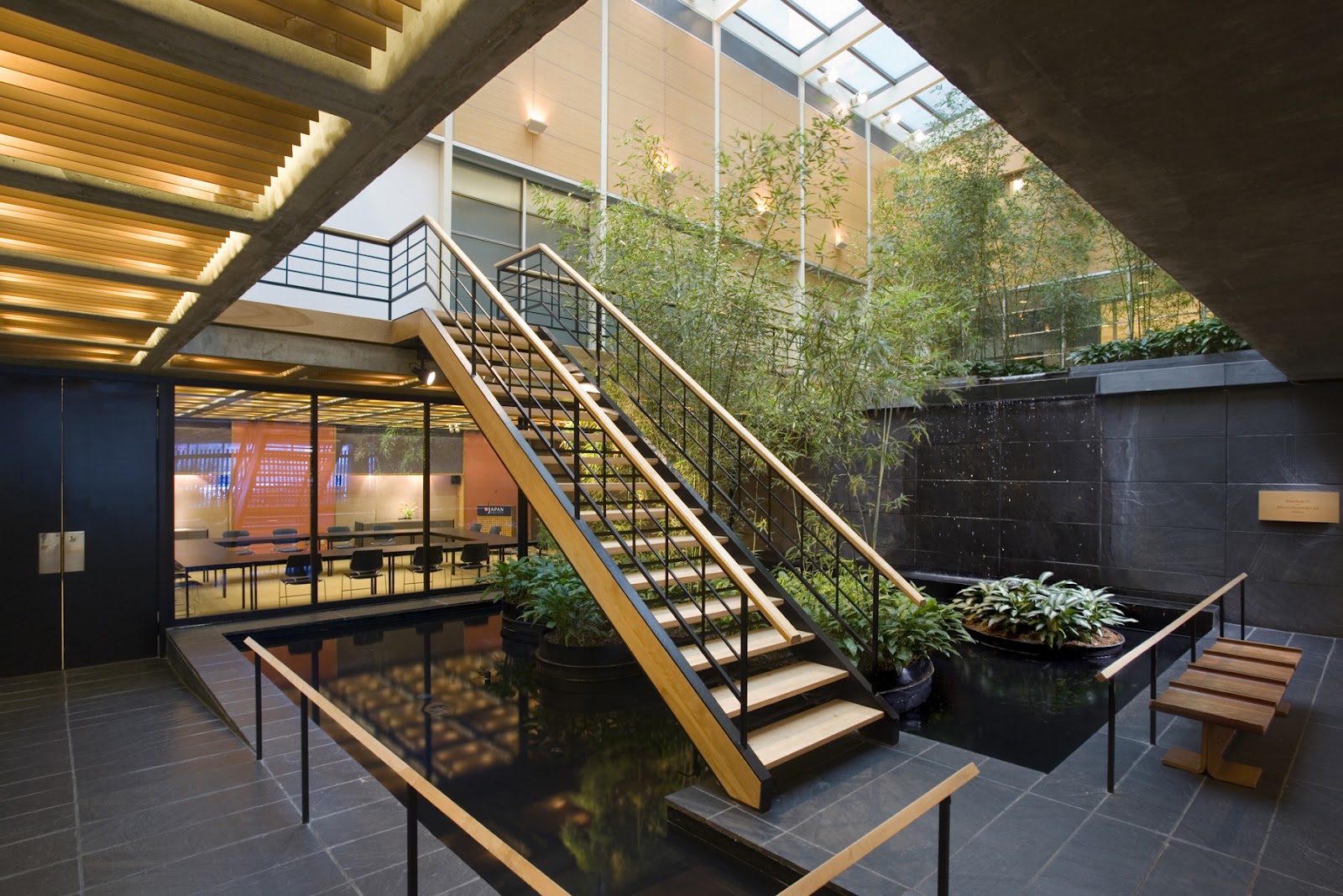
Indoor bamboo garden and waterfall. Photo by Peter Aaron/Esto.

Upon entering Japan Society’s building the cool, gunmetal slate tiles from the exterior carry through the interior, and cover the lobby walls to the cement ceiling. The wooden slats in the ceiling were initially made from hinoki, or Japanese cypress, so when lights heated up the slats, the cypress aroma would fill the building. The cypress has since been coated with flame retardant, which also masks the scent of the wood.

The slate and cement in the lobby is the perfect sound conductor for the indoor waterfall, allowing a gentle white noise rush to echo throughout the building. The waterfall paired with our indoor bamboo garden is such a unique element that it is frequently featured on television and in films most recently for episodes of Gossip Girl and White Collar.

The waterfall was not an original design element in Yoshimura’s drawings. From 1971 until a major renovation that lasted from 1995 to 1997, the area where the waterfall is now was an outdoor sculpture garden.

Architectural rendering of renovations in the 90s.

The renovation also added some other functional spaces to Japan Society—a fifth floor for additional office space, and the second floor of the building was converted into more usable Gallery space. In the original building configuration, only the South Gallery was intended for Gallery use. The North Gallery (the part of the Gallery directly in front of you when you climb the stairs) was originally used as meeting spaces that were available for public rentals. Those rooms were situated with views down onto the pond in the lobby. When Japan House first opened to the public, the lack of contrast between the slate and the stillness of the water confused some patrons, causing them to stumble into the pond because they thought it was a solid surface. There is now a low railing to protect people.

Other, more subtle touches of Japanese décor and design can be seen throughout the building, from the the large river rocks by the entryway to the shoji window and wall treatments in the lobby and on the second floor.

One wonderfully restful feature in the lobby is an original conoid bench by famed woodworker George Nakashima. The arresting work of art is available for anyone wishing to sit and absorb the beauty of Japanese art, architecture and design.

--Cory Campbell

Wednesday, November 9, 2011

Avant Zen: Today’s Japanese Architecture

The Tod. Via.

Purity, clarity, calm. Much of Japan’s contemporary architecture exudes such feelings with wave-like curved walls and deceivingly simple stacked box structures. These buildings inspire awe, break beyond the expected and strive for ecological mindfulness--hand-in-hand with Zen concepts.

On November 10 Japan Society hosts New Japan Architecture: Recent Works & New Trends with celebrated architect Edward Suzuki and Dr. Geeta Mehta, professor of architecture at Colombia University and author of New Japan Architecture: Recent Works by the World's Leading Architects.

Inspired by Design published arresting highlights from this “new magnum opus of Japanese design”, featuring 42 established and fringe architects and 48 major projects from Kisho Kurokawa’s Tokyo National Museum (awesome interview in that link), to Toyo Ito’s Tod building, to Shigeru Ban’s Tokyo headquarters for Swatch. From the book's introduction:

When it comes to contemporary house design, the Japanese can be fearless and willing to forego comforts dear to most of us in order to live in a work of art. Shigeru Ban once remarked that he loved working for clients in Japan because they were willing to take a design further than any Western client.
Edward Suzuki, one of the featured architects in the book, has created a wide range of impressively designed homes, schools, and train stations, as well as the unlikely koban in Shibuya and a parking area out in Chiba. Born in Saitama in 1947, he studied at the University of Notre Dame and worked at various design firms in Tokyo and New York before starting his own in 1977. His works invoke a simultaneous sense of openness and structure through his use of large glass pane windows and repeated squares, rectangles, and the occasional curve to form the framework of a building. Interior greenery like large trees and potted bamboo add to the fresh, breath-taking feel of his designs.

Geeta Mehta has spent much of her life in Japan, graduating from the University of Tokyo, and is partner with Jill Braden at the interior design firm Braden & Mehta Design. Her harmonious blend of Western and Asian influences appear in work throughout U.S., Vietnam, and India as well for various corporations and private homes. Among her humanitarian efforts, she founded the the Mumbai-based Urbz think tank and the nonprofit Asia Initiatives. Along with the publication of New Japan Architecture, Mehta has penned several books on Japanese architecture and design.

--Sean Tomizawa

Earth first in much of Japan’s new architecture. Via.

Thursday, September 15, 2011

Landmark Birthday for Japan Society’s Building

"I have tried to express in contemporary architecture the spirit of Japan." --Junzō Yoshimura
Days before the opening of its 104th gallery exhibition, just after turning 104 years old, Japan Society celebrated the 40th birthday of its building, recently designated New York City’s youngest landmark.

It was shortly after Japan Society launched the Japan Earthquake Relief Fund to aid recovery after the devastating tsunamis struck Northeast Japan when news broke that the New York City Landmarks Preservation Commission approved four new landmarks, including Japan Society.

“We’re very proud of our building,” Japan Society gallery director Joe Earle told HyperAllergic at the time, adding, “It’s a remarkable place to walk into every day.” The article continues:
As a manifestation of the relationship between the United States and Japan, Earle points out, the design and construction of the Japan Society building came at a very interesting time. In 1971, “New York was just becoming aware of Japanese architecture. [The building] represents the rebuilding of the relationship between the two countries after World War II.” As a combination of Brutalist severity and Zen simplicity, the structure crosses artistic cultures.

“Looking out of my window now,” Earle describes during a phone conversation, “the long horizontal bars that filter the light give the whole front [facade] this kind of horizontality that was associated with Japanese domestic architecture … It’s a suggestion of Japanese architecture without actually being a copy of it, that’s what strongly appeals to me.” 

Completing a circle of great Midtown East architecture including the United Nations headquarters, Tudor City, the Ford Foundation building and Grand Central Station, Japan Society’s 5-story, charcoal gray building on 333 East 47th St. overlooks the cozy Dag Hammarskjöld Plaza Park.

The building is a smartly designed, geometrically playful edifice that contains warmth and reflective quietude—as useful for solitary thought as it is for intimate conversation and coming together to share ideas. While some might dismiss it as a “modernist box”, for most who visit, the brooding boxiness is a dark chocolate square with a liquid caramel center. It is the architectural incarnation of the quintessential New Yorker—austere and brusque perhaps at first blush, but warm, storied, and endlessly fascinating once you break the surface.

Known for infusing traditional Japanese elements in his modern works, architect Junzō Yoshimura used a much subtler blending of Japanese sensibility with contemporary materials in Japan Society’s building. The slats mentioned by Earle above, running horizontally on the second and third floors of the façade, are meant to evoke amado (Japanese storm windows used during typhoons). Hinoki (Japanese cypress) louvers in the exterior entry continue into the lobby ceiling, diffusing light and warming shadows. (Initially, the heat from light bulbs would release the wood’s fragrance, but regulations now require they be flame retardant, which masks the scent.)

Although the building has undergone two campaigns of adaptation and extension over the years, its original atmosphere is especially well preserved in the lobby area with a low, modular, precast concrete ceiling; extant original slate floors and walls; a large river stone near the entrance positioned as a foundation for seasonal floral arrangements; bamboo pond and waterfall; and stairs leading invitingly up to the gallery spaces, which encompass the entire second floor.

And while the building also contains a sub-level language center, a 262-seat state-of-the-art theater for lavish performances, pop concerts, film screenings and more; and three floors of administrative space, almost everyone who enters comments on its quiet beauty and remarkable stillness, welcome relief from the tireless energy of the city’s streets.

History

A brief history of the Turtle Bay neighborhood, home to Japan Society, the United Nations, missions of foreign governments and many private organizations including the International Institute of Education and the Ford Foundation, has been included in the Landmark Preservation Commission Japan Society Designation Report (PDF).

The area had remained little developed until after the Civil War, when residential and commercial development followed the opening of the Second and Third Avenue Elevated Railways around 1880. The large waterfront site along the East River between 42nd and 48th Streets was acquired by the Rockefellers, and John D. Rockefeller 3rd later donated the 47th street site to Japan Society in 1968.

“From the start, Japan Society was characterized as ‘the first building of contemporary Japanese design to be built in New York City’”, notes the report. Designed by Junzō Yoshimura in partnership with George G. Shimamoto during 1967-68, Japan Society, earlier called Japan House, opened in 1971.

Gabrielle Birkner in an article in The Real Deal refers to Japan Society as one of the notable exceptions to have been designed by a Japanese architect as it was not until much later that the architectural community in New York was receptive of design talent from abroad. According to the landmark's report, Yoshimura was “likely the first Japanese citizen to design a permanent structure in New York City.”

Shortly before the opening, Leah Gordon, an arts columnist for The New York Times on September 5, 1971 wrote:
In an area replete with UN Missions and consulates, this building has no seals, no mottos and is distinguished only by a slanted, 3-foot iron fence . . . It is soon apparent that this is no customary New York architectural atrocity but a sedate, jewel-like structure that, in its quiet way, commands attention.
Similarly, The Architectural Record in 1973 commented that the building:
...adds quite a dollop of civility to Dag Hammarskjold Plaza. Its exterior is quiet, nicely scaled and guardedly transparent: fleeting glimpses of the interior are afforded through bronze anodized aluminum screens, and the glass entrance doors.
In Yoshimura’s own words:
People the world over used to build their houses with local and traditional materials. Today, however, contemporary buildings all over the world use the same basic materials – concrete, steel and glass – yet different characters and nationalities can still be perceived amongst them. In designing Japan House I have tried to express in contemporary architecture the spirit of Japan.
 --Anu Tulachan and Shannon Jowett


Tuesday, October 26, 2010

Building Social Change Exchange From Tokyo To New York

There's a design charette brewin' for Brooklyn's Brownsville.
Eco products, urban agriculture, renewable energy: relatively new concepts which have become everyday terms around the world and now impact how we live day to day. We see the seeds of these ideas sprouting all over New York, with green roofs coming to life, street-side makeovers turning the city more bike friendly, and green markets popping up all over.

NYC is not alone in this transformation. Japan has made strides to answer the green call promoting more walking-friendly cities, LED lights are now the latest thing to cut energy costs, and architects are finding more ways to make green open space.

There are many ways the U.S. and Japan can learn and benefit from one another in the green revolution, and Japan Society fosters this discussion.

As part of a 2-day program, Japan Society’s U.S.-Innovators Network brings together designers, social entrepreneurs, and architects whose work focuses on social issues. On Tuesday, November 2, The Design Difference features Atelier Bow-Wow's Yoshiharu Tsukamoto, Public Architecture's  John Peterson and moderator Valerie Casey from Designers Accord. They discuss the latest thinking in architecture and design from Japan and the U.S. and explore its influence on behavior, how it illuminates culture, and how the built environment shapes community. 

Tsukamoto seeks to create spaces in ways that align and maximize the harmony (wa) of the space, the surrounding environment, and human need. In his book Behaviorology, he describes his approach as a thought process:
[it] brings about an immediate shift in subjectivity, inviting many different elements together and calling into question who or what may be the main protagonist of a space. Through this ecological approach our imagination follows the principles of nature and experiences space from a variety of perspectives. When one is surrounded by and synchronized to the liveable rhythms embedded in different behaviors – there is no experience quite so delightful.”
Peterson is looking to harness the power of public service by bringing together architects to volunteer 1% of their time to projects focused on public good. The program "challenges architecture and design firms nationwide to pledge a minimum of 1% of their time to pro bono service," connecting and committing  powerful firms with nonprofit organizations in need of design assistance.

Casey recently told the design site Core77 that key questions addressed in the discussion are:
What do Tokyo and Brownsville, Brooklyn have in common? How can we apply the tenets of "Behaviorology" - the interplay of people, nature, and buildings - to change social conditions? How does the built environment shape community and create culture, and what are the responsibilities of architects and designers in making positive change?
Come find out the answers and discover new ways design is shaping our lives! Tickets are $12 for general public and $8 for Japan Society members, students and seniors. And if you’re looking for more, check out MOMA’s Small Scale Big Change exhibit, which also explores how architecture impacts social design.

One of Atelier Bow-Wow's innovative green spaces. Via.
 J.A.

Friday, October 8, 2010

Japan House: A Building That Builds Relationships

Japan Society: a vivisection.
New York City is a little global town. Each block, corner and street contains the swirling, multicultural fingerprints shaped by the people who live here.  We hear it, smell it, taste it, feel it and ever see the impact of the proverbial melting pot on our everyday lives. But one thing we might not notice--because of their permanence, their ubiquity, or their size--are the city's mammoth cultural beacons: the buildings.

On October 9 and 10, the eighth annual OHNY Weekend celebrates New York City's varied architecture and design, from the classic to the more exotic. For the fourth year in a row, Japan Society participates in OHNY with tours of its building (currently fully booked) and free admission to the Gallery show The Sound of One Hand.

Japan Society's building has been the center of the Society's mission to build understanding between the people of U.S. and Japan since it openend in 1971. Joe Earle, director of Japan Society Gallery notes that the building, designed by Junzo Yoshimura as the first example of contemporary Japanese architecture in New York, is a free adaptation of traditional Japanese architecture:
In Japan House (as Japan Society’s building was first called when it opened in 1971) we see a subtle blend of Japanese sensibility with contemporary materials and a modernist aesthetic. Although the building has undergone two campaigns of adaptation and extension over the years, its original atmosphere is especially well preserved in the lobby area with its low, modular, precast concrete ceiling, slate and timber surfaces, bamboo pond and stairs leading invitingly up to the gallery.
Though the Japan Society tours are full, we hope you have a chance to explore the building and the exhibition. In addition to the hundreds of buildings showcased throughout the city,  OHNY Weekend features a family festival to give children hands-on activities to discover and appreciate the beauty of New York City’s abundant architecture. Wherever the weekend takes you, and whatever your age, enjoy the places you pass by everyday in new and unexpected ways!

S.H.

Thursday, September 23, 2010

Shadow Play: Kids Build With Light

Detail of the original architectural sketch of Japan Society's building.


An architect is an artist, painting the tale of man’s relationship with their space. Unlike Western architecture, which keeps people and nature separate, Japanese architecture presupposes that the inside space and the outside space are one continuous piece of artwork.

Like all pieces of artwork, architecture shows the emotion and thoughts of the artist. Kazuo Nishi and Kazuo Hozumi authors of What is Japanese Architecture? remark, “Japanese through the ages have evolved a building art that seems to delight in opposites and contradictions”. Japanese architect uses light and shadow to reflect the purity, beauty, harmony and simplicity that unadorned nature characterizes for us through the changing seasons. 

On Sunday, September 26, two well known architects help children and their parents understand Japanese architecture’s intriguing interplay of light and shadow. Aki Ishida takes her client’s vision about a space and translates it into a distinct, innovative and intelligent design. Mina Hatano-Kirsch's designs melds with its surrounding environment, while reviving the bond between indoors and outdoors.

In the Japan Society family program Light in Japanese Architecture, the two artists explore the playful and friendly manner of Japanese architecture, and guide children through interactive and constructive activities that harnesses their imagination and allows them to create their own art with paper, wood and the never-ending possibilities of shadow and light.

S.H.

Thursday, April 15, 2010

Artists: Sanaa & Contemporary Bamboo Masters

Denis Balibouse/Reuters

Kazuyo Sejima and Ryue Nishizawa, partners in the Japanese architectural firm Sanaa, have won the 2010 Pritzker Architecture Prize, the profession’s highest honor.

“They explore like few others the phenomenal properties of continuous space, lightness, transparency and materiality to create a subtle synthesis,” the jury citation said. “Sejima and Nishizawa’s architecture stands in direct contrast with the bombastic and rhetorical. Instead, they seek the essential qualities of architecture that result in a much appreciated straightforwardness, economy of means and restraint in their work.”

According to The New York Times, the pair’s buildings include the acclaimed New Museum in New York, a sculptural stack of rectilinear boxes on the Bowery, which was completed in 2007. The first Sanaa project in the United States was a glass pavilion for the Toledo Museum of Art, completed in 2006. It holds the museum’s collection of glass artworks, reflecting that city’s history as a major center of glass production.

Although their work has been concentrated in Japan, Mr. Nishizawa and Ms. Sejima have designed projects in Germany, Britain, Spain, France, the Netherlands and the United States. Among their most recent projects is the Swiss Federal Institute of Technology’s Rolex Learning Center in Lausanne, which appears in the above photo.

 Honda Shōryū (b. 1951) Untitled, 2006. Bamboo, 18 1/2 x 39 x 14 1/2 in. Jeanne and Michael Klein.

The Japanese have a stunning history in design and architecture in a variety of mediums. Sunday Morning on CBS News did a great segment called Japanese Bamboo Art that discusses the history of the use of bamboo in art and architecture and features artist Shochiku Tanabe.

And last year, Japan Society hosted an exhibit featuring the contemporary works of bamboo masters, such as the piece above by Honda Shōryū, which demonstrates the phenomenal lengths traditional materials can be taken to.

You can check out an online gallery of photos from the exhibit here

Monday, March 22, 2010

Environmental Art

In an era when living and working mindfully of natural resources is more critical than ever, artists are fusing their creative life with environmental consciousness:

Mariko Mori is a wildly popular contemporary artist whose massive installations encompass "life and death, our role in and with nature."

With innovative buildings throughout the world, the "accidental" environmentalist architect Shigeru Ban "isn't comfortable with the word 'green,' which he finds vague, not to mention fashionable, although his projects are often described as such."

Grammy and Academy Award winning composer (not to mention co-founder of the seminal 80s techno pop band Yellow Magic Orchestra--remember "Computer Games"?) Ryuichi Sakamoto says, "we must take care of our environment... you still eat every day, you breathe air and drink water. That is the environment within you and you are a part of it."

As part of the Green Japan series, Japan Society presents Conscious Inspiration: Juxtaposing Nature & Art Form on Tuesday, March 23, bringing together these three artists to explore connectivity between nature and art and discuss how their relationship with the environment has influenced their creative processes.

The panel is moderated by Stefano Tonchi, editor of T: The New York Times Style Magazine, who has a gorgeous (and surely environmentally conscious!) home. (SJ)