Friday, May 28, 2010
America's Heroes: Meet Graphic Heroes
Starting Memorial Day, the National Endowment for the Arts and Blue Star Families have echeloned over 700 museums and galleries across America for the Blue Star Museums initiative.
Japan Society is honored to be taking part, inviting active duty military personnel and their families to enjoy Graphic Heroes, Magic Monsters for FREE through the exhibition's June 13 closing. With New York City's Fleet Week in full swing, we'll start the Blue Star Museums action a bit early on Saturday, May 29.
Graphic Heroes, Magic Monsters' 1850s pacific overtures are filled with selfless samurai, tattooed tough guys, lovely ladies, ghastly ghosts, cozy cats, and rockin' octopi. The critics have noted Kuniyoshi's "eye for the fantastic and the ghoulish remains unmatched," and his "greatest prints represent turbulent, epic visions" that are "as fresh as this morning’s manga."
Blue Star Museums lasts through Labor Day. Though Japan Society Gallery closes June 13 until fall, other New York City organizations taking part include: American Folk Art Museum, Asia Society, Brooklyn Museum, Brooklyn Children's Museum, Bronx Museum, Guggenheim, The Jewish Museum, The Met, MoMA, Museum of Arts and Design, Museum of Jewish Heritage, Museum of the City of New York, New York Botanical Garden, New York City Fire Museum, New York Transit Museum, Noguchi Museum, Staten Island Children's Museum, Wave Hill, and the Whitney.
This Memorial Day Weekend, Japan Society Gallery is open Friday until 9 pm, and Saturday & Sunday from 11 am to 5 pm. The Gallery is closed Monday. As always, members and children under 16 are free anytime.
Have a safe holiday!
(NO, SJ)
Labels:
art,
Blue Star Families,
children,
family,
Graphic Heroes,
holiday,
membership,
military,
NEA,
new york,
Utagawa Kuniyoshi
Tuesday, May 25, 2010
Goodbye for Now!
Hi there,
This is goodbye for now! My internship with Japan Society has ended. I hope to return to work on this blog in the future as I'm rather devoted to it.
Much luck to everyone!
Laura
This is goodbye for now! My internship with Japan Society has ended. I hope to return to work on this blog in the future as I'm rather devoted to it.
Much luck to everyone!
Laura
Summertime and the Learning is Easy
Photo by Kenji Takigami
During July and August, the Corporate Program slows down and takes a well-deserved break but it's during these months that our teaching programs get jazzed up.Our list of summer courses is extensive and covers all manner of ability levels and topics, including classes on mastering kanji and classes devoted solely to reading. What better way to escape the groggy summer heat than by sitting in a cool, air-conditioned classroom and sharpening your Japanese skills?
And we're not just offering lessons on language.
Nearly every year the Education Program invites high school students to participate in an 11-day immersion workshop on Japanese cuisine and culture, during which they examine the multifaceted history of Japanese cuisine in connection with health and wellness. And on the last day of the program, families and friends are invited to a Japanese-style reception where Japanese dishes and tea are served, including those prepared by chefs and participating students.
This is a great confidence booster for any high school student. For example, Josephine Ledda (grade 12) participated in the workshop in the summer of 2008 and remarked:
“The great thing about the Japan Society is that they know how to approach teenagers in a way that'll encourage them to learn. When we took this cooking workshop, we weren't just learning about Japanese food, we were learning about a very important part of their culture. And who wouldn't want to learn about a country through their food?”
You can find other participants' comments, photos, highlights, and activity descriptions of the program in 2008 on our website and if you're interested, don't hesitate to sign up for this summer's Japanese Cuisine 101.
And don't forget to check out the 2010 Course Catalog. I bet you'll find something whether you're just beginning, want to brush up your advanced skills, or need a quick conversation lesson.
みんなさん、がんばってね!
Japanese + American
From the California roll to hip hop to Zen gardens, the cultures of the United States and Japan have crisscrossed the Pacific, profoundly influencing one another.
As New York City starts warming up for summer, Japan Society is taking a look at some of the amalgamations of Japanese and American culture over the last 150 years.
First, our Film department is bringing you Toyo's Camera: Japanese American History during WWII on May 28th (this Friday).
Although World War II was a bleak period for Japanese-American fusions, it is a worthwhile topic to begin such a discussion with because knowledge of the internment of Japanese-Americans following the attack on Pearl Harbor remains surprisingly low in both the United States and Japan. To get a better grasp on the cultural exchanges of today, we should first learn about the history and the processes that brought us to the present.
Even though bringing in cameras to the internment camps was prohibited, one man managed to smuggle in his own camera lens and build a camera to document life behind barbed wires, with the help of other craftsmen in the camp. That man was Toyo Miyatake, a successful issei (first generation immigrant) photographer and owner of a photo-shop in the Los Angeles Little Tokyo district, and of one of the many Americans who was interned with his family against his will.
With his makeshift camera, Miyatake captured the dire conditions of life in the camps during World War II as well as the resilient spirit of his companions, many of whom were American citizens who went on to fight for their country overseas. Suzuki's documentary carries on the legacy of Miyatake's photography, addressing the historical context of the internment as well as the stories of other Japanese-Americans who were touched by this unfortunate chapter in American history.
The screening will be followed by a Q&A with special guests writer/director Junichi Suzuki and actor George Takei.
Although he is best known in the U.S. for his role as Hikaru Sulu in the television series Star Trek, Takei is also an outspoken proponent of gay rights and active in state and local politics. He has won several awards and accolades in his work on human rights and Japanese-American relations, including his work with the Japanese American National Museum.
Then prepare yourselves for a busy June!
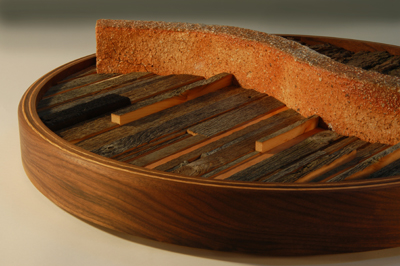
The above picture is actually an example of Marc Peter Keane's zen-inducing garden trays for the Portland Japanese Garden in the autumn of last year. You can sense the luxurious quality of the materials he chooses to work with.
And on Monday the 14th, Senator Daniel Inouye, Chairman of the Senate Appropriations Committee and of the Senate Defense Appropriations Subcommittee, is going to address Japan Society. Long a champion of Japanese-American issues, Senator Inouye has been outspoken in urging the Japanese government to accept the relocation of Futenma within Okinawa and thus conclude these recently contentious bilateral negotiations.
But where would the fun be if we told you every exciting summer event we've got planned?
Make sure you keep an eye out for as yet unannounced programs!
As New York City starts warming up for summer, Japan Society is taking a look at some of the amalgamations of Japanese and American culture over the last 150 years.
First, our Film department is bringing you Toyo's Camera: Japanese American History during WWII on May 28th (this Friday).
Although World War II was a bleak period for Japanese-American fusions, it is a worthwhile topic to begin such a discussion with because knowledge of the internment of Japanese-Americans following the attack on Pearl Harbor remains surprisingly low in both the United States and Japan. To get a better grasp on the cultural exchanges of today, we should first learn about the history and the processes that brought us to the present.
Even though bringing in cameras to the internment camps was prohibited, one man managed to smuggle in his own camera lens and build a camera to document life behind barbed wires, with the help of other craftsmen in the camp. That man was Toyo Miyatake, a successful issei (first generation immigrant) photographer and owner of a photo-shop in the Los Angeles Little Tokyo district, and of one of the many Americans who was interned with his family against his will.
With his makeshift camera, Miyatake captured the dire conditions of life in the camps during World War II as well as the resilient spirit of his companions, many of whom were American citizens who went on to fight for their country overseas. Suzuki's documentary carries on the legacy of Miyatake's photography, addressing the historical context of the internment as well as the stories of other Japanese-Americans who were touched by this unfortunate chapter in American history.
The screening will be followed by a Q&A with special guests writer/director Junichi Suzuki and actor George Takei.
Although he is best known in the U.S. for his role as Hikaru Sulu in the television series Star Trek, Takei is also an outspoken proponent of gay rights and active in state and local politics. He has won several awards and accolades in his work on human rights and Japanese-American relations, including his work with the Japanese American National Museum.
Then prepare yourselves for a busy June!
Marc Peter Keane, "SHINSO: Where Forest Meets Field"
On Thursday the 10th, in this commemorative 150th year of the first Japanese delegation to the U.S., a distinguished panel will examine the influence, modification and adaptations of food, music and landscape architecture in Fusion in Motion: 150 Years of Japan-America Integration. This panel will include Theodore C. Bestor, Professor and Chair of the Department of Anthropology at Harvard University, Ian Condry, Associate Director of Comparative Media Studies at MIT and Marc Peter Keane, landscape architect.The above picture is actually an example of Marc Peter Keane's zen-inducing garden trays for the Portland Japanese Garden in the autumn of last year. You can sense the luxurious quality of the materials he chooses to work with.
And on Monday the 14th, Senator Daniel Inouye, Chairman of the Senate Appropriations Committee and of the Senate Defense Appropriations Subcommittee, is going to address Japan Society. Long a champion of Japanese-American issues, Senator Inouye has been outspoken in urging the Japanese government to accept the relocation of Futenma within Okinawa and thus conclude these recently contentious bilateral negotiations.
But where would the fun be if we told you every exciting summer event we've got planned?
Make sure you keep an eye out for as yet unannounced programs!
News Blast
Photo courtesy of Kyodo News PR Wire
Hatoyama Cabinet to continue 'cool biz' campaign this summerThe government on Tuesday confirmed plans to continue this summer the "cool biz" light clothing campaign initiated in 2005 to help reduce air conditioning by setting office temperatures several degrees higher than usual. At a meeting of Cabinet members, Chief Cabinet Secretary Hirofumi Hirano instructed ministers to don traditional Okinawan "kariyushi" open-neck shirts at a Cabinet meeting June 1 to mark the start of the seasonal drive, during which men are encouraged not to wear ties or jackets.
Salmon takes over as top table treat in Japan
Salmon has overtaken horse mackerel as the most popular fish for Japanese people to eat, due largely to improvements in freezing technology that have raised the quality of imports as well as housewives' preference for a fish that is easy to prepare. The government released a study on fish consumption on May 21 in which salmon emerged as the most popular to eat at home, followed by squid and tuna, all of which are straightforward to turn into a meal. In 1965, salmon was not in the top five as it was much harder to find good quality fish because it deteriorated in quality as it was being shipped to Japan.
Cheap rent-a-car services revving up in Japan
Cheap rent-a-car services are starting to gain a foothold in Japan, with some outlets providing vehicles for about half the price charged by major car rental companies. Niconico Rentacar, one of Japan's biggest cheap rent-a-car businesses, operates a membership system with no initial fee or annual charges. Customers can rent a compact car for 12 hours for 2,525 yen or a regular sedan for 4,725 yen -- roughly half the price charged by other major companies. In the two years since its founding in 2008, the business has accelerated rapidly, and now operates 300 outlets.
Osaka seeks special business zone
Osaka Gov. Toru Hashimoto called on the central government Sunday to designate his prefecture as a special business zone that would serve as an entry point for businesses across Asia. The government has been considering legislating a system for special business zones, and during a meeting Sunday with Hashimoto, Senior Vice Cabinet Office Minister Motohisa Furukawa unveiled the administration's intention to submit the bill to the Diet early next year.
Is Japan becoming more insular?
With so much talk of globalization, it might seem counterintuitive to suggest that Japan is turning inward, but that's what some have concluded. The Washington Post recently focused on one example: the dwindling number of Japanese students studying abroad. Roughly 80,000 Japanese students now study outside the country, far fewer than, say, South Korea with less than half Japan's population. The fall has been particularly sharp in the United States, where Japanese undergraduate enrollment in universities is down by over a half since 2000.
Labels:
asia,
business,
car rental,
cool biz,
fish,
green zone,
insular,
mackeral,
news,
Osaka,
salmon,
student,
study abroad,
summer,
Toru Hashimoto
Wednesday, May 19, 2010
Green & Clean
Photo courtesy of Virginia Gardiner
In Japanese, the word for "clean" and "beauty" is one and the same: kirei (きれい). With cutting-edge green technology and fixtures rendered into works of art, the Japanese bathroom has become an object of fascination and admiration worldwide.
For those of you who want to become experts on toilets, the reading list isn't long because not enough serious books have been written on the subject. However, your first step should be to buy a copy of Rose George's The Big Necessity: The Unmentionable World of Human Waste and Why It Matters (Metropolitan Books, 2008).
To quote from Virginia Gardner's thorough review:
"With good humor and deep seriousness, George travels the world and presents impressive research about the current state of sanitation. Colorful encounters with people and places are centered around dismal facts. 2.6 billion people worldwide currently have no toilets--as George puts it, "Four in ten people have no access to any latrine, toilet, bucket or box." Resulting waterborne illness kills about 7000 people every single day. The centuries-old solution that's still current--flush toilets with sewers--is already taxing the richest economies, and won't be sustainable anywhere in the long term. George asks why such a fundamental aspect of our designed lives remains on the margins of polite conversation."
On Wednesday, May 26, at 6:30 pm, Rose George and Gunnar Baldwin, water efficiency specialist for TOTO USA, Japan's leading luxury plumbing manufacturer, will explore high tech and eco innovation in the Japanese bathroom, and the prospects for their wide adoption in the U.S.
Japan Society has TOTO washlet toilets installed in all the bathrooms and I'd recommend them personally. Although, sad to say, my enthusiasm lies less in the eco-friendly nature of the devices and more in having a toasty toilet seat in winter.
Hope to see you on the 26th!
Labels:
bath,
culture,
flush,
Gunner Baldwin,
human waste,
Rose George,
The Big Necessity,
toilet,
TOTO,
washlet
Cosplay Photos!
If our spectacular cosplay event on the 15th wasn't enough for you (or if you missed it) and you're simply dying to dress up, June 7th is International Lolita Day!
In honor of this event, Kinokuniya Bookstore in New York City is teaming up with Del Rey Manga, Samurai Beat Radio, and VIZ Pictures to hold the very first Lolita and Maid Day. So dust off your parasols and bonnets!
“We’re proud to help create Lolita and Maid Fashion Day at Kinokuniya,” New York Anime Festival Show Manager Lance Fensterman said. “Lolita and Maid fashion have quickly become two of the most prolific ambassadors of anime, manga, and Japanese culture in America, and the New York Anime Festival couldn’t be happier bringing these fashions to New York City – the fashion capital of the world.”
Kinokuniya’s Lolita and Maid Fashion Day will include special all-day activities as well as a series of Lolita and Maid-themed speakers and presentations. But what I'm most excited about is the cake!
Café Zaiya on Kinokuniya’s second floor is going to be serving up a special menu of Lolita and Maid-themed desserts made especially for Lolita and Maid Day.
There's more information here.
Labels:
anime,
Café,
cosplay,
costume,
Festival,
International Lolita Day,
Kinokuniya,
Lance Fensterman,
lolita,
manga,
NYAF,
Zaiya
Monday, May 17, 2010
News Blast
AP Photo/Junji Kurokawa
Beauty products offer Japan women rare promotions
It shouldn't be surprising that Panasonic's star manager for developing appliances for women is a woman herself - except that this is Japan, a nation notorious for holding back females in the workplace. The beauty products Shiori Yamada has developed and runs marketing campaigns for have turned out to be hits. And that was the easiest way to silence all the male skeptics at Panasonic Corp. One of Yamada's popular products, the ball-shaped Nano Care humidifier billed as moisturizing your skin, sold 350,000 in a year. She came up with an improved version that works while you sleep, a feature designed to appeal to busy working women.
Greek crisis to hit Japan indirectly
The Greek financial crisis is unlikely to wreak havoc on the Japanese economy, although a strengthening of the yen as a result of the euro's depreciation will inevitably affect exports bound for Europe, according to some economists. But they caution that Japan shouldn't regard the crisis as just something happening on the other side of the planet and the nation must work hard to rebuild its finances, which are actually worse than Greece's.
Japan, China in spat over nuclear arsenal
Japan has urged China to cut its nuclear arsenal or at least to stop stockpiling more atomic weapons, prompting a strong reaction from Beijing at their foreign ministers' talks, officials said Sunday. The rare demand came when Japanese Foreign Minister Katsuya Okada met his Chinese counterpart Yang Jiechi at regional talks in South Korea Saturday, said Kazuo Kodama, the press secretary of Japan's foreign ministry.
Japan to make high-tech bid for 2022 Cup
Japan plans to use its technological expertise to win the right to host the 2022 World Cup. Members of Japan's 2022 World Cup Bid Committee gave a preview on Monday of some of the advanced technology they plan to use for hosting football's quadrennial showpiece. Japan officially submitted its bid to host the 2022 World Cup on Friday when organisers took their bid book to FIFA in Zurich.
Prized Japanese social values that withstand 'Westernization'
Japan is a fascinating and beautiful country, but its culture can be baffling to Westerners. This seems especially true for Americans, with our long history of geographic and cultural isolation from Europe and Asia. In their quick visits to Kyoto's majestic Buddhist temples and Tokyo's ultramodern glitz, our tourists catch a glimpse of the old versus the new. But they get almost no real contact with Japanese people. As for those motivated by commerce, most Americans realize soon enough that guidebooks on "how to do business with the Japanese" are cliched, oversimplified and even misleading.
Labels:
debt,
economic crisis,
finance,
Greece,
japan
Meet Japan Society's New Chairman of the Board: Wilbur Ross
We were thrilled to announce today that Wilbur L. Ross is the new Chairman of the Board, effective June 9.
Mr. Ross, Chairman & CEO, WL Ross & Co., LLC, spoke to The Wall Street Journal* about his appointment and noted, "the world has become more interconnected, making relations with Japan--America's fourth largest trading partner after Canada, Mexico, and China--more relevant today than ever."
Upon his election, he said "I have witnessed Japan Society's power to connect the people of the U.S. and Japan firsthand as a supporter, a participant in its galvanizing programming, and, in the last few years, as a member of its Board. Where mutual understanding remains our mission, I am excited to further support the Society as it seeks a broader, more continuous relationship between the people of the U.S. and Japan."
Since 2000, WL Ross & Co. LLC has underwritten Japan Society's Corporate Program and recently renewed their support as a program partner.
A collector of Japanese photography, Mr. Ross supported Hiroshi Sugimoto: History of History at Japan Society Gallery 2005-06, as well as the Society's 2007-08 centennial celebration.
As a participant in Japan Society programming, Mr. Ross spoke at a major corporate restructuring symposium, presided a Japanese economic recovery discussion with Hiroshi Watanabe, Vice-Minister of Finance for International Affairs of Japan, and talked with Scott Callon of Ichigo Asset Management, Ltd., to discuss the firm's landmark decision to launch what became Japan's first successful proxy solicitation.
Mr. Ross has served on Japan Society's Board of Directors since February 2005. He is a gala chair for the Society's 2010 Annual Dinner on May 24, keynoted by Jamie Dimon, Chairman & CEO, JPMorgan Chase & Co.
*Note: The WSJ article inaccurately reported this appointment marked "the end of an era" for the Rockefeller family's involvement with Japan Society. In fact, we received a generous gift from the Blanchette Hooker Rockefeller Fund during our 100th anniversary year; our centennial gala dinner honored David Rockefeller, Sr., and Senator John D. Rockefeller IV introduced President Clinton's keynote; and Justin Rockefeller currently serves on our Board. Kudos to WSJ though for highlighting our Language Center and the U.S.-Japan Innovators Network, two important JS programs that the media tends to overlook!
Photo Credit: Wilbur L. Ross, Jr. (left) greets Fujio Cho, Chairman, Toyota Motor Corporation (right), in 2007 at the "Centennial Speakers" lecture series during the Society's 100th anniversary year. Photo (c) Ken Levinson.
Tumblr
Since he recently appeared on the cover of New York Magazine, I think it's safe to say that David Karp is a hot topic these days. When you consider the exponentially rising popularity of tumble blogging platform Tumblr, the reason why becomes clear.
It's hard to beat Doree Shafrir's introduction to Karp as it appeared in The New York Observer back at the beginning of 2008. So I won't try:
"When the 21-year-old Internet entrepreneur David Karp was 17, he moved himself to Tokyo for five months—he prepaid the rent on his apartment because he was under 18—where he continued working as the chief technology officer of UrbanBaby, the New York-based message board and e-mail list for overprotective parents with a lot of disposable income and free time on their hands. He had been home-schooled since he was 15, after dropping out of Bronx Science, and had been taking Japanese classes at the Japan Society on 47th Street."
Yep, that's us! I'd suggest reading the rest of her article, if you get the chance, as it is an in-depth telling of Karp's fascinating history and unique trajectory. However, much like the clipping below (which comes from Page Six Magazine of The New York Post), it is just a touch outdated.
But what from 2008 isn't by now?
When Japan Society first decided to get into the blogosphere, Tumblr came immediately to mind and indeed, you can find us at http://japansociety.tumblr.com/ as well as on Twitter. While this blog serves as a hub and Twitter is great for quick updates, our Tumblr allows us to drum up enthusiasm for Japan Society through the sharing of individual photos and quotes with other Japan lovers on a less rigidly structured platform.
Karp is actually in Japan right now and, as you can imagine, he posts frequently. You can check out his personal Tumblr at http://www.davidslog.com/. Perhaps someday you'll also be able to see him speak at Japan Society...
Subscribe to:
Posts (Atom)