Showing posts with label manga. Show all posts

Tuesday, November 5, 2013

Swallowing The "Disney Of Japan": Osamu Tezuka's Dark Descent

Tezuka's post-Astro Boy stamp of approval. Via.

The year was 1968. Faced with the end of Astro Boy’s run and declining sales, iconic Japanese animator and manga artist Osamu Tezuka, often called the "Walt Disney of Japan," realized he had to make a change or risk fading into irrelevance.

The result was anything but Disney.

Those who know Tezuka only as the smiling figure behind the likes of Astro Boy and Kimba the White Lion might be surprised to read some of his work from the late 60s and 70s, a period during which his study of the less savory and infinitely more complex side of humanity took him into a bleak realm of violence, passion, and alienation. 

Credited with establishing manga and anime as popular mediums in Japan, Osamu Tezuka (aka "God of Manga", "Godfather of Anime") established his career upon rich, largely kid-friendly stories like that of the not quite-human, not-quite-robot Astro Boy. In doing so he drew heavily upon Western sources, including Popeye, Betty Boop, and Disney’s own Bambi (Tezuka admitted to watching the film over 80 times in his youth). 

He also brought his own innovations to the medium. In Japanamerica, Roland Kelts, who appears at Japan Society this week to highlight some of Tezuka most influential works, describes Tezuka's frustration with the static nature of earlier comics, which “bore a greater resemblance to the staging of a play: one character enters stage left, exits stage right, and so on.” However, in manga such as Ayako and Swallowing the Earth, both highlights from Tezuka’s later years, we see a new and often disturbing contrast between his comic drawing style and increasingly adult themes.

Study in Black: Tezuka’s Gekiga Period

Today’s fans of Japanese manga and anime are likely to think little of commercialized violence. Shingeki no Kyojin (Attack on Titan), one of the most popular titles of 2013, shows no qualms about having its characters squashed, eaten, dismembered, and subjected to any number of physical and emotional torments. In the manga world of 1960s Japan, such graphic violence, even one of a far less extreme nature, was unheard of until artists working in a genre known a gekiga began to cater to darker tastes. Suddenly, manga went from being a childhood diversion to a mature exploration of society.

His once unshakeable base eroded by a generation of younger, edgier artists, Tezuka replied with Swallowing the Earth, a darkly comic tale excoriating the love of money that characterized postwar Japan, as well as the country’s troubled relation with the U.S.

It is telling that Tezuka’s hero in this story is a man who is able to avoid greed and temptation only through a singular pursuit of alcohol. In his essay "Dark Side of the Manga," Rob Vollmar of the University of Science and Arts of Oklahoma describes the sometimes jarring relationship between Tezuka’s style and subject matter: “Tezuka retained a strange dichotomy in his work throughout his career, characterized by the juxtaposition of round, bouncy-looking figures engaged in progressively disturbing actions.”

A boozy, dizzying panel from Tezuka's Swallowing. Via.

While not remotely graphic or disturbing, the panels depicting Zephyrus, the enigmatic temptress out for revenge in Swallowing the Earth, nonetheless exemplify the development of a new sexual element that would grow progressively twisted—ingrown might be more to the point—as Tezuka plumbed the depths of human degeneracy.

Tezuka carried the theme of beautiful, amoral women to what could be called either its creative climax or its lowest point, depending on one’s view of his work, with the inarguably disturbing Ayako.

Ayako is kept in a cellar by her in-laws for over a decade after learning their family secret. While Jiro, the protagonist, provides an early glimmer of hope as the story’s redemptive element, his position as a spy for the Americans and his collusion in Ayako’s torment make him as guilty as any. Jiro and the rest of the cast signal Tezuka’s move away from a “dualistic worldview” of right and wrong. In shifting toward far darker and more adult themes, Tezuka carries the artistic baggage of his earlier years, resulting in an often unwieldy interplay between gags and an oppressive cynicism.

In his Japan Times review of the book, David Cozy uses the word "Naturalism" to describe Tezuka’s examination of moral corruption. The official website of Tezuka Productions calls the work a “social drama.” While these terms capture certain important aspects of the book, they fall short of conveying the full weight of Tezuka’s subject matter, not because Tezuka was the first to deal with family secrets and sexual violence—Fumiko Enchi’s Masks (1958) tackles both with mesmerizing narrative efficiency—or even with the legacy of evil in the postwar era, but because in Ayako and other works of the decade we see the man responsible for creating one of Japan’s most beloved children’s characters scrape the bottom of the barrel of transgression. 

For all the darkness of Tezuka’s works during the late 60s and 70s, many view this era in the artist’s life as a stage in his development, the same way scholars place Picasso’s early 20th-century paintings under the category of the Blue Period. This is not to say that Tezuka’s thematic and stylistic experimentations amount to nothing more than a passing whim. While Kelts makes note of Miyazaki’s opinion that “Tezuka took the themes of death and loss far too lightly,” both Susanne Phillipps and Vollmar argue that Tezuka’s gekiga titles served a key role in his growth as an animator.

“Far from allowing himself to be consumed by his disappointment and disapproval of his nation,” Vollmar writes, “Tezuka’s scope expanded to a more global perspective that allowed him to conceive of these shortcomings as human rather than specifically Japanese.” Meanwhile, Phillipps cites Tezuka’s transition toward a more realistic, anatomically correct drawing style as evidence of his maturation.

“Disney of Japan” indeed. While the comparison might, at best, give the uninitiated a small idea of the scope and influence of Tezuka’s work, those hoping to delve into his work should bring a flashlight; it’s going to get dark.

--Andres Oliver 

Thumper Bumper: Tezuka's epic, eight volume Buddha begins with a woodland creature's sacrificial self-immolation. Via.

Monday, November 15, 2010

Midnight Moonlight Reads

Look into my… um. Via.

We're still finding empty candy wrappers in hidden corners of Japan Society from our OBAKE! Halloween party, and we've barley recovered from the exquisite psychological turmoil of our Onibaba screening last Friday. With no further frights in sight on the calendar, what better way to start a week than with a list of incredible horror/supernatural/thriller manga and manga-based anime!

I've compiled my 13 top personal favorites,  ranging from delightfully spooky tales to extremely disturbing paranormal lore. There's lots of ways to pick up these titles (libraries, conventions, trading etc.), but a great source to learn more is Anime News Network. Enjoy a good ghoulish read, and I would love to hear about your favorites in the comments! Without further ado and in  no particular order:

Friday, November 5, 2010

You Better Workshops: Manga & Anime In The Classroom + Some Hakuin Help

Manga and anime can color classroom doldrums. Via.

The influence of anime and manga (Japanese animated films and comic books respectively) in America has grown beyond its cult status of the last decades of the 20th century. Anime conventions in the U.S.  draw thousands of participants rocking out in costume and taking part in readings, demos, panels, collecting, workshops and screenings. Major chain book retailers like Borders and Barnes & Noble have shelves of manga, and our traditional comic book stores are filled to the brim with Japanese imports.The rise of manga and anime as entertainment in the U.S. is ever growing, but there’s another area where it increasingly brings people together and makes a difference:

The classroom.

When I attended Japanese high school, the only manga I saw in class was sneakily hidden behind my friend’s textbooks during the occasional boring lesson. These days manga serves as a teaching tool to provide a fun and interactive way to expose American students to art, social sciences and foreign culture.

"For teachers of Japanese Studies, Asian Studies, or any kind of diversity studies, the rising popularity of anime and manga among young North Americans seems an opportunity too good to miss," writes Toni Levi, in her excellent essay "Anime & Manga: It's Not All Make-Believe"  at our About Japan teachers website. Levi discusses introducing the material to students:
There are basically three ways to approach anime and manga in the classroom: 1) to focus on the content using approaches drawn from the social sciences, 2) to focus on the content using analytical methods drawn from literary and dramatic criticism, and 3) to focus on the anime or manga as a cultural document in its own right. Each of these has something different to offer and all in all, this is a great way to bring exciting, entertaining, and culturally relevant works into the American classroom.
Various manga and anime have Japanese cultural references that can enlighten American children about foreign customs. For example, the classic Hayao Miyazaki children’s film, My Neighbor Totoro has a scene where the father takes a bath at night with his two children illustrating the importance of bath culture in Japan. Much manga and anime contains great coming-of-age stories suitable for young adults or teenagers. English teachers may like to know that there are also many references to old forms of Japanese storytelling such as kamishibai, bunraku and kabuki, whose influence is clearly seen in modern works literature.

On November 8 & 10, the Japan Society Education Program  presents the two-session workshop What’s With Japanese Comics?: Bringing Manga Into the Classroom, introducing educators to the art of manga and anime and how to utilize them as powerful teaching tools.

The November 8 session features Brian Camp, Programming Manager for CUNY TV and co-author of Anime Classics Zettai! 100 Must-See Japanese Animation Masterpieces. He introduces seminal works and themes as well as Japanese concepts of storytelling with special attention to popular animated cartoon shows that have sprung from manga. He'll discuss sources of manga’s appeal to American readers today, showing how trends in the comic book genre in the U.S. from the 60s-90s reflects what's happening today with manga, using the recent explosion of shoujo (girls’) manga as an example.

November 10 features artist and professional mangaka (comic book illustrator) Hiroki Otsuaka, who created the original manga Samurai Beam for our spring 2010 Kuniyoshi exhibit. Otsuka introduces manga from the creative side, and shows participants how to turn themselves into a manga character and create a manga-esque storyline from their life.

Because the classics are as valuable as modern fare to inspire learning, the Education Program recently wrapped up a sister-workshop called Integrating Art and Social Studies Using Paintings by Zen Master Hakuin, showing how Hakuin's lessons towards enlightenment can enrich a child’s educational experience. K-12 educators took a guided tour of The Sound of One Hand: Paintings and Calligraphy by Zen Master Hakuin and collaborated to create teaching ideas and materials to bring back to their classrooms.

According to Education Program staff, the workshop cleared up a number of misconceptions about Zen (a Google search for “zen” brings up an insane amount confusion), outlining three basic characteristics: the master/disciple relationship; opposition to the use of idols; and meditation on koans, "verbal paradoxes with no answers aimed at encouraging unorthodox approaches to self-reflection by the Zen believer," according to presenter Frank Felten. They discussed the simple formula of the "3 Hakuins": the playful Hakuin + the serious Hakuin = Hakuin the Zen monk, and Felton outlined Hakuin's major themes:
Hakuin chose themes that were in some way or another directly related to himself.  Supreme deities (Kannon/Avalokitesvara), sages that he admired or that interested him (Hotei, Yen t’ou), everyday objects as an important part of religious practice, elements of folk belief that he was accustomed to and that he considered an important part in life, calligraphy.
Concluding the workshop, Linda Mulhauser led a sumi ink painting lesson, where participants had a lot of fun working the brush and discovering that bamboo looks deceptively simple to paint. We're lucky to have Linda return November 21, to lead a sumi ink painting workshop for children ages 8-12.

T.D.

Wednesday, October 6, 2010

By These Powers Combined: New York City's Largest Pop Culture Convention To Date

Despite great peril, we survived the 2009 conventions. Image via.
The New York Comic Con and NY Anime Festival join forces, storming the Javits Center October 8-10 in what will undoubtedly be the greatest otaku show on Earth!

The hybrid monster convention features three days of East and West pop culture luminaries, virtuosos of ink and pen in the flesh, the unabashed selling and trading of precious goods, cult actors and VIPS dangled precariously before their devotees, and music, music and more music (and even some discussions about music).

For the third straight year, Japan Society joins hundreds of events and participants to give revelers a broader sample of the joys of Japanese culture (check out our vid from 2009).

Stop by the booth Friday to take part in an insane scavenger hunt with prizes from Kidrobot. We host a cosplay costume competition on Saturday (recruiting for our first-ever Halloween party in late October)—best costumes receive prizes from Kinokuniya Book Store. All weekend we'll be handing out free passes for our current exhibit of pop-y Zen Buddhist art from the 18th century, and there will be give-aways of our past exhibition catalogues, classic film screenings (currently focusing on the interplay of Buddhism and violence), and lectures ranging from Japan's influence on Western design  to Japan's inimitable vegetarian cuisine. We'll also be running around snagging choice interviews for our new Nihon New York video series (watch episodes 1 and 2) .

If you're at New York Comic Con or the NY Anime Fest this weekend, stop by the booth and say konnichiwa!

Konnichiwa Comic Con! Via.
S.H., S.J.

Tuesday, August 31, 2010

Summer Reads: Books About And Inspired By Japan

Bet you can't read just one. Via.

It's the last week of summer and we assume you're headed out of town or just in need something to keep your mind off the crushing fall season about to tumble upon you (or maybe that's just us). Behold our first ever Japan-related reading list! Enjoy these bestsellers and perennial favorites—perfect for the beach, poolside, or any well-lit destination your Labor Day Weekend takes you. Stay cool and have a great end-of-summer!

Tokyo Vice, Jake Adelstein
A firsthand look at Japan "from the underbelly up" by the only American to be admitted to the Tokyo Metropolitan Police press club. Read excerpts at NPR and Metropolis. 

The Chrysanthemum and the Sword: Patterns of Japanese Culture, Ruth Benedict
Whether promoted as essential reading or panned as a populist mainstream misreading, there's no denying the lasting influence of Benedict's seminal piece of cultural studies (just be sure to follow it up with some of the more contemporary books on this list.) Acclaimed for its accessibility and eloquence, if not accuracy or scholarship, the book recently got the "Mad Men" bump.

Snakes and Earrings
, Hitomi Kanehara

A dark tale that explores one girl’s dangerous obsession with fashionable body modifications in present day Tokyo. Winner of the Akutagawa Prize for Literature in 2003.

Japanamerica, Roland Kelts 
The Village Voice calls Kelts' lively distillation of the otaku invasion of America "a Wired magazine article on steroids." Read the book's foreword.

The Selling of the American Economy: How Foreign Companies Are Remaking the American Dream, Micheline Maynard
Japan plays a key role Maynard's lucid and insightful re-education of foreign investment in America. Read The Times excerpt.

The Thousand Autumns of Jacob de Zoet, David Mitchell
Behind this wildly popular, rip roaring adventure tale is a well researched and richly described Japan at the turn of the 19th century, including the strange but true story of the artificial island of Deshima—the only place foreigners were permitted. Check out excerpts at The Times, NPR, and from the author. Plus, Dave Eggers really liked it.

Norwegian Wood, Haruki Murakami
This modern classic coming of age story sold more than 4 million copies in Japan in its 1987 release and established Murakami around the globe. Read it before the film adaptation is released later this year.

Edwin O. Reischauer and the American Discovery of Japan, George R. Packard

A graceful biography of the charismatic man who helped steer Japan toward democracy and then wrote its definitive English-language history. Japan Times review.

The Japan Journals: 1947-2004
, Donald Richie
An intriguing record of the nation from one of the world's most influential Japanese culturalists. Richie paints a fascinating firsthand postwar picture of Japan and the ritzy glamour of the film industry. The Times says "wonderfully evocative and full of humor, but also honest, introspective and often poignant."

Confucius Lives Next Door, T.R. Reid
Known for his trenchant, funny, and deeply knowledgeable commentaries on NPR, Reid discovers the "postwar miracle" of Japan when his family is transplanted there from the Midwest. Examining East Asia's impressive social stability, he highlights the many benefits (and some drawbacks) of the "Asian Way."

Edokko: Growing Up a Foreigner in Wartime Japan, Isaac Shapiro

Born in Tokyo in 1931, Shapiro, a famed New York lawyer, shares  Japan's lasting influence on him and his Jewish family transplanted from Europe.

The Tale of Genji, Murasaki Shikibu
This 11th century masterpiece by the Lady Murasaki is considered one of the world's first novels, brimming with the subtleties of the era's etiquette and ritual. Of course, a classic of such historical significance has no less than three lauded  translations to choose from: the unabashed Edwardian eloquence of the 1933 interpretation by Arthur Waley (who's story is itself fascinating), Edward Seidensticker's more literal 1976 version, and the more recent and faithful Royall Tyler interpretation from 2001. Notes one JS staffer: "Although Waley took considerable liberties with the original and did not have the resources of modern scholarship at his disposal, his elegant writing has an appeal that cannot be matched by the more accurate versions by Seidensticker and Tyler." While you mull how to choose a translation, prep for reading with images of the story's many locales.

In Praise of Shadows, Junichiro Tanizaki
This classic treatise on Japanese aesthetics retains the elegant prose that Tanizaki employed in his many lauded works of fiction.

Buddha, Volume 1: Kapilavastu, Osamu Tezuka
A manga retelling of the life and times of Gautama Buddha (nee Siddhartha) that is as entertaining as it is enlightening. BBC calls it "a vibrant, action packed epic" (link includes an image gallery). TIME's rich overview notes: "filled with beauty, cruelty, drama, comedy, romance and violence, Osamu Tezuka's Buddha encompasses the entirety of life in a masterpiece of graphic literature."

For even more staff picks, click here.


Japan Society Staff

UPDATED 9/4/15

Thursday, August 5, 2010

'Our Alliance' Our Future?

Usa-kun and Arai Anzu take on ゴキブリ!

This week the U.S. military released a Japanese-langauge children's manga entitled Our Alliance — A Lasting Partnership, the first of a four-book series available in print and online. A spokesperson for the U.S. forces' Japan public affairs office told the BBC that the manga is a "light-hearted approach to telling the story of the alliance through the eyes of two young people who are learning why the U.S. military are in Japan."

The U.S. military community news site Stars and Stripes summarizes the story:
"It weaves the metaphorical story line of the American boy and Japanese girl with panels explaining Japan’s pacifist constitution, its self-defense forces and the 50-year-old Treaty of Mutual Cooperation and Security, which essentially allows the U.S. military to operate in Japan in exchange for defending the island nation."
In the story, the blonde-haired, blue-eyed Mr. USA (Usa-kun in the book) kills a cockroach for Alliance (Arai Anzu), a Japanese girl who is hosting the boy during his stay in Japan. 
"Next time, we will get rid of cockroaches together!" Mr. USA says.
Alliance refuses, then adds: "But I’m happy that there is a friend with me so that I can feel safe."
The message is simple and straightforward (though the symbologist in me can't help wonder what the cockroach represents), and the release is timely. In addition to commemorating the Treaty of Mutual Cooperation and Security, the publication bookends recently contentious (and ongoing) debate surrounding Futenma and America's first appearance at Japan's annual Hiroshima memorial.

This isn't the first time the U.S. armed forces have used manga to educate the Japanese public. In 2008 the navy published a 200-page fictionalized story introducing adults to the first American nuclear-powered naval vessel based in Japan. But to my knowledge, Alliance is the first time the U.S. has used a children's medium to explain 21st century politics.

The release is telling of the American government's belief in the power of Japan's soft power. I also wonder, if successful, would this sort of resource benefit American children? Growing up in the barely metropolitan Midwest (a.k.a. Topikachu), the Japan I was exposed to as a young person consisted mainly of Godzilla, "Mr. Roboto" and a few sections in the WWII chapters of my history books. I wouldn't learn of the intricacies of Japanese culture and the depth of the U.S.-Japan relationship until I came to work at Japan Society.

Perhaps Alliance is overly simple. Perhaps even one-sided (certainly neither pacifists nor Japanese militarists will be pleased with it.) But it does attmept to address complicated issues in ways that weren't available when I was a child.

There are still gaps in the system for teaching about Japan in the U.S. (something Japan Society's Education Program fills with school visits, lesson plans and teacher workshops). Whatever its reception, Alliance aligns possibilities of teaching Japan in the U.S. with Japanese tools. We know manga and anime can be used in the classroom. Is manga geared specifically towards the classroom far off for American schools? Manga Math anyone?

 S.J.

Friday, June 18, 2010

News Blast: Manga News, Kan's First Week, Rice Ball Day And More!

Manga News reports on the BP oil spill. Image via.

Manga Brings News into the Now

A new Japanese website publishes the latest news in manga format. Many 1-2 page stories are commissioned from famous manga artists, and range from a 2-pager on the BP oil spill to a new study which proves that monkeys enjoy watching TV. We're hoping Hiroki Otsuka will be available to illustrate our news blasts!

Prime Minister Kan’s First Week   

The New York Times
reports Naoto Kan is off to good start, breaking politics as usual with tough talk and giving his party a poll bounce.Only a week in office, and Kan, the new Japanese PM with a whistleblower’s reputation, has been making waves. He unveiled a campaign to halve Japan's debt in 6 years, saying "Politics is power, and power must be used to remove the cause of people's unhappiness." In his first meeting with a foreign leader, Afghan president Hamid Karzai visited to promise effective use of  Tokyo's pledged $5bn in aid. Party members have even designed and distributed 'Yes We Kan'  T-Shirts, punning on his name and U.S. President Obama’s campaign slogan from 2008.

Kan said Tuesday that he would not visit the Yasukuni War Shrine in Tokyo during his time as Prime Minister. Yasukuni is a shrine for World War II dead, and has long been associated with ultra-nationalist sentiment in Japan. Protests frequently occur in and around it about Japanese foreign policy and immigration policies – it has symbolic significance for both right-wingers and left-wingers. When PM Koizumi visited frequently between 2001 and 2006, it caused a foreign policy rift with China. Kan says "I think it is a problem for the prime minister or cabinet ministers to officially pay their respects at the Yasukuni Shrine because Class A war criminals are honored there."

Controversial off the record comments Kan made a year ago are resurfacing. According to a new book written by Shokichi Kina, a DPJ party member, Kan told him that Okinawa "should just become independent" and that negotiations to remove the U.S. bases in the prefecture "aren't resolvable." The comments have come to light only days after Kan expressed his support of Futenma, and his intent to continue Hatoyama’s policies in respect to it.

Tokyo Indie Music Scene

CNNGo goes to a Go!Go!7188 gig and gets blown away. Writer/Photographer Alex Zolbert interviewed the local Tokyo indie band before the show. They were reticent and answered many of his questions only with blank stares, so he wasn’t expecting much. He ended up being pleasantly surprised by their "relentless" performance, and "their throngs of fans were surging and pumping their fists."

If you want to hear more great Japanese indie bands with attitude, check out this list from the end of the decade with acts like Shugo Tokumaru and Macdonald Duck Éclair. My personal favorites for the record: The Boredoms and Cokiyu.

JAPAN CUTS Watch


The Japan Times gives an intriguing review of Confessions, which opened June 5th in Japan and receives its U.S. premiere at our JAPAN CUTS festival in July. Reviewer Mark Schilling says director Nakashima’s work "turns genre on its head," and that Confessions has "a strange power."

Also playing at JAPAN CUTS is omnibus film Mutant Girl’s Squad. Asahi gives an overview of the film’s drunken genesis at last year’s NYAFF and its international screening schedule.

World Cupdate – Samurai Blue Victorious

Samurai Blue defeated Cameroon 1-0 this week. The victory marks Team Japan’s first-ever in World Cup finals, and response to it in Japan was jubilant. Public viewings of the televised match happened in stadiums throughout the country, and late-night parties spilled out from bars into the streets after the winning goals .

Keisuke Honda, who scored the winning goal, said: "This goal was a nice birthday present for me. I am so happy now and there is a great atmosphere in the team. We were able to stop Cameroon’s attacking players and I think that was why we were able to get a good result. We had confidence before the game."

Fans at home were overjoyed, though many Japanese on the street don’t predict Samurai Blue progressing past the next matches. The World Cup Blog previews Japan v. Netherlands. Our fingers are crossed!

World Cup fans, or Japan Society's proposed staff uniforms? Via. 
  
Bite-Sized News:

►Happy Rice Ball Day! Celebrating the world's oldest existing rice ball (aprx. 2000 y.o.).

►U.S. bans military forces in Okinawa from drinking at off-base bars and clubs after midnight 

►June 16 was the 150th anniversary of the first Japanese delegation sent to the U.S. New York City holds three events to celebrate.

►Though recuperating from cancer treatments, maestro Seji Ozawa cancels more concerts, but still plans to appear at Carnegie Hall in December to launch their Japan NYC season.

►Taliban holds Japanese journalist for $1m. He says he's in good health, but giving into demands would have the incident repeated.

►In news about news, The Japan Times reports over 90% of Japanese still read newspapers every day--a consistent figure over the past decade where U.S. readerships have steadily declined .

►The Japanese government launches sexy new ad campaign... for bonds. One real-life testimony: "I want my future husband to be diligent about money. Playboys are no good."

►A space capsule that may contain the first-ever asteroid samples heads for its final destination from Australia to Japan. Related, Discovery News shows first photos of Japan's experimental solar sail spacecraft sailing.

►Japan-U.S. panel called to maintain a program inviting English and other foreign language instructors to Japan, challenging a government view that it is an unnecessary public project.

►The Wall Street Journal reports about Japan's quirkier inventions becoming an economic conerstone, the rise of Tokyo’s bike commuters, revival of Japanese blood-type personality indicators, development of a baby robot, and not one but two Japan news recaps.

►The Economist reports e-commerce bucks Japan's economic downs.

►Time Out takes a Japanese 'staycation' in New York City. Getting hungry just looking at the food page.

►For drinking devotionals, CNNGo lists Tokyo bars affiliated with religious organizations. At Bozu’s Vow Bar  (Monk’s Vow Bar), the Buddhist décor isn’t fake and the bartenders are ordained Buddhist priests.

►Author Shoichi Uchiyama tells the Daily Telegraph that he's had to increase his monthly insect tasting sessions in restaurants across Japan because of their popularity.

►Not sure what pairs best with hornet larvae, but we may have something for escargot: Kanazawa brews sake fit for French restaurants.

N.O., S.J.

Friday, June 11, 2010

News Blast: Kickin' It With Samurai Blue

Artwork via Vanity Fair , ESPN and the AM I Collective.

World Cupdate

Japan's men's soccer team (affectionately nicknamed the Samurai Blue) landed in South Africa on Sunday to gear up for another warm-up World Cup match for 2010. Japan faced Zimbabwe on Thursday and came to a tie 0-0. Fans at home geared up too by holding a screaming competition in honor of their team. Whoever screamed the word 'GOAL!' the loudest got unofficial bragging rights. Norio Nakayama won (32 seconds) and said in regards to Japan’s fate in the World Cup the "The ball is round and everything may happen." But added: "Of course I'd like them to do their best and be hell-bent on winning." Watch a video of his winning scream here.

Naoto Kan Chosen as Next PM

The Democratic Party of Japan chose ex-PM Hatoyama’s Finance Minister, Naoto Kan, for Japan's next Prime Minister. Kan, 63, was elected last Friday by a wide margin in an internal Party vote. He has a reputation as a whistleblower and a civil rights activist. Early in his career in the 1970s, he served on the election campaign of Fusae Ishikawa, a major figure in the Women’s Rights movement. Also, while serving as a Health Minister in 1996, when his political party formed a ruling coalition with the Liberal Democratic Party, he exposed and apologized for his government’s accidental distribution of blood tainted with HIV. His frankness and candor won him many allies both within the political sphere and in the public’s eyes.

While Hatoyama’s Cabinet resigned en-masse to make way for Kan’s picks, Kan re-instated most officials in the same positions they previously held.

Kan will continue many of Hatoyama’s policies – most notably on the U.S. military base on Okinawa. He telephoned President Obama to discuss Futenma, saying  both the U.S. and Japan should do more to resolve the base issue. In his first press conference as PM, he said he wants to "drastically rebuild Japan" and that fiscal challenges are "the biggest issue the country must tackle and must be discussed beyond our party’s boundaries."

Almost immediately following his formal appointment earlier this week, a number of fake Twitter accounts purporting to be Kan himself cropped up, though they were quickly shuttered.

Beard Burn in Isesaki City

In Isesaki City, about 60 miles north of Tokyo, the municipal government has banned beards on all city officials. The ban follows a number of public complaints that found beards on some workers to be "unpleasant." Local barbers and 'beard advocacy groups,' such as the Hige (Beard) Club are trying to work within the confines of the ban: Minoru Fujii, a Tokyo member says "I am designing beards for my customers that are considered acceptable in the company workplace." According to The Japan Times’ 'Views from the Street' public opinion column, most people agree that public officials should be neat and tidy, but that banning all facial hair is going a bit too far. Isesaki is the only municipality in Japan to instate such a ban.

Government Adds 'Sexy' Kanji to Everyday Use List

The Council for Cultural Affairs added 191 new characters to the jōyō kanji list, the list of kanji approved for everyday usage and taught to elementary- and middle-schoolers. Most of the new kanji had been omitted when the last list was compiled in 1981, because they were considered too complex to have to write longhand on a regular basis. However, because most people nowadays write on computers or cell phones, there is no longer as much need to write by hand. New kanji includes: 額 (ton – stop or pause), 藤 (fuji – creeper plant), and 艶 (en – sexy/ voluptuous) .

Bite-Sized News:

►Construction on a golf course in Japan’s ancient capital Nara disturbed some ancient tombs. We're hoping nobody picked up a curse!

►The spread of foot-and-mouth disease in Miyazaki Prefecture, Japan’s livestock center, continues.

►Japanese and American manga publishers fight scanlations.

►Japanese construction conglomerate Shimizu, Corp. unveiled plans to build a floating eco-city. It’s a joint project between 14 Japanese universities and the corporation to be completed in 15 years. "We would like to make it a utopia that belongs to no particular state," says Makoto Kajitani, director of the Super Collaborative Graduate School project director and president of the University of Electro-Communications in Tokyo.

►A UK vet will publish a book about his experience as a prisoner of war during WWII, detailing his resulting lifelong friendship with one of his Japanese prison guards.

►A moving memorial for butoh legend Kazuo Ohno by Antony Hegarty from Antony and the Johnsons.

►NYT profiles director Shu Matsuri, noting "contemporary Japanese theater remains by and large terra incognita" around the world. The paper also profiled vernerable Japanese dance duo Eiko & Koma.

►Arthur R. Miller, one of America's top legal minds collects the ukiyo-e woodblock prints of Utagawa Kuniyoshi because of the artist's championship of free speech.

►Kuniyoshi in closing: "Graphic Heroes, Magic Monsters… is part history lesson, part barometer of Japan's political climate of the day, part manga precursor. It is all exquisitely created, boldly rendered, and remarkably preserved."

►Asahi reports "wacky candy says 'Japan' like no other gift"

►Finally, Japan Society launched a Japanese-language Twitter feed @js_desu  in addition to @japansociety, @Education_JS, @Innovators_JS, and @JSNY_Film. Happy following!

N.O.

Wednesday, June 9, 2010

Graphic Heroes, Magic Monsters March Toward the Sunset

Sunday June 13th is the last chance to be speared, spooked and spirited away by Utagawa Kuniyoshi’s ukiyo-e imagination at Japan Society Gallery's Graphic Heroes, Magic Monsters. Featuring over 130 of Kuniyoshi’s sly and enthralling woodblock prints, the show has been one of Japan Society’s most well-attended traditional art exhibitions of all time. And no wonder: the art is cool. From the first rooms, featuring epic battles with supernatural beasties, through rooms where portraits of beautiful ladies, effete avengers and strapping warriors tantalize from the walls, all the way to the surreal quirky comics in the final room (cats mimicking the 53 stations of the Tōkaidō!), walking through the exhibition was like peeling the curtain back and peering into a world just to the left of real.

As Arthur Lubow wrote in New York magazine, Kuniyoshi’s art wasn’t just witty and fun to look at; he was something of a pioneer as well:
“In an almost 50-year career, spanning the first half of the nineteenth century, Kuniyoshi pushed across boundaries. He uses every part of the frame, deploying strong colors and powerful forms. He also works many genres: landscapes, beautiful women, actors, cats, and mythical animals, not to mention the battles of samurai and legendary heroes for which he is best known. Formally, he is brilliantly innovative: His three-panel compositions revolutionized Japanese art by spreading one image over an entire triptych.”

Kuniyoshi’s prints got rave reviews from local New York press: The New Yorker said his "eye for the fantastic and ghoulish remains unparalleled," CityArts found it "impressive," and Thrillist called them "Psychedelic" and "the venerable origins of bad-ass Japanese art." The New York Times commented on Kuniyoshi's erotic inclinations, featured briefly in the catalogue, but not in the physical exhibition.

After June 13th Japan Society’s mangaka-in-residence, Hiroki Otsuka, will bid us adieu, too, having worked since the exhibition's opening. In the meantime, he’ll be finishing up his original Kuniyoshi-based manga, Samurai Beam. Check out the final pages as they get posted online!

Too busy or geographically miss-located to catch the show before it closes? There are two ways it can live with you forever. Check out curator Timothy Clark's 300+ page, full color, gorgeously illustrated catalogue published by our co-presenters at London's Royal Academy of Arts. Or take home one of 36 high-quality Kuniyoshi reproductions, lovingly digitized and sized by our friends at the Museum of Fine Arts.

Japan Society Gallery is open this Thursday 11 am-6 pm, Friday 11 am-9 pm, and Saturday and Sunday 11 am-5 pm. Admission is free all the time for children under 16, Japan Society members, and,  thanks to the NEA's Blue Star Museums initiative, active duty military service members and their families. It is also free to everyone on Friday, 6-9 pm.

Catch the exhibition before it’s too late!


N.O.

Photo caption: TOP, Utagawa Kuniyoshi, Kabuki Actor Onoe Kikugorō III as the Spirit of the Cat Stone, c. 1835, olor woodblock print, R: 14 1/2 x 10 1/8 in., C: 14 5/8 x 10 in., L: 14 1/2 x 10 1/8 in, American Friends of The British Museum (The Arthur R. Miller Collection) 19408, photo © Trustees of The British Museum. BOTTOM, details of the exhibition catalogue Kuniyoshi: From the Arthur R. Miller Collection by Timothy Clark.

Wednesday, May 19, 2010

Cosplay Photos!


If our spectacular cosplay event on the 15th wasn't enough for you (or if you missed it) and you're simply dying to dress up, June 7th is International Lolita Day!

In honor of this event, Kinokuniya Bookstore in New York City is teaming up with Del Rey Manga, Samurai Beat Radio, and VIZ Pictures to hold the very first Lolita and Maid Day. So dust off your parasols and bonnets!

“We’re proud to help create Lolita and Maid Fashion Day at Kinokuniya,” New York Anime Festival Show Manager Lance Fensterman said. “Lolita and Maid fashion have quickly become two of the most prolific ambassadors of anime, manga, and Japanese culture in America, and the New York Anime Festival couldn’t be happier bringing these fashions to New York City – the fashion capital of the world.”

Kinokuniya’s Lolita and Maid Fashion Day will include special all-day activities as well as a series of Lolita and Maid-themed speakers and presentations. But what I'm most excited about is the cake!

Café Zaiya on Kinokuniya’s second floor is going to be serving up a special menu of Lolita and Maid-themed desserts made especially for Lolita and Maid Day.

There's more information here.

Tuesday, May 11, 2010

Time to Break Out your Gundam Suit, Bunny Ears, and Oversized Sword!

Since last year's Cosplay Party was...

...rather popular, we're doing it again!

At 2:00pm on Saturday May 15th, the huge Cosplay Party begins! Included will be a screening of Evangelion 1.11: You Are (Not) Alone (2010, 100 min., Japanese with English subtitles, PG-13) in our big screen theater, delicious onigiri (riceballs) and tea, a photo booth, free admission to Graphic Heroes, Magic Monsters, and of course...

 ...costumes!

We're holding a costume competition all day Saturday with special appearances from Uncle Yo, Mario Bueno, World Cosplay Summit 2009 Team USA, and manga Artist Hiroki Otsuka. Prizes are coming to you from Kinokuniya Bookstore and the musical entertainment is none other than cosplay DJ Ruby Red.

We can't wait to see what you guys come up with this year!

Tuesday, April 20, 2010

Japan Society's First Annual Manga Competition


In celebration of Utagawa Kuniyoshi’s fundamental contributions to the world of contemporary manga, Japan Society is hosting MANGA MADNESS!

So, if you love manga and like to draw, submit your own previously unpublished manga and have it judged by world renowned manga master, Hiroki Otsuka, our Mangaka-in-Residence!

Prizes will be awarded for Best Overall entry and for 1st place in two separate categories: A Comic Strip Inspired by Utagawa Kuniyoshi and Doujinshi.

Best Overall prize winner will receive a $75 gift certificate for the Kinokuniya bookstore and 1st place winners will receive $50 gift certificates for Kinokuniya. Winners will also receive an exhibition catalog from Graphic Heroes, Magic Monsters: Japanese Prints by Utagawa Kuniyoshi from the Arthur R. Miller Collection, a special mystery bonus prize and have their artwork displayed at Japan Society!

Wednesday, March 31, 2010

News Blast


'Doraemon' author's museum to feature 50,000 original drawings

A museum dedicated to the author who created "Doraemon" and other popular cartoon series will feature around 50,000 original drawings, the desk and other items the late cartoonist used as well as his cartoon characters, planners announced Monday. The Fujiko F. Fujio Museum is scheduled to open Sept. 3, 2011 in Kawasaki, Kanagawa Prefecture, the city where he spent more than three decades till his death in 1996. The three-story structure will have a total of around 5,500 square meters, according to an outline unveiled.

Toyota takes steps to improve image

With its reputation severely damaged by safety issues, Toyota Motor Corp. announced several steps Tuesday to improve its image, including the establishment of a panel of regional and local quality-control executives that will call the shots on recalls and other steps. The committee, which held its first meeting Tuesday, will also share global information on claims, defects and recalls more speedily, Toyota said.

Japanese man faces execution in China

Beijing has notified Tokyo of the imminent execution of a Japanese man sentenced to death for smuggling drugs, Chinese Foreign Ministry spokesman Qing Gang said Tuesday. It will be China's first execution of a Japanese national since the two nations normalized diplomatic relations in 1972.

Monday, March 22, 2010

The Play Company in association with Japan Society presents…


The Play Company is producing the English-language premiere of Enjoy, a play by wunderkind playwright Toshiki Okada. The play will run on Tuesdays and Sundays from March 27 to April 25. Dan Rothenberg, Co-Artistic Director of Philadelphia’s Obie Award-winning Pig Iron Theater Company, directs a cast of American actors in this new English translation.

Following the lives and romances of 20 and 30-somethings who work part-time in a manga café in downtown Tokyo, this slacker comedy of manners reveals a portrait of Japanese youth culture adrift and illustrates the current socio-economic rifts in Japan that have widened the gap between generations.

Toshiki Okada, Japanese playwright/director/choreographer and founder of the red-hot theater company chelfitsch, is going to lead an intensive workshop for choreographers, dancers and physical theater artists at Japan Society on Monday, March 29 from 5:00 PM to 8:00 PM!


Okada, whose award-winning play Five Days in March was presented at Japan Society last year to much buzz, has become the most talked-about theater artist in Japan and Europe for his use of “super-real” dialogue accompanied by a choreography made up of exaggerated everyday gestures of fidgets and twitches. Okada’s workshop opens up the possibility of theater and dance vocabulary to include these quotidian movements, and to go beyond “real” to find the hyper-real.

Friday, March 12, 2010

Maybe The Manga Ate Your Baby

Interview with Hiroki Otsuka, Japan Society's First-ever Mangaka-in-Residence

Sometime in the late 70s around the age of 4, little Hiroki Otsuka was bitten by the drawing bug and simultaneously consumed by Japanese manga—comics that have long been a popular form of literature in Japan, and have only recently become staples in Western bookstores, libraries and the secret compartments of adolescents across America.

In a story befitting a comic book hero, Hiroki's prodigious talent and lifelong obsession led to a professional illustration career in 1994. After 10 grueling years crafting 20 pages every week, he landed in New York and almost instantaneously began making his mark in the art world. After his first solo exhibition in 2005, he appeared in major U.S. galleries, art fairs in Japan and Europe, and group shows at venues such as The Museum of Contemporary Art, Los Angeles and Japan Society. Most recently he had a large retrospective at Berlin's Kunstraum Richard Sorge.

Hiroki was drawn into the Japan Society family in 2007 when curator Eric C. Shiner included him among 33 artists in the Society's centennial exhibition Making a Home: Contemporary Japanese Artist in New York. In 2009, he created the illustrations for a Japan Society-commissioned multimedia dance by award-winning choreographer Jeremy Wade.


Whether a manga panel or massive mural, Hiroki's lithe black ink concoctions are alternate worlds—evocative, dark, playful, intricate, irreverent and intoxicating. The compositions are psychologically complex, the lines compelling, often cut with a single use of bold color. His characters' eyes glisten with piercing vacuity, yet their bodies emote powerfully through subtle tilts and gentle gestures. For every fluid stroke of sadness, there is dry dash of wit. Regardless of the image or scene, the depth of Hiroki's work can be attributed to his mastery of storytelling.

On the eve of Japan Society's spring exhibition Graphic Heroes: Magic Monsters: Japanese Prints by Utagawa Kuniyoshi from the Arthur R. Miller Collection, we sat down with Hiroki  to discuss life as an artist, the power of manga, and the host of activities he will be engaged in as Japan Society first-ever mangaka (comic book illustrator) artist-in-residence. Humble, easy-going and even easier to laugh, it was no surprise to discover that Hiroki still wholeheartedly embraces the childhood manga monster within.

Interview after the jump.

Wednesday, March 10, 2010

Brutes, Beauties & Beasts


Calling all manga lovers!

Sign up for one or more two-hour sessions with internationally acclaimed artist, Hiroki Otsuka, Japan Society’s Mangaka-in-Residence. Start your visit by seeing our exhibition: Graphic Heroes, Magic Monsters: Japanese Prints by Utagawa Kuniyoshi from the Arthur R. Miller Collection.

Choose one or more of the five themes from the show as the inspiration for your character: Warriors, Beautiful Women, Theater, Landscapes, and Humor. Workshops take place on the first floor in the Murase room amidst a bamboo garden and an indoor waterfall.


The first residency of its kind in the United States in terms of content, scale and breadth of public engagement, Hiroki Otsuka will create an original full-length manga (Japanese style comic book) inspired by the work of Kuniyoshi—often working on site and visible to visitors. In addition, Otsuka lends his talents to an array of related activities, including the illustration workshops for the general public and New York City high school students (mentioned above), devising and judging an international manga competition, blogging about his work and experience at Japan Society, and creating original Kuniyoshi-inspired artwork to be made available to the public.

Otsuka will also participate in Japan Society's food-themed all-day festival j-CATION (April 10), and the Society's second annual cosplay event, Cosplay Party 2.0 (May 15), for which he will create promotional artwork.

"Kuniyoshi's love of complex narrative, his busy, frenetic style, his powerful characterization, his inventive use of space, and his mass-market appeal all mark him as a grandfather of contemporary manga," says Joe Earle, Director of Japan Society Gallery and organizer of Graphic Heroes, Magic Monsters. "We are underlining the parallels between Kuniyoshi’s work and contemporary manga by asking Hiroki Otsuka—an outstanding manga artist living in New York—to serve as our mangaka-in-residence, inspiring visitors by creating his own meta-narrative about Kuniyoshi and his work."

Otsuka's yet-to-be titled original manga, which begins production on the March 12 opening of Graphic Heroes Magic Monsters, centers on a teenager who comes to Japan Society's exhibition as part of a school group. The student literally gets drawn into the artwork as a Kuniyoshi-inspired warrior and is called on to save New York City from the multitude of monsters marauding throughout Kuniyoshi's prints.

Kuniyoshi Mention in Time Out New York & The New Yorker


While The New Yorker is featuring Kuniyoshi's “Hatsuhana Prays Under a Waterfall” on their Goings On About Town page, Time Out New York noted that

"Nobody at Japan Society would blame you for confusing Utagawa Kuniyoshi’s richly hued paintings of muscular samurai warriors facing off against wild-eyed sea monsters and evil spiders with a graphic-novel illustration. In fact, in its new exhibit, the institution seeks to further emphasize the strong connection between the 19th-century Japanese artist—who created more than 10,000 works in his lifetime—and contemporary manga and anime...The exhibit is divided into subsections (“Warriors,” “Beautiful Women,” etc.) that highlight both the artist’s range (creepy skeleton prints might be mere steps from a quiet, serene portrait of Mount Fuji) and his marketability."

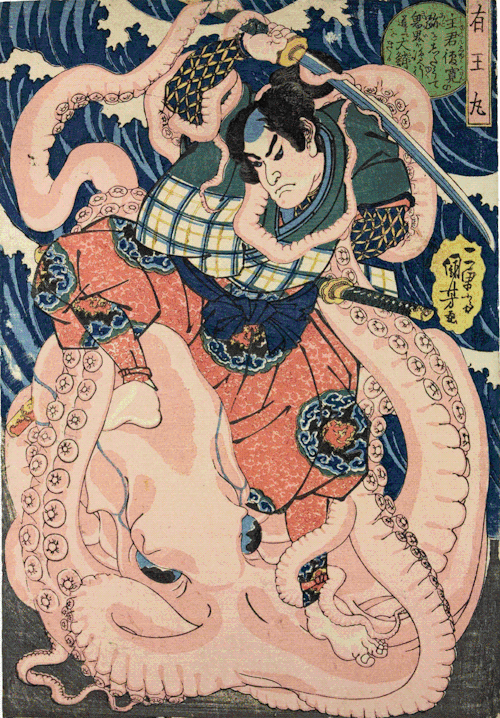
Above is Kuniyoshi's Ariōmaru Kills a Giant Octopus, circa 1833-1835. In Japanese medieval military chronicles Ariō was a servant of Priest Shunkan who gave particularly loyal service during Shunkan's banishment and death on Kikai island. The inscription in the top right of the picture tells how Ariō killed a giant octopus during his journey to Kikai island to join his master.

Wednesday, January 27, 2010

Notes from the Gallery

Goodbye Serizawa! We'll miss you!

Today, the exhibit is getting deconstructed. Loud bangs and outrageous crashes have been emanating from the 2nd floor all morning. All the noise keeps ricocheting up the staircase. If for some unfortunate reason, you couldn't make the fabulous Serizawa exhibit, you can always check out some of the pieces on our online gallery. It's sad to hear it go.

But in order to create, one must first destroy, right? Our next exhibit looks super cool! Its official title is: Graphic Heroes, Magic Monsters: Japanese Prints by Utagawa Kuniyoshi from the Arthur R. Miller Collection and it's going to run from March 12th to June 13th.

Utagawa Kuniyoshi's vivid scenes from history and legend, wildly popular 150 years ago, are a major influence on the work of today's manga and anime artists. This exhibition features over 100 dramatic depictions of giant spiders, skeletons and toads; Chinese ruffians; women warriors; haggard ghosts; and desperate samurai combat.

I. Can't. Wait.

Since all of February is going to be dedicated to putting together the new exhibit, there will definitely be more posts about Utagawa through the coming weeks.

Here's your first sneak peak:

Wednesday, November 25, 2009

Learn How To Create Japanimation

With the explosion of Japanese manga and anime taking America by storm in recent years, we can expect that a lot of kids today are dreaming of becoming future animators and manga-ka. But how do you become one exactly? Well, one way to get started is by getting the appropriate training, which was hard to come by in the US until now…

[ Chopsticks New York ]

Another option could be to check out A*NI*ME, Japan Society’s summer program for students.