Showing posts with label butoh. Show all posts

Friday, April 27, 2012

Seeding Japanese Culture One Commission At A Time

Shadows of commissions past: (l-r) Other Here, Partch, Dogugaeshi.

Japan Society stirs New York City's proverbial melting pot not only through regular whisks of Japanese culture, but also by piecing together completely new stews through commissioning American, Japanese and artists around the world to create new works.

Since the inception of the Performing Arts Program in 1953, the Society has presented nearly 650 performing arts events (approximately 2000 individual performances). Some twenty of these have been wholly original works created in recent years. Japan Society Artistic Director Yoko Shioya, who heads up the Performing Arts Program, explains:
Over the past decade, Japan Society has continued its efforts to commission non-Japanese artists to create works which are somehow related to Japan – whether they are based on Japanese literature; incorporate the stylized forms of Japanese performing arts; draw inspiration from Japan’s unique culture; include a collaboration with artists from Japan; or utilize Japanese traditional art forms or techniques.
Playing a more dynamic role than typical of the commissioning process, the Society goes beyond pledging kick-start money. It provides consultation for the artists in order to aid the art-making process by coordinating with residency partners and collaborators, helping clear Japanese copyrights, and providing means of practicing traditional performance techniques, for example. Through the active “seeding” of Japan-related creativity in the U.S., the hope is that the artist’s vision is allowed to grow beyond what was initially conceived. These performances go on to successfully tour throughout the U.S. and sometimes internationally with a lot of care taken to pair the shows with suitable presenters.

Since its inception, the Performing Arts Program commissioned a number of smaller scale works. After receiving an Endowment from the Doris Duke Charitable Foundation in the early 00s, commissions increased in scale and regularity.

Highlights include Basil Twist’s screen door puppetry spectacle Dogugaeshi, which received the prestigious Bessie Award and New York Innovative Award, and has been remounted several times since its 2004 premiere, including in Japan and most recently at D.C.'s National Cherry Blossom Festival centennial anniversary; Harry Partch’s Delusion of the Fury, the second-only full production since its 1969 premiere, featuring Partch’s mammoth musical instrument inventions (you can play electronic versions here); and Big Dance Theater’s fantastical The Other Here, which launched Japan Society’s centennial celebration in 2007.

A Global “(glowing)” Dance Of Darkness


Opening today, Japan Society’s latest commission (glowing) is by renowned New York-based choreographer Kota Yamazaki and his company Fluid hug-hug. Breaking tradition, the commission is for a Japanese artist, yet the scope of the work is truly global, blending Japanese, African and Western aesthetics, as beautifully illustrated by the piece's trailer:


Inspired by novelist Junichiro Tanizaki’s In’ei Raisan (In Praise of Shadows), Yamazaki uses the slow and deliberate Japanese form of contemporary dance known as butoh to express the novel’s idea of the subtle beauty found in the recesses of darkness and shadows. Taking butoh to another level, elements of African dance are introduced by dancers Marie Agnes Gomis of Senegal and Shiferaw Tariku of Ethiopia who are joined by Japanese and American dancers to round out the cast of six. Architect Robert Kocik, trained in traditional Japanese carpentry, is responsible for the scenery while lighting designer Kathy Kaufmann replicates the descriptions of a dimly lit Japanese house interior described in In Praise of Shadows. Koji Setoh composed the original score and sounds for the show.

As Yamazaki’s triumphant return to butoh—Japan’s dance of darkness—something he trained for many years in but distanced himself for a while, he seeks new discoveries through its comparison to African dance and exploration within profound Japanese architectural aesthetics. As the name of his company suggests, Yamazaki seeks a fluidity like water in the movement as well as between people of different cultures in order to smoothly and creatively exchange ideas.

Having premiered at the Curtis R. Priem Experimental Media and Performing Arts Center (EMPAC), a co-commissioner for the piece, and with stops in Philadelphia and Pittsburgh, (glowing) was called a “spare, contemplative and strangely beautiful work” by the Albany Times Union. The tour concludes at Japan Society on Friday, April 27, and Saturday, April 28, at 7:30 pm. Observation seats are still available for the Saturday movement workshop from 1:00-4:00 pm.

--Sean Tomizawa 


UPDATED 5/1/12

Monday, November 29, 2010

Dance Duo Bends Beyond Butoh, Makes Movement For Everybody


"You connect to their world not by watching, but by imagining that you are living inside their bodies."

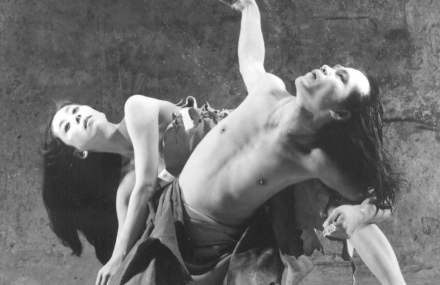
Percussion pounds in the distance as identical, scantily clad figures with snow white faces move together through time in a slow, fluid motion—an odd combination of spiritual ritual and martial art. The slowness is gripping, the stillness is suffocating, and a sense of awe emerges from the twisting and tangling of limbs and faces.

Butoh, Japan's inimitable form of modern dance was founded in the post war period by Tatsumi Hijikata and Kazuo Ohno. Hijikata felt dance in Japan following World War II was merely a copy of Western dance and wanted to create a form uniquely Japanese. A sense of rebellion permeated butoh performances, which emerged from a backdrop of student riots and protests. The movements were incredibly raw, as though animal instinct and sexual desire governed the dancers. This was intentional, as Hijikata and Ohno sought to tackle taboo ideas regarding human sexuality and challenge authority by showcasing the human body’s untamed movements. 

Two contemporary artists who tamed the untamed are the legendary husband and wife choreography/dance team Eiko and Koma. Though they met at Hijikata's studio in 1971 and studied with Ohno, they don't consider their dance butoh out of respect to the masters. Nonetheless the influence manifests itself in their style. In her fantastic recent New York Times profile of the "king and queen of slow", Gia Kourlas describes Eiko and Koma's movement:
While the moving-painting quality of their choreography is profoundly arresting, both theatrically and visually — they find the beauty in ugly — there is another layer that gets to the essence of nature. You connect to their world not by watching, but by imagining that you are living inside their bodies.
Japan Society, which debuted Eiko and Koma in 1976 and has presented them many times to great acclaim, hosts Eiko & Koma: Delicious Movement Workshop. The venerable duo hopes that anyone who takes their workshop—no matter what level of dance experience—find a renewed sense of focus and coordination, as well as take a primal pleasure in the simple act of moving one’s body.

The one-day workshop is held on December 4. Tickets are $40 or $32 for Japan Society members.

Friday, June 4, 2010

Kazuo Ohno: 1906-2010

Kazuo Ohno (l) and his son Yoshito perform at Japan Society in 1999. (c) William Irwin.

A shining light from Japan's "dance of darkness" took to the sky this week: Kazuo Ohno passed away at age 103 in Yokohama, Japan.

"It is extremely sad news for the dance community--not only in Japan and America but across all five continents," said Yoko Shioya, who oversees Japan Society's Performing Arts Program. "Although formally trained in Western modern dance, Kazuo Ohno, together with the late Tatsumi Hijikata, pioneered Butoh--Japan’s inimitable contribution to contemporary dance."

Butoh developed in the 50s after World War II as a radical alternative to traditional Japanese dance. It embodied human agony with rigid, extreme, and highly controlled movement. Early pieces were ritualistic, almost primeval in their execution. Ohno's work, however, captured an ethereal, timeless beauty amidst the despair.

Jennifer Dunning wrote in The Times' obituary: "Mr. Ohno’s solo performances, for which he was known, were irresistibly powerful and fraught with ambiguity. A humanist, he communicated the themes of the form through identifiable characters, most often flamboyantly female." Ohno was particularly adept at depicting "decaying women", who, amidst their ostentatious hats, skewed wigs, or faded robes, were always forces of nature.

What is especially remarkable about Ohno's contribution to dance is that it came when he was well over 50. He didn't make his U.S. debut until age 77 at La MaMa E.T.C. Japan Society had the privilege to present him in 1993, 1996, and the 1999 retrospective Requiem for the 20th Century [photo above], which was Ohno's final performance outside of Japan. In 2007, as part of Japan Society's 100th anniversary celebration, the Society presented a month-long butoh festival in honor of Ohno's 101st birthday, including performances by Ohno's son, Yoshito Ohno, who heads the Kazuo Ohno Dance Studio.

Ohno danced well into his nineties. Even after he became confined to a wheelchair, he performed by any means he could, with his hands alone, or by crawling across the stage, "making use of the working parts of a body ravaged by illness and age," as Dunning notes, "perhaps the perfect metaphor for the dark art of Butoh."

Ohno continues to be an influence on a variety of international artist, as Antony Hegarty  recently told Sterogum of his collaboration with the Kazuo Ohno Dance Studio.

YouTube has a great collection of video with Ohno, including snippets of several of Ohno's performances from an independent documentary, and lengthy excerpts from The Dead Sea and Mother.

For additional background, see obituaries from BBC and Associated Press.

UPDATE: After this post went up, The Guardian UK published Antony Hegarty's moving tribute to Ohno, and The Washington Post ran their obituary [free registration required for the latter].

N.O., S.J.