Showing posts with label dance. Show all posts

Friday, April 27, 2012

Seeding Japanese Culture One Commission At A Time

Shadows of commissions past: (l-r) Other Here, Partch, Dogugaeshi.

Japan Society stirs New York City's proverbial melting pot not only through regular whisks of Japanese culture, but also by piecing together completely new stews through commissioning American, Japanese and artists around the world to create new works.

Since the inception of the Performing Arts Program in 1953, the Society has presented nearly 650 performing arts events (approximately 2000 individual performances). Some twenty of these have been wholly original works created in recent years. Japan Society Artistic Director Yoko Shioya, who heads up the Performing Arts Program, explains:
Over the past decade, Japan Society has continued its efforts to commission non-Japanese artists to create works which are somehow related to Japan – whether they are based on Japanese literature; incorporate the stylized forms of Japanese performing arts; draw inspiration from Japan’s unique culture; include a collaboration with artists from Japan; or utilize Japanese traditional art forms or techniques.
Playing a more dynamic role than typical of the commissioning process, the Society goes beyond pledging kick-start money. It provides consultation for the artists in order to aid the art-making process by coordinating with residency partners and collaborators, helping clear Japanese copyrights, and providing means of practicing traditional performance techniques, for example. Through the active “seeding” of Japan-related creativity in the U.S., the hope is that the artist’s vision is allowed to grow beyond what was initially conceived. These performances go on to successfully tour throughout the U.S. and sometimes internationally with a lot of care taken to pair the shows with suitable presenters.

Since its inception, the Performing Arts Program commissioned a number of smaller scale works. After receiving an Endowment from the Doris Duke Charitable Foundation in the early 00s, commissions increased in scale and regularity.

Highlights include Basil Twist’s screen door puppetry spectacle Dogugaeshi, which received the prestigious Bessie Award and New York Innovative Award, and has been remounted several times since its 2004 premiere, including in Japan and most recently at D.C.'s National Cherry Blossom Festival centennial anniversary; Harry Partch’s Delusion of the Fury, the second-only full production since its 1969 premiere, featuring Partch’s mammoth musical instrument inventions (you can play electronic versions here); and Big Dance Theater’s fantastical The Other Here, which launched Japan Society’s centennial celebration in 2007.

A Global “(glowing)” Dance Of Darkness


Opening today, Japan Society’s latest commission (glowing) is by renowned New York-based choreographer Kota Yamazaki and his company Fluid hug-hug. Breaking tradition, the commission is for a Japanese artist, yet the scope of the work is truly global, blending Japanese, African and Western aesthetics, as beautifully illustrated by the piece's trailer:


Inspired by novelist Junichiro Tanizaki’s In’ei Raisan (In Praise of Shadows), Yamazaki uses the slow and deliberate Japanese form of contemporary dance known as butoh to express the novel’s idea of the subtle beauty found in the recesses of darkness and shadows. Taking butoh to another level, elements of African dance are introduced by dancers Marie Agnes Gomis of Senegal and Shiferaw Tariku of Ethiopia who are joined by Japanese and American dancers to round out the cast of six. Architect Robert Kocik, trained in traditional Japanese carpentry, is responsible for the scenery while lighting designer Kathy Kaufmann replicates the descriptions of a dimly lit Japanese house interior described in In Praise of Shadows. Koji Setoh composed the original score and sounds for the show.

As Yamazaki’s triumphant return to butoh—Japan’s dance of darkness—something he trained for many years in but distanced himself for a while, he seeks new discoveries through its comparison to African dance and exploration within profound Japanese architectural aesthetics. As the name of his company suggests, Yamazaki seeks a fluidity like water in the movement as well as between people of different cultures in order to smoothly and creatively exchange ideas.

Having premiered at the Curtis R. Priem Experimental Media and Performing Arts Center (EMPAC), a co-commissioner for the piece, and with stops in Philadelphia and Pittsburgh, (glowing) was called a “spare, contemplative and strangely beautiful work” by the Albany Times Union. The tour concludes at Japan Society on Friday, April 27, and Saturday, April 28, at 7:30 pm. Observation seats are still available for the Saturday movement workshop from 1:00-4:00 pm.

--Sean Tomizawa 


UPDATED 5/1/12

Monday, November 29, 2010

Dance Duo Bends Beyond Butoh, Makes Movement For Everybody


"You connect to their world not by watching, but by imagining that you are living inside their bodies."

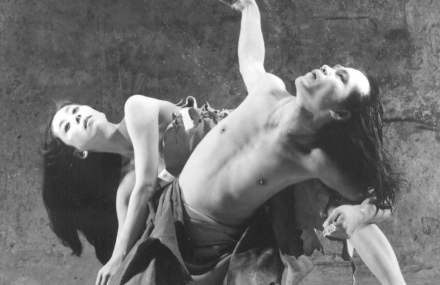
Percussion pounds in the distance as identical, scantily clad figures with snow white faces move together through time in a slow, fluid motion—an odd combination of spiritual ritual and martial art. The slowness is gripping, the stillness is suffocating, and a sense of awe emerges from the twisting and tangling of limbs and faces.

Butoh, Japan's inimitable form of modern dance was founded in the post war period by Tatsumi Hijikata and Kazuo Ohno. Hijikata felt dance in Japan following World War II was merely a copy of Western dance and wanted to create a form uniquely Japanese. A sense of rebellion permeated butoh performances, which emerged from a backdrop of student riots and protests. The movements were incredibly raw, as though animal instinct and sexual desire governed the dancers. This was intentional, as Hijikata and Ohno sought to tackle taboo ideas regarding human sexuality and challenge authority by showcasing the human body’s untamed movements. 

Two contemporary artists who tamed the untamed are the legendary husband and wife choreography/dance team Eiko and Koma. Though they met at Hijikata's studio in 1971 and studied with Ohno, they don't consider their dance butoh out of respect to the masters. Nonetheless the influence manifests itself in their style. In her fantastic recent New York Times profile of the "king and queen of slow", Gia Kourlas describes Eiko and Koma's movement:
While the moving-painting quality of their choreography is profoundly arresting, both theatrically and visually — they find the beauty in ugly — there is another layer that gets to the essence of nature. You connect to their world not by watching, but by imagining that you are living inside their bodies.
Japan Society, which debuted Eiko and Koma in 1976 and has presented them many times to great acclaim, hosts Eiko & Koma: Delicious Movement Workshop. The venerable duo hopes that anyone who takes their workshop—no matter what level of dance experience—find a renewed sense of focus and coordination, as well as take a primal pleasure in the simple act of moving one’s body.

The one-day workshop is held on December 4. Tickets are $40 or $32 for Japan Society members.

Friday, August 27, 2010

News Blast: Death Chamber Opens, US-Japan War Games, Cat Island, Museum Manga And More

 Japan's Cat Island. Via.

The New York Times reports Prime Minister Naoto Kan will face challenge in September from Ichiro Ozawa, "scandal-tainted power broker within his own party". The announcement comes shortly after the outspoken Ozawa told Japanese press that he found British People unlikeable and Americans 'monocellular', according to reports from Japan Today and Mainichi  (confirmed by Great Britain's Telegraph and followed up humorously by The Wall Street Journal.)

►Where most Japanese political parties limit membership to nationals, regulations of the ruling DPJ allow membership to anyone over 18, including Japanese nationals living abroad and foreigners living in Japan.

►As Japan reviews defense policies, and a panel wary of China urged change, AFP reported the U.S. and Japan plan to practice 'war games' in December that simulate recapturing a remote southwestern island from an enemy. Notes the AFP: "Such an exercise could bring a stern response ... Japan has territorial disputes with both China—its key Asian economic rival—and Taiwan."

►A second wave of bilateral talks between PM Kan and President Barack Obama are likely to take place at the UN in late September. The discussion may encompass the planned relocation of the Marine Corps’ Futenma Air base in Okinawa, North Korea’s nuclear program, economic stimulus, and global warming. Related, Japan is working to disclose an expert report on the Futenma relocation by the end of August.

►This week Japan's Justice Minister allowed media rare entry into an execution chamber. Mainichi carries images and officials' description of the facilities and Reuters published facts about death penalties around the world, such as Japan and the U.S. are the only countries in the Group of Eight rich nations that conduct executions.

►In a long-awaited reconciliation move, Japan hosts World War II POWs. Five American POWs and the families of deceased POWs will visit Kyoto and Tokyo among other destinations in a government supported tour. Kinue Tokudome, founder and director of the U.S.-Japan Dialogue on POWs, explained to Stars and Stripes: "the idea that Japan should apologize for anything after what happened at Hiroshima and Nagasaki—the first and only nuclear attacks in history and carried out by the United States—is a sometimes difficult proposition in Japan."

►Meanwhile, California approved a bill requiring bidders for a prestigious high-speed railway project to release details on transportation of WWII POWs.

►Artists and writers reflect on Japan's tumultuous postwar history after the signing of the 1960s security treaty in the new documentary Anpo, due out in Japan next month. The film is directed by Linda Hoaglund, a frequent collaborator with Japan Society's film and education programs, who produced the fascinating kamikaze expose Wings of Defeat, and who has for years handled English subtitles for about 200 films, including those directed by Akira Kurosawa and Hayao Miyazaki.

International Herald Tribune Op-ed: "Japan and its youths, old beyond their years, may well reveal what it is like to outgrow growth."

Kimono from Cameroon. Via.

Africa unveils gorgeous kimonos for the 21st Century .

Asahi launches "Fun! Fun! Fashion!" column. This week: socks!

►Japan invents the smallest, safest oil-to-plastic conversion machine.

►A new Japanese toilet measures blood pressure, body temperature, weight and sugar levels in urine.

►Sports Roundup: the New York Mets hold their first annual "Japanese Heritage Night", the trend is shifting for American managers of Japanese teams, Japan wins women's world baseball championship, Okinawa’s Konan High School took the Koshien national championship, and Sumo elite get iPads to enter 21st century and accommodate their meaty fingers.

►Japanese filmmaker and comic-book artist Shatoshi Kon (Paprika) "whose dazzling visual compositions and humane, emotionally resonant stories won him a devoted following in animation circles and beyond", according to The Times obituary, died in Tokyo at age 46. Read Japan Society's tribute in memoriam.

David Mitchell talks to NPR about the inspiration for his acclaimed novel A Thousand Autumns of Jacob de Zoet.

►Japanese novelist Haruki Murakami: writing a novel is "just like having a dream."

►Though conductor Seiji Ozawa says he has successfully completed treatment for esophageal cancer, he will still curtail appearances at the Saito Kinen Festival Matsumoto in Japan next month. We're hoping for his speedy recovery and look forward to him kicking off Carnegie Hall's JapanNYC fest in December.

►A Japanese manga exploits British Museum treasures (which sounds vaguely familiar!) Notes The Economist: "In Japan manga is a mainstream medium, with sales of magazines and books amounting to around $5 billion a year. Though many are juvenile, violent or pornographic, others are intricate narratives skilfully illustrated and meant to educate as much as to entertain."

The Times says the Museum of the City of New York's Samurai in New York exhibition "delivers more than you’d expect ... In this case it offers a lot to think about in terms of photography and its role in early publicity and celebrity culture as well as a fascinating look at how different societies responded to 19th-century stirrings of globalization."

Japan Times profiles Junko Fisher, a New York-based performer who teaches traditional Okinawan dance at Queens Library in New York.

►10-year-old Japanese guitar prodigy Yuto Miyazawa shreds onstage with Ozzy Osbourne.

►(To the Jurassic Park theme): Welcome... to Japan's Cat Island!

S.J.

Wednesday, August 11, 2010

Get Seasoned In Japan's Performing Arts With Another Season Of Music, Theater And Dance


A recent New York Times article noted that while plenty of people are acquainted with Japanese literature, film, and pop culture, few know much about Japanese performing arts. Sure, traditional forms like kabuki  and noh are known by name, but not many Westerners have had the opportunity to see them live, let alone have had access to modern Japanese performing arts.

This summer several high-profile Japanese stage productions played to crowded houses: Lincoln Center debuted Yukio Ninagawa’s Musashi and Saburo Teshigawara’s Miroku (which received a rave in The Times), and Toshiki Okada's Enjoy had an extended Off-Broadway run.

It's surprising Japan's performing arts aren't more popular in the U.S., given that Japan Society has presented over 600 shows since the inception the Performing Arts Program in 1953. But the recent spate of popular shows is auspicious news as we announce the latest season – an eclectic showcase of the best of Japan’s traditional and modern performing arts, with a range of music, theater and dance confirmed from September 2010 to March 2011! (View a video trailer of the season here.)

The season kicks off with the prolific and pioneering electronic recording artist Ryoji Ikeda, who performs his new high concept multimedia work datamatics [ver 2.0]. Ikeda is Paris-based, so naturally we're co-presenting with our good friends at French Institute Alliance Française, where the performances will be held coupled with a gallery installation.

In October, the great actor/director Yoshi Oida performs his venerable one-man comedy Interrogations: Words of the Zen Masters (check out The Times review from 1981, though the piece has been updated for this performance with a new live score.) The story follows a Zen master and the trials of his acolyte, and so links to our fall Gallery exhibit The Sound of One Hand, with related lectures and workshops, including one featuring the shakuhachi, a traditional bamboo flute used to practice shuzen breathing meditation.

Introducing Japan's hottest playwrights to the U.S., our Play Reading Series continues in November with Shoji Kokami's Trance. The play had its English-language debut at London’s prestigious Bush Theatre, with the Financial Times calling it "quirky and engaging."

In January, Japan Society’s 14th annual Japanese and East Asian Dance Showcase tears up the stage with the debut performances of companies from Japan, South Korea, and Taiwan. And in March, the season culminates with Kyoto's Kashu-Juku Noh Theater, giving New Yorkers the rare opportunity (even in Japan!) to see ancient noh and kyogen performances in a single evening.

Whatever your performance poison, get a healthy dose in the coming months at Japan Society!

N.O.

Images (l-r): Kashu-Juku Noh Theater, photo courtesy of the artists; Ryohei Kondo and company, photo by Takashi Ito.

Wednesday, June 23, 2010

Musashi Pities The Fool!

Fujiwara (R) as Musashi

If you don’t get your summertime fill of Japanese culture from the movies on tap at JAPAN CUTS  (or also the NYAFF), Lincoln Center for the Performing Arts has got your back!

There are two Japanese shows at this year’s annual festival – a dance performance by Suburo Tshigawara called Miroku and a staged retelling of Musashi. The latter has quite a pedigree. It’s directed by Yukio Ninagawa, who has directed hundreds of plays – ranging from Shakespeare to modern Japanese dramas – and is one of the major figures in the Japanese theater world. It’s written by the recently deceased prolific novelist and playwright Hisashi Inoue. And the main role of Musashi is played by bona-fide superstar Tatsuya Fujiwara of Battle Royale and Death Note fame.

The play is based on the Japanese tale of the wandering 17th century swordsman Musashi. He was famed for his sword-fighting techniques, and dueled many people throughout Japan. In this version, Musashi tricks a rival swordsman, Kojiro, by arranging to fight with his back to the sun, thereby temporarily blinding his opponent. After he wins the duel, he leaves Kojiro for dead – but he isn’t! And he’s itching for a rematch. Kojiro catches up with Musashi at a temple, and the peaceful villagers hanging out there must try and convince the rivals not to kill each other. Here’s a trailer.

Musashi was performed in London in May to breathlessly positive notices. The Independent writes that “Yukio Ninagawa’s productions are often hauntingly numinous, but what he's done with Hisashi Inoue’s play Musashi transports us to a realm where life and death are literally one and the same.” The Telegraph notes the strong vein of comedy that goes through the performance (a samurai duel that turns into a tango? I’m in!) and says that “Both the play and the performances are vivid and entertaining.” He also notes that Fujiwara’s performance is “charismatic.”

Fujiwara’s newest film, Parade, directed by Isao Yukisada, will be screening in JAPAN CUTS. Like Musashi, Parade is balanced with serious themes and a light, breezy tone. Fujiwara will be attending the Noon screening of Parade on July 10th for a Q&A session – and later that evening will appear in one of the four performances of Musashi at the Lincoln Center. We hear tickets are getting scarce, so if you are interested, reserve ASAP!

A deptiction of Musashi battling a giant whale by our old friend Kuniyoshi

N.O.

Friday, June 11, 2010

News Blast: Kickin' It With Samurai Blue

Artwork via Vanity Fair , ESPN and the AM I Collective.

World Cupdate

Japan's men's soccer team (affectionately nicknamed the Samurai Blue) landed in South Africa on Sunday to gear up for another warm-up World Cup match for 2010. Japan faced Zimbabwe on Thursday and came to a tie 0-0. Fans at home geared up too by holding a screaming competition in honor of their team. Whoever screamed the word 'GOAL!' the loudest got unofficial bragging rights. Norio Nakayama won (32 seconds) and said in regards to Japan’s fate in the World Cup the "The ball is round and everything may happen." But added: "Of course I'd like them to do their best and be hell-bent on winning." Watch a video of his winning scream here.

Naoto Kan Chosen as Next PM

The Democratic Party of Japan chose ex-PM Hatoyama’s Finance Minister, Naoto Kan, for Japan's next Prime Minister. Kan, 63, was elected last Friday by a wide margin in an internal Party vote. He has a reputation as a whistleblower and a civil rights activist. Early in his career in the 1970s, he served on the election campaign of Fusae Ishikawa, a major figure in the Women’s Rights movement. Also, while serving as a Health Minister in 1996, when his political party formed a ruling coalition with the Liberal Democratic Party, he exposed and apologized for his government’s accidental distribution of blood tainted with HIV. His frankness and candor won him many allies both within the political sphere and in the public’s eyes.

While Hatoyama’s Cabinet resigned en-masse to make way for Kan’s picks, Kan re-instated most officials in the same positions they previously held.

Kan will continue many of Hatoyama’s policies – most notably on the U.S. military base on Okinawa. He telephoned President Obama to discuss Futenma, saying  both the U.S. and Japan should do more to resolve the base issue. In his first press conference as PM, he said he wants to "drastically rebuild Japan" and that fiscal challenges are "the biggest issue the country must tackle and must be discussed beyond our party’s boundaries."

Almost immediately following his formal appointment earlier this week, a number of fake Twitter accounts purporting to be Kan himself cropped up, though they were quickly shuttered.

Beard Burn in Isesaki City

In Isesaki City, about 60 miles north of Tokyo, the municipal government has banned beards on all city officials. The ban follows a number of public complaints that found beards on some workers to be "unpleasant." Local barbers and 'beard advocacy groups,' such as the Hige (Beard) Club are trying to work within the confines of the ban: Minoru Fujii, a Tokyo member says "I am designing beards for my customers that are considered acceptable in the company workplace." According to The Japan Times’ 'Views from the Street' public opinion column, most people agree that public officials should be neat and tidy, but that banning all facial hair is going a bit too far. Isesaki is the only municipality in Japan to instate such a ban.

Government Adds 'Sexy' Kanji to Everyday Use List

The Council for Cultural Affairs added 191 new characters to the jōyō kanji list, the list of kanji approved for everyday usage and taught to elementary- and middle-schoolers. Most of the new kanji had been omitted when the last list was compiled in 1981, because they were considered too complex to have to write longhand on a regular basis. However, because most people nowadays write on computers or cell phones, there is no longer as much need to write by hand. New kanji includes: 額 (ton – stop or pause), 藤 (fuji – creeper plant), and 艶 (en – sexy/ voluptuous) .

Bite-Sized News:

►Construction on a golf course in Japan’s ancient capital Nara disturbed some ancient tombs. We're hoping nobody picked up a curse!

►The spread of foot-and-mouth disease in Miyazaki Prefecture, Japan’s livestock center, continues.

►Japanese and American manga publishers fight scanlations.

►Japanese construction conglomerate Shimizu, Corp. unveiled plans to build a floating eco-city. It’s a joint project between 14 Japanese universities and the corporation to be completed in 15 years. "We would like to make it a utopia that belongs to no particular state," says Makoto Kajitani, director of the Super Collaborative Graduate School project director and president of the University of Electro-Communications in Tokyo.

►A UK vet will publish a book about his experience as a prisoner of war during WWII, detailing his resulting lifelong friendship with one of his Japanese prison guards.

►A moving memorial for butoh legend Kazuo Ohno by Antony Hegarty from Antony and the Johnsons.

►NYT profiles director Shu Matsuri, noting "contemporary Japanese theater remains by and large terra incognita" around the world. The paper also profiled vernerable Japanese dance duo Eiko & Koma.

►Arthur R. Miller, one of America's top legal minds collects the ukiyo-e woodblock prints of Utagawa Kuniyoshi because of the artist's championship of free speech.

Kuniyoshi in closing: "Graphic Heroes, Magic Monsters… is part history lesson, part barometer of Japan's political climate of the day, part manga precursor. It is all exquisitely created, boldly rendered, and remarkably preserved."

►Asahi reports "wacky candy says 'Japan' like no other gift"

►Finally, Japan Society launched a Japanese-language Twitter feed @js_desu  in addition to @japansociety, @Education_JS, @Innovators_JS, and @JSNY_Film. Happy following!

N.O.

Friday, June 4, 2010

Kazuo Ohno: 1906-2010

Kazuo Ohno (l) and his son Yoshito perform at Japan Society in 1999. (c) William Irwin.

A shining light from Japan's "dance of darkness" took to the sky this week: Kazuo Ohno passed away at age 103 in Yokohama, Japan.

"It is extremely sad news for the dance community--not only in Japan and America but across all five continents," said Yoko Shioya, who oversees Japan Society's Performing Arts Program. "Although formally trained in Western modern dance, Kazuo Ohno, together with the late Tatsumi Hijikata, pioneered Butoh--Japan’s inimitable contribution to contemporary dance."

Butoh developed in the 50s after World War II as a radical alternative to traditional Japanese dance. It embodied human agony with rigid, extreme, and highly controlled movement. Early pieces were ritualistic, almost primeval in their execution. Ohno's work, however, captured an ethereal, timeless beauty amidst the despair.

Jennifer Dunning wrote in The Times' obituary: "Mr. Ohno’s solo performances, for which he was known, were irresistibly powerful and fraught with ambiguity. A humanist, he communicated the themes of the form through identifiable characters, most often flamboyantly female." Ohno was particularly adept at depicting "decaying women", who, amidst their ostentatious hats, skewed wigs, or faded robes, were always forces of nature.

What is especially remarkable about Ohno's contribution to dance is that it came when he was well over 50. He didn't make his U.S. debut until age 77 at La MaMa E.T.C. Japan Society had the privilege to present him in 1993, 1996, and the 1999 retrospective Requiem for the 20th Century [photo above], which was Ohno's final performance outside of Japan. In 2007, as part of Japan Society's 100th anniversary celebration, the Society presented a month-long butoh festival in honor of Ohno's 101st birthday, including performances by Ohno's son, Yoshito Ohno, who heads the Kazuo Ohno Dance Studio.

Ohno danced well into his nineties. Even after he became confined to a wheelchair, he performed by any means he could, with his hands alone, or by crawling across the stage, "making use of the working parts of a body ravaged by illness and age," as Dunning notes, "perhaps the perfect metaphor for the dark art of Butoh."

Ohno continues to be an influence on a variety of international artist, as Antony Hegarty  recently told Sterogum of his collaboration with the Kazuo Ohno Dance Studio.

YouTube has a great collection of video with Ohno, including snippets of several of Ohno's performances from an independent documentary, and lengthy excerpts from The Dead Sea and Mother.

For additional background, see obituaries from BBC and Associated Press.

UPDATE: After this post went up, The Guardian UK published Antony Hegarty's moving tribute to Ohno, and The Washington Post ran their obituary [free registration required for the latter].

N.O., S.J.

Thursday, January 14, 2010

We made the Times!

"Think of baby animals with spooky, giant eyes and ghosts who talk about their bodily functions. Veith Michel’s three-paneled video features plenty of these, including beautiful line drawings by the manga illustrator Hiroki Otsuka, as well as a barrage of predictable media images.

It is an immersive, at times assaultive, world, especially when paired with a recorded text created by Mr. Wade, Mr. Gradinger and Marcos Rosales that careers from fantastical adventures in outer space to heavy-handed, childlike discussions about the government, consumerism and queer politics.

Mr. Gradinger tends to be subsumed by this environment, which sometimes morphs into an alienating television show for children, full of Andreas Harder’s abrupt lighting shifts. The most successful moments come early on, when his messy, often pedestrian movement palette unspools against the text’s Neverland of shattering space, ninja battles and princesses in need of saving.

Dressed in a loose blue T-shirt and lighter blue shorts printed with rocket ships, Mr. Gradinger seems a lost boy, grinning madly, galloping about or huddling into his body; scooting his rear end across the enclosed white stage; or flipping his hands in troubled little gestures."

[ The New York Times Dance Review ]