Showing posts with label Kazuo Ohno. Show all posts

Monday, November 29, 2010

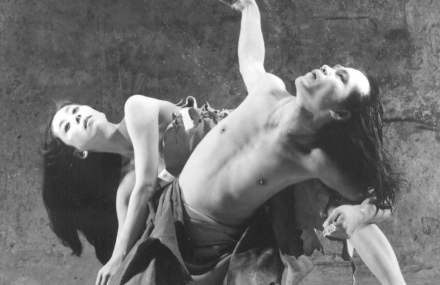
Dance Duo Bends Beyond Butoh, Makes Movement For Everybody


"You connect to their world not by watching, but by imagining that you are living inside their bodies."

Percussion pounds in the distance as identical, scantily clad figures with snow white faces move together through time in a slow, fluid motion—an odd combination of spiritual ritual and martial art. The slowness is gripping, the stillness is suffocating, and a sense of awe emerges from the twisting and tangling of limbs and faces.

Butoh, Japan's inimitable form of modern dance was founded in the post war period by Tatsumi Hijikata and Kazuo Ohno. Hijikata felt dance in Japan following World War II was merely a copy of Western dance and wanted to create a form uniquely Japanese. A sense of rebellion permeated butoh performances, which emerged from a backdrop of student riots and protests. The movements were incredibly raw, as though animal instinct and sexual desire governed the dancers. This was intentional, as Hijikata and Ohno sought to tackle taboo ideas regarding human sexuality and challenge authority by showcasing the human body’s untamed movements. 

Two contemporary artists who tamed the untamed are the legendary husband and wife choreography/dance team Eiko and Koma. Though they met at Hijikata's studio in 1971 and studied with Ohno, they don't consider their dance butoh out of respect to the masters. Nonetheless the influence manifests itself in their style. In her fantastic recent New York Times profile of the "king and queen of slow", Gia Kourlas describes Eiko and Koma's movement:
While the moving-painting quality of their choreography is profoundly arresting, both theatrically and visually — they find the beauty in ugly — there is another layer that gets to the essence of nature. You connect to their world not by watching, but by imagining that you are living inside their bodies.
Japan Society, which debuted Eiko and Koma in 1976 and has presented them many times to great acclaim, hosts Eiko & Koma: Delicious Movement Workshop. The venerable duo hopes that anyone who takes their workshop—no matter what level of dance experience—find a renewed sense of focus and coordination, as well as take a primal pleasure in the simple act of moving one’s body.

The one-day workshop is held on December 4. Tickets are $40 or $32 for Japan Society members.

Friday, June 11, 2010

News Blast: Kickin' It With Samurai Blue

Artwork via Vanity Fair , ESPN and the AM I Collective.

World Cupdate

Japan's men's soccer team (affectionately nicknamed the Samurai Blue) landed in South Africa on Sunday to gear up for another warm-up World Cup match for 2010. Japan faced Zimbabwe on Thursday and came to a tie 0-0. Fans at home geared up too by holding a screaming competition in honor of their team. Whoever screamed the word 'GOAL!' the loudest got unofficial bragging rights. Norio Nakayama won (32 seconds) and said in regards to Japan’s fate in the World Cup the "The ball is round and everything may happen." But added: "Of course I'd like them to do their best and be hell-bent on winning." Watch a video of his winning scream here.

Naoto Kan Chosen as Next PM

The Democratic Party of Japan chose ex-PM Hatoyama’s Finance Minister, Naoto Kan, for Japan's next Prime Minister. Kan, 63, was elected last Friday by a wide margin in an internal Party vote. He has a reputation as a whistleblower and a civil rights activist. Early in his career in the 1970s, he served on the election campaign of Fusae Ishikawa, a major figure in the Women’s Rights movement. Also, while serving as a Health Minister in 1996, when his political party formed a ruling coalition with the Liberal Democratic Party, he exposed and apologized for his government’s accidental distribution of blood tainted with HIV. His frankness and candor won him many allies both within the political sphere and in the public’s eyes.

While Hatoyama’s Cabinet resigned en-masse to make way for Kan’s picks, Kan re-instated most officials in the same positions they previously held.

Kan will continue many of Hatoyama’s policies – most notably on the U.S. military base on Okinawa. He telephoned President Obama to discuss Futenma, saying  both the U.S. and Japan should do more to resolve the base issue. In his first press conference as PM, he said he wants to "drastically rebuild Japan" and that fiscal challenges are "the biggest issue the country must tackle and must be discussed beyond our party’s boundaries."

Almost immediately following his formal appointment earlier this week, a number of fake Twitter accounts purporting to be Kan himself cropped up, though they were quickly shuttered.

Beard Burn in Isesaki City

In Isesaki City, about 60 miles north of Tokyo, the municipal government has banned beards on all city officials. The ban follows a number of public complaints that found beards on some workers to be "unpleasant." Local barbers and 'beard advocacy groups,' such as the Hige (Beard) Club are trying to work within the confines of the ban: Minoru Fujii, a Tokyo member says "I am designing beards for my customers that are considered acceptable in the company workplace." According to The Japan Times’ 'Views from the Street' public opinion column, most people agree that public officials should be neat and tidy, but that banning all facial hair is going a bit too far. Isesaki is the only municipality in Japan to instate such a ban.

Government Adds 'Sexy' Kanji to Everyday Use List

The Council for Cultural Affairs added 191 new characters to the jōyō kanji list, the list of kanji approved for everyday usage and taught to elementary- and middle-schoolers. Most of the new kanji had been omitted when the last list was compiled in 1981, because they were considered too complex to have to write longhand on a regular basis. However, because most people nowadays write on computers or cell phones, there is no longer as much need to write by hand. New kanji includes: 額 (ton – stop or pause), 藤 (fuji – creeper plant), and 艶 (en – sexy/ voluptuous) .

Bite-Sized News:

►Construction on a golf course in Japan’s ancient capital Nara disturbed some ancient tombs. We're hoping nobody picked up a curse!

►The spread of foot-and-mouth disease in Miyazaki Prefecture, Japan’s livestock center, continues.

►Japanese and American manga publishers fight scanlations.

►Japanese construction conglomerate Shimizu, Corp. unveiled plans to build a floating eco-city. It’s a joint project between 14 Japanese universities and the corporation to be completed in 15 years. "We would like to make it a utopia that belongs to no particular state," says Makoto Kajitani, director of the Super Collaborative Graduate School project director and president of the University of Electro-Communications in Tokyo.

►A UK vet will publish a book about his experience as a prisoner of war during WWII, detailing his resulting lifelong friendship with one of his Japanese prison guards.

►A moving memorial for butoh legend Kazuo Ohno by Antony Hegarty from Antony and the Johnsons.

►NYT profiles director Shu Matsuri, noting "contemporary Japanese theater remains by and large terra incognita" around the world. The paper also profiled vernerable Japanese dance duo Eiko & Koma.

►Arthur R. Miller, one of America's top legal minds collects the ukiyo-e woodblock prints of Utagawa Kuniyoshi because of the artist's championship of free speech.

Kuniyoshi in closing: "Graphic Heroes, Magic Monsters… is part history lesson, part barometer of Japan's political climate of the day, part manga precursor. It is all exquisitely created, boldly rendered, and remarkably preserved."

►Asahi reports "wacky candy says 'Japan' like no other gift"

►Finally, Japan Society launched a Japanese-language Twitter feed @js_desu  in addition to @japansociety, @Education_JS, @Innovators_JS, and @JSNY_Film. Happy following!

N.O.

Friday, June 4, 2010

Kazuo Ohno: 1906-2010

Kazuo Ohno (l) and his son Yoshito perform at Japan Society in 1999. (c) William Irwin.

A shining light from Japan's "dance of darkness" took to the sky this week: Kazuo Ohno passed away at age 103 in Yokohama, Japan.

"It is extremely sad news for the dance community--not only in Japan and America but across all five continents," said Yoko Shioya, who oversees Japan Society's Performing Arts Program. "Although formally trained in Western modern dance, Kazuo Ohno, together with the late Tatsumi Hijikata, pioneered Butoh--Japan’s inimitable contribution to contemporary dance."

Butoh developed in the 50s after World War II as a radical alternative to traditional Japanese dance. It embodied human agony with rigid, extreme, and highly controlled movement. Early pieces were ritualistic, almost primeval in their execution. Ohno's work, however, captured an ethereal, timeless beauty amidst the despair.

Jennifer Dunning wrote in The Times' obituary: "Mr. Ohno’s solo performances, for which he was known, were irresistibly powerful and fraught with ambiguity. A humanist, he communicated the themes of the form through identifiable characters, most often flamboyantly female." Ohno was particularly adept at depicting "decaying women", who, amidst their ostentatious hats, skewed wigs, or faded robes, were always forces of nature.

What is especially remarkable about Ohno's contribution to dance is that it came when he was well over 50. He didn't make his U.S. debut until age 77 at La MaMa E.T.C. Japan Society had the privilege to present him in 1993, 1996, and the 1999 retrospective Requiem for the 20th Century [photo above], which was Ohno's final performance outside of Japan. In 2007, as part of Japan Society's 100th anniversary celebration, the Society presented a month-long butoh festival in honor of Ohno's 101st birthday, including performances by Ohno's son, Yoshito Ohno, who heads the Kazuo Ohno Dance Studio.

Ohno danced well into his nineties. Even after he became confined to a wheelchair, he performed by any means he could, with his hands alone, or by crawling across the stage, "making use of the working parts of a body ravaged by illness and age," as Dunning notes, "perhaps the perfect metaphor for the dark art of Butoh."

Ohno continues to be an influence on a variety of international artist, as Antony Hegarty  recently told Sterogum of his collaboration with the Kazuo Ohno Dance Studio.

YouTube has a great collection of video with Ohno, including snippets of several of Ohno's performances from an independent documentary, and lengthy excerpts from The Dead Sea and Mother.

For additional background, see obituaries from BBC and Associated Press.

UPDATE: After this post went up, The Guardian UK published Antony Hegarty's moving tribute to Ohno, and The Washington Post ran their obituary [free registration required for the latter].

N.O., S.J.