Showing posts with label Performing Arts. Show all posts

Sunday, May 17, 2015

Christianity In Japan & A Noh Theater Prayer For Peace

Scenes from Holy Mother in Nagasaki
A woman in a white mask emerges on stage and slowly glides down a narrow path. Clad in a vibrant blue veil and robes of blue and shimmering gold, she stops and turns. Beneath the pulse of drums and intermittent shrieks of flutes characteristic of the music of ancient Japan, the fluid hum of Gregorian chant gives the scene an otherworldly feeling—eerie, incongruous, mesmerizing.

Slowly, the woman begins to kneel, then rises, extending her hand. She walks center stage, quickening her pace as she approaches the audience. Finally, she shields her face with her arm and begins to slowly dance about the stage, alternating slow and fast gliding that ends in a dramatic flip of her long sleeve above her head. With a giant cross looming behind her, a revelation is at hand: The Holy Mother has arrived.

So ends Holy Mother in Nagasaki, a noh play of the classical tradition written in 2005. Part of Japan Society’s new and traditional noh presentation commemorating the 70th anniversary of the end of WWII, the story unfolds at the famous Urakami Cathedral, as a priest tells a traveler the tale of Nagasaki’s suffering following the dropping of the second atomic bomb in Japan. The majestic cathedral rose as a beacon of hope and religious freedom in the late 19th century after years of Christian persecution in Japan, and then was completely destroyed in the atomic bombing of Nagasaki.

The priest recounts hardships the survivors faced, and the resolve they had to rebuild the cathedral. He also shares the story of a woman who appeared the evening of the bombing to console the victims. No one knew who the woman was, but many believed she might be the Holy Mother returned.

In addition to being true to noh theater traditions that go back over 600 years, the tale is deeply rooted in the history of Christianity in Japan. (Nagasaki was the first port open to foreigners, so it has an unusual history of foreign influx compared to other locations in Japan. For example, at the height of Christianity’s spread to Japan, so many churches were built in Nagasaki that it became known as “Little Rome”.)

The Urakami Cathedral before and after the bombing. Via.

Christianity was introduced to Japan in 1549 by Francis Xavier of Navarre (modern-day Spain)†, who would later become the patron saint of missionaries, baptizing an estimated 30,000 people over his lifetime.

Furthering the spread of Christianity, Sumitada Omura became the first of Japan’s daimyo (feudal lords) to convert. He ceded Nagasaki and Mogi to the Society of Jesus in 1580, which began to worry then-shogun Hideyoshi Toyotomi, who began his crusade against Christianity in 1587 when he demanded that all foreign missionaries leave the country.

Tensions came to a head in 1597, when Toyotomi ordered the execution of 26 Christians on a hill in Nagasaki by crucifixion. From there, sanctions against Christianity only grew stricter, as in 1614, Christianity was banned by Tokugawa Ieyasu, Toyotomi’s successor.

Japanese Christians were forced to practice in secret while pretending to be Buddhist, a practice that would continue for nearly 250 years until the Meiji government officially lifted the ban in 1873.

The most shocking part of the ordeal, however, came eight years earlier, when a group of these so-called “Hidden Christians” visited Oura Cathedral, newly built by a French missionary and reserved only for foreigners, in order to proclaim their faith. Father Bernard Petitjean, the priest at the cathedral, was extremely excited to discover that there in fact existed towns and villages full of Christians in Nagasaki, encouraging the Hidden Christians to practice their faith openly.

But Christianity was still illegal, which meant that 3,400 of these newly found Christians were arrested, some tortured, and 36 put to death. The Hidden Christians would have to remain that way for a few more years.

When it was finally safe to do so, approximately 30,000 Hidden Christians finally emerged, their faith having survived nearly two and a half centuries in secrecy. In a letter to Japan’s bishops written in March, Pope Francis said, “If our missionary efforts are to bear fruit, the example of the 'hidden Christians' has much to teach us.”

But even after their religious freedom had been won, the struggle of the Hidden Christians was not over. Due to years of persecution, many of them had been and were still living in poverty. Despite this, they decided to build churches, reducing the cost as much as possible by using lime they had made by burning shells, and drawing patterns on window glasses instead of using stained glass. Due in large part to their efforts, today there are more than 130 churches in Nagasaki Prefecture, more than anywhere else in Japan.

A Noh Theater Prayer for Healing and Peace

When programming the performing arts portion of Japan Society's Stories from the War series commemorating the end of WWII, Artistic Director Yoko Shioya felt that one of the most important “stories” Japan can share with the world is the aftermath of the atomic bombings.

In the program notes, Shioya writes that Holy Mother in Nagasaki "not only speaks about this sorrowful story, but also conveys the strong belief in the resilient spirit of humanity."

The play was written by the late Dr. Tomio Tada, an internationally renowned scientist (in the 1970s he discovered the suppressor T cells that subdue immune response) and respected author. Of several noh plays, he wrote two about the atomic bombings: Holy Mother in Nagasaki, and Genbaku-ki (Atomic Bomb Mourning) about Hiroshima.

"In the program notes from the Nagasaki premiere Tada explained that while the latter was written as a requiem, the former was written as a paean for revitalization, and he intentionally decided on these two different themes based on his observations of both of the A-bomb-ravaged cities," writes Shioya.

In an interview after performances of Holy Mother in Nagasaki began at Japan Society, Shioya posited that perhaps it was the element of Christianity that gave the play its inherent message of hope. Religious themes of classic noh are typically derived from Buddhism, which sees the soul go through an eternal cycle of rebirth, whereas Christianity sees the spirit set free in an eternal afterlife.

Shioya also feels that the centuries-old stylized noh might be one of the best art forms that addresses eternal challenges for human beings. Shimizu Kanji, lead actor in Holy Mother in Nagasaki and a designated Intangible Cultural Asset by the Japanese government, explains further in his portion of the program notes:
In many stories of noh drama, a ghost appears and recounts the story of his life—what events occurred, how he died, who mourns for him and where he is buried. I think these elements must be important for human beings. This consideration led me to realize that there are countless outrageous ways in which people lose their lives—by the blast of a single bomb or in a massive battle, through an earthquake, a tsunami or a hurricane.
Shimizu recounts the first performance of and how it affected him :
The new noh piece, Holy Mother in Nagasaki, premiered at the Urakami Cathedral in Nagasaki City on November 23, 2005. It was held on the site of the cathedral that was destroyed by the atomic bomb, and on the exact 60th anniversary of the first mass and memorial service held after the bombing. I knew that nothing would be able to reenact that tragic day realistically, yet I wore a noh mask and costume in the role of the spirit of an A-bomb victim and walked slowly down the long aisle toward the altar to read my lines, which narrated "that day." While I was performing, I felt the Gregorian chant sung by the choir run through my body. Since then, we have performed this piece in many cities, and we have now arrived at the 70th anniversary of the end of WWII.
Shimizu says he is humbled to present the noh performance to an American audience, especially during the once-every-five years Treaty on the Non-Proliferation of Nuclear Weapons international assembly at the United Nations, and his hope is that the performance helps those who have lost their lives in such catastrophes to rest peacefully and restores those catastrophically damaged sites back to life. But he notes, "world peace has not yet arrived and the souls of the hibakusha [atomic bomb survivors] remain unhealed."

Telling stories is one of the most powerful forms of communications, and it is well documented that sharing personal stories can have health benefits and help psychological healing. It can also help transmit a message through generations.

In Holy Mother in Nagasaki, the traveler listens to the priest's story and finally says, “I have resolved to mourn the victims and pray for world peace.” Once can only assume audiences will do the same.


--Mark Gallucci, Lara Mones, Shannon Jowett
†The portions of this article detailing the history of Christianity in Japan were informed by "Churches and Christian Sites in Nagasaki", published by the Nagasaki Prefectural Government.

Tuesday, April 21, 2015

The Mystery Of Merii of Hama And The Birth Of 'Yokohama Rosa'

Merii of Hama on the streets of Yokohama. Circa 1990.

"What? What’s my name? I’ve long forgotten my real name. But people call me all sorts of names. Like Merii of Hama, Mary, ‘Merican Li’l or Rosa. But Rosa is my favorite of all." – Yokohama Rosa


Nearly 15 years ago, Japan’s legendary TV/film/stage actress Michiko Godai encountered Merii-san on the streets of Yokohama (Japan’s second largest city just outside of Tokyo), roaming around with her oversized rolling suitcase and face painted as white as fresh snow. On first sight, Godai wanted to learn more about the mysterious woman. Who was she? Where did she come from? What was her story?

Godai began her investigation by searching for the makeup store where Merii-san bought her white face paint. She learned that Merii-san once fancied expensive American brand makeup products, but with her dwindling savings, the shop owner introduced her to a 500 yen stage paint which ended up becoming her signature look, together with thick kabuki-like eyeliner.

Godai then found the dry cleaner that laundered Meri-san’s frilly white dresses and would kindly allow her to change in the store before returning to the streets, the hair salon that styled her hair until their clients requested that she no longer be allowed in, and the cafĂ© that held a rose cup just for her use so as not to alienate the other customers.

Godai, together with the late playwright Giho Sugiyama, strung these stories carefully together like beads on a chain, and the powerful one-woman play Yokohama Rosa was born. 

“Through Rosa, I want to depict Japan’s postwar history and convey it (to future generations),” Godai told the Asahi Shimbun about why she created the play. Since its premiere in April 1996 at the Mitsukoshi Theatre in Tokyo, the piece has been presented 110 times to more than 51,000 people. Beginning in 2003, the piece has been performed each August in Yokohama’s Red Brick Warehouse in commemoration of the end of WWII.

Having its U.S. premiere this weekend as part of Japan Society's Stories from the War series marking the 70th anniversary of the war's end, Godai said, “A war produces tragedies regardless of whether a country wins or loses it... I want Americans to see 'Yokohama Rosa' as a message to pray for peace.”

Michiko Godai portrays Merii over the decades. Photos by © Hideo Mori.

Details of Merii-san’s early life are vague and inconclusive, as she never let down her guard to tell anyone her true story. Merii-san’s Japanese Wikipedia page states that:
She was born in 1921 in Okayama Prefecture to a farming family. The oldest daughter of eight, she was married just briefly. After the war she worked at a local food joint that catered to foreign soldiers. It was there where she met and fell in love with a U.S. Army Official who whisked her off to Tokyo before getting drafted into the Korean War, never to return. Abandoned and forlorn, she turned towards Yokosuka (home of the Yokosuka naval base) in Yokohama, where she began her life as a pan-pan [the word in occupied Japan for prostitute*]. Some records say this was the early 60s, others the mid-50s. She began garnering real attention in the 80s, then disappeared in the mid-90s. She was said to have died in a nursing home near her hometown in 2005 at the age of 84. Numerous songs, manga, films and even a novel and poem exist, inspired by her story.
In 1995, Michiko Godai visited the GM Building where former pan-pan Merii-san (then in her seventies) dwelled and “worked” as a so-called Elevator Girl, escorting people up and down to the floors they wished to go. The tips that she made were now her only source of income. Godai explained to Merii-san that she would like to do a one-woman play about her life and according to Godai she smiled and said, “Is that so?”

Godai’s Yokohama Rosa is a fictionalized account inspired by the woman who came to be known as Merii-san. The 100 minute play traces the life of a woman known as Yokohama Rosa from the time she arrives in Yokohama, through her journey into prostitution, to her love-affair with a foreign soldier and her fears and insecurities about time moving on and her own aging.

The play depicts an innocent life completely tossed and turned by war (in this play not only is WWII considered, but also the wars in Korea and Vietnam) and is performed with live musicians and a panoramic display of striking images from the times. Part post-war history lesson, part testament to the perseverance of the human spirit, Merri-san's story, and the story of all women she represents, lives on through Michiko Godai's heartrending performance in this poignant production.

--Lara Mones

Merii of Hama on the streets of Yokohama. Circa 1990.

*Pan-pan (pronounced pahn-pahn, unknown origin) n. 1. The word for street walker or prostitute used in Japan at the end of WWII. (Kojien); 2. Prostitutes who catered to the Occupied Troops. At the end of WWII, the terms pan-pan girl and pan-suke emerged to describe the prostitutes who appeared on the streets and who specifically worked for the GI troops in Occupied Japan. While the origins of the word are uncertain, some believe it to have come from the English word “pom-pom” meaning sex, while others, the American pronunciation of the Indonesian word for woman “Perem-paun” (pronounced purom pan). Still others believe that it came from the onomatopoeia “pen-pen” describing the shamisen (aka geishas). Whatever its origin, the word that the GIs used became “pan-pan” when it eventually reached the years of the Japanese. (Zokugo); 3. Today, the word or sound “pan-pan” is a commonly used adjective meaning full or to be stretched tight. Via.

Sources:

Shiroi Kao no Densetsu wo Motomete: Yokohama kara Yokohama Rosa he no Deshin, Michiko Godai

Yokohama Rosa, Giho Sugiyama and Michiko Godai

Yokohama Merii (film), Takayuki Nakamura

Kojien Dictionary and zokugo-dict.com

Monday, January 26, 2015

The Story of Tokyo Rose

 A multitude of Tokyo Roses in Miwa Yanagi's Zero Hour. (c) Naoshi Hatori 

Commemorating the 70th anniversary of the end of World War II, Japan Society launches its Stories from the War programming series this week with Miwa Yanagi's Zero Hour, a theatrical retelling of the legend of Tokyo Rose. Hayley Valk, a recent intern for Japan Society's Performing Arts Program, reports from Frederick P. Close's seminal book on the subject, Tokyo Rose / An American Patriot: A Dual Biography (Scarecrow, 2010).

Born on the Fourth of July

An immigrant to Los Angeles from Yamanashi Prefecture, Jun Toguri was overjoyed when his daughter Iva was born on Independence Day, 1916. Iva was American through and through – she loved baseball, had no taste for Japanese music but loved Big Band, and her extroverted personality won her many Caucasian friends but clashed with her father’s conservative Japanese style. Her childhood was spent in various cities in Southern California, as her father moved through the import-export business and eventually came to own grocery stores. Iva graduated with a degree in zoology from UCLA, but without many career prospects due to her gender and Japanese heritage.

In June 1941, Iva’s aunt fell ill in Tokyo. Since Iva’s mother Fumi also suffered from failing health, Iva decided to pay a visit in her place and travel to Japan for the first time. She boarded a ship with her friend Chiyeko Ito, not knowing that she wouldn’t return to the U.S. for another seven years.

An American in Tokyo

Six months after arriving in Tokyo, Iva heard the shocking news: Japan had bombed Pearl Harbor. She struggled to book passage on a ship leaving the country but, without the appropriate passport or funds, was stranded. The police regularly came knocking at her door to harass Iva and convince her to renounce her U.S. citizenship, but she refused again and again. Though she lived with her aunt for a time, this unyielding support of the enemy made Iva’s relatives and neighbors uncomfortable and in time resentful, and she ultimately decided to move into a boarding house found with the help of her Japanese language school. Meanwhile, her family back home had been interned.

Realizing that she would have to make her own way in Japan for some time to come, Iva continued learning Japanese, improving on the very little knowledge she possessed before arriving in Japan. She found several small jobs in these years, transcribing English for Domei News Agency, teaching piano to children from wealthy families, and doing office work for the Danish Minister. As Japan struggled in a time of severe rationing, Iva actively traded on the black market and smuggled goods to POWs, saving Allied lives. Finally, she began part-time work as a typist at Radio Tokyo.

Zero Hour

Early in Japan’s propaganda effort, three English-speaking POWs with broadcasting experience were brought to Radio Tokyo to develop programming. Charles Cousens, Ted Ince, and Norman Reyes were forced by the Japanese government to oversee an hour-long radio show called Zero Hour, containing music, skits, censored news, and POW messages. They searched for a female broadcaster to introduce the jazz music segments and deliver short scripted announcements, and came across typist Iva Toguri; fluent in English and with a raspy, unalluring voice, she was exactly what the program needed. Facing government threats, she was given little choice but to accept the position.

As the primary of multiple women broadcasting for Zero Hour, Iva became established under the identity “Orphan Ann.” She could sympathize with the stranded GIs as she greeted them, “my fellow orphans in the Pacific.” Though these comments ostensibly served the Japanese government’s objective of weakening the Allied forces’ morale, the POWs carefully scripted the show to subvert the negativity in favor of cleverly-worded encouragement. The preserved records of Iva’s Zero Hour broadcasts reveal that, in fact, she did little more than entertain GI listeners and announce the upcoming music selections.

Will the Real Tokyo Rose Please Stand Up?

Meanwhile, from very early in the war talk was flying about a radio personality known only as “Tokyo Rose.” According to GIs in the Pacific, Tokyo Rose was famous for demoralizing comments, rumors of unfaithful girlfriends back home, and leaking military secrets. She was described as a seductress with an English accent. Impossible to pin on any one broadcaster, the name was attributed in rumors to other broadcasters such as Radio Manilla’s Myrtle Lipton or even to Amelia Earhart. The popularity of the Tokyo Rose legend became so widespread that she was even common vocabulary back in the U.S., encouraged by movies, cartoons, and articles.

To this day, no records exist of any broadcaster introducing herself as “Tokyo Rose” on the air. Furthermore, no one woman’s voice or broadcast contents perfectly match all the myriad qualities and statements attributed to her. With the information available at this point, it is safe to say that no single Tokyo Rose ever existed. Rather, she existed as an amalgamation of various broadcasters born to fill a void in the GIs lives left by homesickness, hopelessness, and sexual frustration. A figment of collective imagination, she became all too real when successively propagated by GIs and the media.

Suspect Treason

Given these facts, the next mystery is why Iva Toguri ever claimed to be the “one and original ‘Tokyo Rose’” in the confusion that followed the war. Possibly out of a desire for the money to return home or the promise of fame, or perhaps just out of ignorance, Iva quickly dug herself into a hole she couldn’t escape from. After being promised $2,000 for the first interview as “Tokyo Rose,” Iva agreed to give many more, and signed her name over and over as “Iva Toguri/Tokyo Rose," which would cause her trouble for years to come.

On October 17, 1945, Iva entered Sugamo Prison under suspicion of treason against the U.S. Facing entirely false and fabricated accusations, Iva was treated far worse by her home government than by even the Japanese military government during the war. She was alternately confirmed as a U.S. citizen and therefore capable of treason, and denied the benefits of U.S. citizenship under the false accusation that she had renounced it in favor of the Portuguese citizenship she acquired after marrying Phil d’Aquino in her Radio Tokyo years. After a year in jail full of painful investigations, a lack of substantial evidence led the CIC and FBI to drop the case, and Iva walked out of Sugamo on October 25, 1946.

In response to civilian outrage towards Iva’s release spurred by Walter Winchell’s U.S. radio show, the Truman administration sought to save face and not appear too easy on traitors. The FBI reopened the case with an open call for witnesses. The witness testimonies were censored to make the strongest case against Iva, and she was returned to Sugamo and slated to return to the U.S. for further investigation. Because her case would be under the jurisdiction of the location she first set foot on U.S. soil, her destination was set for San Francisco, where she would be likely to encounter the greatest opposition. In 1948, after seven years abroad, Iva was reunited with her father in her home country.

Iva Toguri's Sugamo mugshot. Via

The United States v. Iva Toguri

Thanks to Jun, Iva was grateful to finally have legal representation from Wayne Collins, yet was still forced to spend almost two years in jail before and during the trial without having been convicted. She was charged with eight overt acts of treason, so vague they proved no anti-U.S. crimes in and of themselves. In desperate prosecution, Thomas DeWolfe and the U.S. government went so far as to bribe and coach witnesses, spend exorbitantly to secure testimonies, sabotage the defense, destroy records, and exclude all minorities from the jury.

The deceitful actions of the U.S. government only worked to confirm the verdict of a trial that was doomed at the core. The question was never, “Did Iva Toguri commit treason?” but instead, “Is Iva Toguri truly Tokyo Rose?”, Tokyo Rose automatically assumed a guilty identity. The eight overt acts of treason were ambiguously worded and lacked concrete evidence on either side. The judge eliminated the possibility of duress and, left merely with speculations of Iva’s intention, the jury found her guilty of one overt act: “speaking into the microphone concerning the loss of ships.” After 12 weeks, 800,000 words of testimony, and $500,000 prosecution (if not five or ten times more), Iva Toguri was sentenced on October 6, 1949 to a $10,000 fine and 10 years in prison.

“Pardon me, Iva”

Iva stayed busy during her next six years in Alderson Federal Reformatory for Women. She learned and worked in coding, medicine, and dentistry, and spent free time reading and making bags and other crafts to sell. She was well-liked for her poise and generosity, and developed strong relationships with her inmates and guards.

During her time in prison, Collins attempted to appeal the court’s decision and applied to President Eisenhower for a pardon, to no avail. The day before Iva was to be released from prison, she was informed that she would be deported and forcibly expatriated for treason. On January 28, 1956 Iva left Alderson, but, rather than join her family in Chicago, had to stay in California for two and half years before the effort to deport her was dropped.

Iva returned to Chicago and lived quietly until 1973, when unexpectedly a Boston pediatrician named Dr. Clifford Uyeda read a dissertation about her trial and resolved to achieve a pardon. He spearheaded an action committee with the support of the Japanese American Citizens League, scholars, and politicians. Journalists took up the subject anew, finally acquiring truthful statements from the witnesses that had been coerced by the prosecution. GIs and the state of California even supported the effort. Finally, on January 19, 1977, Iva Toguri was overjoyed to receive word that Gerald Ford, on the final day of his presidency, had pardoned her for the charges pressed thirty years earlier.

Epilogue

Iva lived the rest of her life in Chicago, grateful to have finally secured her U.S. citizenship. She managed her father’s business until her final years, and spent time visiting friends across the U.S. and supporting the arts. Though memories of the war influenced the rest of her years, Iva was never bitter about what had passed. She died of a stroke at home on September 26, 2006, at age 90. Still, the legends of Orphan Ann and Tokyo Rose live on.

--Hayley Valk

Hayley Valk is a junior at Barnard College majoring in East Asian Cultures with a focus on Japan. She has also worked as Stage Manager/Producer for numerous student theater productions at Columbia University. Hayley interned at Japan Society in the Performing Arts Department from Fall 2013 through Summer 2014. She is currently studying abroad in Kyoto, Japan under the KCJS: Kyoto Consortium for Japanese Studies program housed at Doshisha University and recently volunteered for the Kyoto Experiment International Performing Arts Festival.

Wednesday, November 19, 2014

Three String Theory: Japan's Shamisen Threads Culture and History

Shamisen building circa 1909. Via

The warmth of a calming resonance slowly spreads to each corner of the room. A shrill tapping quickens and that warmth turns to fire – a frenzied, wailing blaze, starting and stopping of its own accord. In an instant, as if all the oxygen in the room suddenly ran out, it is extinguished, though the reverberance remains. Reduced to cinders, the soothing warmth returns.

Such is the burning power of the shamisen, a three-stringed instrument that has played an integral role in Japan’s historic entertainment culture.


The shamisen (literally “three strings”) originated from a Chinese instrument called the sanxian, which was exported to Okinawa in the late 14th century. It eventually became the Okinawan sanshin, which entered mainland Japan in the 16th century, when Japanese biwa players began using it for short songs. As the sanshin grew more popular, it was adapted to suit various Japanese performing arts and eventually became the shamisen we know today.

Those unfamiliar with the shamisen by name have likely heard its distinctive sound at some point. In the States, it normally accompanies popular American ideas of Japanese culture—think of samurai, geisha or cherry blossoms and you will probably hear the shamisen (perhaps with the koto or shakuhachi running counterpoint). While it may sound similar to a banjo, and is sometimes even called "Japan's banjo", it has fewer strings and a deep twang that differentiates it from the American instrument.

The shamisen has been used in performance arts such as kabuki theater, bunraku puppet theater, and salon music concerts for hundreds of years, and there are many different shamisen styles to accompany them. Nagauta (literally “long song”) typically accompanies kabuki, featuring singers and shamisen players performing behind dancers. Gidayu, named after its creator, Takemoto Gidayu, includes chanting alongside shamisen playing and is used in both kabuki and bunrakuJiuta is a style that was popular among blind musicians of the Edo period. It is a pure instrumental form of music that is relatively separate from the world of performing arts. In jiuta, the performer chants while playing the shamisen.

These three styles are featured as part of Japan Society’s Shamisen Series Vol. 3: A Salute to Tradition on November 20. Eight of Japan’s most respected traditional artists will appear, including Takemoto Komanosuke, one of Japan’s Living National Treasures – a group of people deemed by the Japanese government to be preservers of important cultural properties. Komanosuke, a gidayu chanter, makes her North American debut t alongside musicians such as Tsuruzawa Yumi (aka Yumiko Tanaka), an avant-garde shamisen expert who also performed in Volume 2 of the series.

With only three strings, the shamisen may seem simple – a relic of Japan’s past. But it’s still very much alive. Nowadays, it’s used in a wide variety of musical genres by contemporary artists such as Hiromitsu Agatsuma, who incorporates aspects of jazz, funk, and electro music into his songs. There’s also the electric shamisen and instruments such as the shaminome, a cross between a shamisen and Monome controller, invented in part by Yumiko Tanaka.

From its origins to its modern remodeling, the shamisen hasn’t merely survived – it’s undergone a rebirth.

--Mark Gallucci

World renowned contemporary shamisen-ist Agatsuma. Image courtesy of the artist.

Monday, August 4, 2014

Taiko Drumming: The Whole Body Pulse of Japan's Resounding 'Heartbeat'

Does Kodo have a workout video? Image via.

Learning an instrument is a physical challenge as much as a musical one, from proper finger placement on guitar, to shoulder and back strength for cello, to mastering a variety of breathing techniques needed to sound any wind instrument. After thousands of hours of rigorous practice, the sole motivator for taking on such an arduous task may be the rewarding feeling when a song finally plays to perfection.

But motivators can also be mental health, a means of meditation or a whole body workout. All three are possible with taiko, the word for Japanese drums and traditional Japanese drumming, often considered the resounding 'heartbeat' of Japanese culture.

The popularity of taiko can be seen in its many benefits. Some choose to play taiko because of their love of music or their interest in Japanese culture. The meditative aspect stems from the instruments' roots in religion, specifically Buddhism. In terms of full body workout, the physical stamina required increases depending on the size of the drums and weight of the drumsticks, as well as the degree of strength and control needed to create different sounds. This does not necessarily mean taiko players must be physically fit to learn to play (though they probably will be after a few years of playing regularly). Anyone can learn from small children to the elderly, and benefits abound for people with disabilities (taiko has been used as therapy for people with Downs Syndrome and autism, and deaf people can play by feeling the vibrations made by other players).

Originally, taiko was not the big production that it is today. According to Japanzine, a national magazine about Japan, the clay figure of a man beating a drum dated around the 6th or 7th centuries is the earliest evidence of taiko in Japan. Further evidence supports that it was originally used on the battlefield as a way to intimidate the enemy.

Over the centuries, taiko was incorporated into daily village life as a timekeeper, into imperial court music, into religious activities as the powerful sounds became associated with the gods, and  has become the centerpiece of many matsuri (Japanese festivals). It was not until post-war Jazz musician Daihachi Oguchi created the first ensemble format of taiko with multiple drums and rhythms that taiko developed into the arrangements seen today.

Kenny Endo Taiko Ensemble performs in 2012. 

Taiko has spread across the globe with world renowned professional groups like Tao and Kodo, purveyors such as Kenny Endo and hundreds of esteemed amateur ensembles. Among several in New York are the New York Suwa Taiko Association, which has performed at several Japan Society events; the New York Taiko Aiko Kai, a resident group of the TC Taiko Society at Columbia University's Teachers College; and Brooklyn's only taiko group Taiko Masala, which will head up the taiko portion of Japan Society's 2014 summer high school workshop, From Taiko Drumming to J-Pop Music & Dance.

Everywhere people are inspired to play taiko with its unforgettable sound and enriching benefits. As much as an opportunity to learn an instrument, taiko is a way to experience and contribute to the heartbeat of Japan.

As the old kakegoe goes, SO-RE!

--Ana Belen Gomez Flor
The New York Suwa Taiko Association launched Japan Society's all day j-CATION festival in 2012. Photo by George Hirose.

Tuesday, November 19, 2013

A Play Is Born: 'Our Planet' Emerges From Beyond The Fourth Wall

Japan Society's reflecting pool: garnering primordial oohs since 1971.

An actor steps into the reflecting pool near the back of the lobby of Japan Society’s landmarked building. It’s the kind of thing many a young visitor to the building (and perhaps some of the adult ones) itches to try—just cast off their socks and go splashing in the water. But our actor wets his feet with a purpose: the creation of the world.

It’s the first scene of Alec Duffy’s English adaptation of Yukio Shiba’s Our Planet, opening tomorrow at Japan Society, and the room is near total darkness. The actor, Julian Rozzell, Jr. pulls candles from a backpack and sets them afloat. These are the stars of first creation. After a while, he changes character to become Terri, the Earth personified as an ordinary Tokyo dweller, in a tale juxtaposed with our planet’s birth and death. The dark, now barely broken by the candles’ flames, melts away room by room as he and actress Jenny Seastone Stern guide the audience through transformed public and private spaces.

Shiba's work won him one of Japan’s highest playwriting honors, the Kishida Drama Award, at the age of 27. In converting the entire Japan Society space into a stage for the play, Duffy assumes the role of creator as much as Rozzell with his candles. Where Shiba’s original production stood out for its minimalist staging, with only a white circle painted in the center to represent the edges of the universe, Duffy’s adaptation expands--a big bang of creativity from that first scene, to fill the unseen corners of Japan Society, taking audiences from the lobby to the atrium to the cubicles behind, even pausing to visit the site of Mariko Mori’s Rebirth, an appropriate stop to match this ultimately hopeful tale of life and death.

With its unique mix of bamboo greenery, a waterfall in the lobby, wood paneling throughout, and hidden offices, Japan Society's building is a planet unto itself. The gradual reveal of the interior allows the audience to witness a kind of twin birth, of both Shiba’s brainchild and of Planet 333 East 47, now terraformed by the hands of Duffy and his creative crew.


Duffy talks indepth about his conception of Our Planet.

Already a star in the New York theater scene, Duffy is no stranger to adapting unconventional spaces for a performance. His 2010 revival of T. S. Eliot’s Murder in the Cathedral took place in the Brooklyn-based Church of St. Joseph, and his theater company’s adaptation Shadows from the 1959 John Cassavetes film made use of a garage that opened onto the street.

Viewers of Duffy’s production should anticipate a very different show than the Japanese original. Apart from the reduction of the cast from eight to two, as well as a departure from the rap style of dialogue in the Japanese version, Duffy’s adaptation takes the idea of an imagined planetary boundary, conveyed in the original through the white circle on the floor, much further by expanding that boundary to the roofs and walls of Japan Society.

The freedom to improvise upon Shiba’s core idea, especially as it related to staging, was something that immediately drew Duffy to the script. In his own words:
A lot of plays that I read are pretty much successful only if they’re staged exactly as the playwright intends, and the playwright will often make a lot of notes on the set design, even the blocking and what happens on stage… But this play was so open and flexible that I thought it would be a lot of fun to collaborate with some artists to create a full production.
Among Duffy’s many collaborators helping him push the boundaries of staging and space in this production is Nobuyuki Hanabusa, a Japanese artist known for his innovative live motionographic performances, in which an actor or dancer seems to interact with a CGI visual on the screen behind him. One of his digital creations will unfold atop a long table in the Society's posh Murase room, where the two actors perform in conjunction with the moving pictures. 

Mimi Lien, in charge of scenic design, is known for hyper-realistic sets, with credits including Zero Cost House, inspired in part by Thoreau’s Walden, and Elephant Room, and won an OBIE award for sustained excellence last year. In Our Planet, she is turning this tradition of realism on its head by taking a (literally) concrete stage, the Japan Society building, and putting it to use as an expression of the abstract turns of space and time.

Duffy’s adaptation marks a monumental undertaking, not only on his part as director, but also on that of Japan Society itself. With the building acting simultaneously as both planet and universe, one where productions like Our Planet can be born and thrive (and in fact where well over 600 productions have been produced in 60 years), one need only to attend to witness the building blocks of creative life within these walls.

--Andres Oliver

Jenny Seastone Stern and Julian Rozzell, Jr.rehearse in the bambbo. 
[UPDATED 11/20/13]

Photos by George Hirose (top) and Ben Warren (bottom). 

Wednesday, September 18, 2013

60 And Sitting Pretty: The 'Kanreki' Rebirth

Kitty in vestments. Via.

It’s been said that old age is a kind of second childhood. How about a second spring? Japanese tradition celebrates both of these ideas in the form of a kanreki, or sixtieth birthday.

The kanreki tradition stretches back to Japan’s adoption of the Chinese zodiac calendar and includes its own particular vestments for the occasion. Those lucky enough to reach 60 receive the traditional red cap, chanchanko vest, and seat cushion that mark them as having completed a full cycle of the twelve-pronged zodiac calendar. Achievements are celebrated and a lifetime’s troubles are forgotten as the celebrated individual enters a new stage of life with all the joy and possibilities of a newborn.

The red coloring of the vest and cap (available for humans and felines alike) is intended to promote a spirit of youth (the Japanese word for baby, akachan, is composed of aka, meaning “red,” and -chan, a suffix often used for children). Furthermore, many visitors to Japan can attest to the ubiquitous presence of the red-bibbed ojizosama statues, which are thought to protect the spirits of children.

In the past, reaching kanreki would have signified a person’s transition from a lifetime of gainful employment to comfortable dependence on the eldest son. In the Journal of Cross-Cultural Gerontology, Mary L. Dol describes the tradition:
The 60 year old man “retired” from active work and from the responsibilities of household representation and management. His successor, typically the oldest son, assumed control of the family enterprise and took care of his parents in their old age. The retiree’s wife… passed the rice paddle to her son’s wife to symbolize the transfer of responsibility for the internal management of household affairs.
In reality, many men and women continued to provide some degree of labor in the form of caring for children or carrying out household chores. Even today, a quick drive through the countryside of Japan and many other Asian nations will reveal a large number of spritely, aged individuals looking after gardens and crops.

Though some might think 60 years to be no more than middle aged in a country that boasts the world’s longest life expectancy, it’s important to remember that anything beyond 40 would have been considered long-lived a century ago. We can see this reality in the old Japanese concept of yakudoshi, or "calamitous ages," the most significant of which occurred at the age of 33 for women and 42 for men. The age of 60, on the other hand, was a positive yakudoshi signaling a return to the beginning of the zodiac calendar, and the other yakudoshi of age 70, 77, 87 and 99 would have involved some sort of celebration. One can only wonder how many Japanese men and women have gone on to reach the Dai Kanreki, a sort of kanreki-plus known in Buddhism as the Greater Kanreki.

Tonight Japan Society's Performing Arts Program launches its kanreki season featuring a spate of international cross-cultural collaborations, encompassing beloved encore performances, world and U.S. premieres, legendary performers and emerging artists. With the Program going strong after 60 years and over 600 productions, it looks like the Greater Kanreki is still very much within reach. Whether the caps and chanchanko vests will make an appearance remains to be seen.

-- Andres Oliver (additional research by Matt Jefferis)

Wednesday, June 5, 2013

Taiko Vs. Shamisen: Ancient Instruments Intertwine In Performance First

Kenny Endo (left) rehearses with Agatsuma before the big concert.

Tonight two masters of modernizing ancient Japanese instruments while retaining their classic vitality converge on stage for the first time ever.

Kenny Endo is a legendary contemporary percussion and rhythm artist. Over his forty year career, he has taken the genre of taiko (traditional Japanese drums) to new heights, blending classical elements with global rhythms and original melodies and improvisations. 

Endo warming up his skins. "Taiko" is Japanese for “fat drum” (although the drums vary in size) and usually played in a set called kumi daiko.

Hailing from Hawaii, where he has his own "Kenny Endo Day" as proclaimed by the Mayor of Honolulu, Endo originally trained as a jazz musician in California. He honed his taiko skills at the renowned San Francisco Taiko Dojo, then embarked on a decade-long odyssey through his ancestral Japan in the 80s, studying and performing with the masters of ancient techniques. He has recorded and performed around the world and has the honor of being the first non-Japanese national to have received a natori (stage name and masters degree) in hogaku hayashi (classical drumming).

Hiromitsu Agatsuma is a young and boundary busting virtuoso on the shamisen, a three-stringed banjo-like Japanese instrument performed with an aggressive style developed over centuries in northern Japan. He has been playing the instrument since he was a child, winning his first major competition at 14. After garnering much acclaim in the traditional Japanese music world, Agatsuma began infusing other instruments with beat-driven rock, attracting young and enthusiastic audiences.

Since his U.S. debut at Japan Society in 2003, Agatsuma has toured the world extensively. Like Endo, he explores traditional aspects of his instrument, while constantly experimenting with sound and incorporating diverse musical genres.

Performing together for the first time tonight at Japan Society, these two greats promise music magic, combining classical Japanese sounds with a 21st century feel.

If you cannot make it, check out this exclusive Spotify playlist or see more pictures from the historic rehearsal.

--Susan Berhane

Endo gets some shamisen tips from Agatsuma.

Friday, April 27, 2012

Seeding Japanese Culture One Commission At A Time

Shadows of commissions past: (l-r) Other Here, Partch, Dogugaeshi.

Japan Society stirs New York City's proverbial melting pot not only through regular whisks of Japanese culture, but also by piecing together completely new stews through commissioning American, Japanese and artists around the world to create new works.

Since the inception of the Performing Arts Program in 1953, the Society has presented nearly 650 performing arts events (approximately 2000 individual performances). Some twenty of these have been wholly original works created in recent years. Japan Society Artistic Director Yoko Shioya, who heads up the Performing Arts Program, explains:
Over the past decade, Japan Society has continued its efforts to commission non-Japanese artists to create works which are somehow related to Japan – whether they are based on Japanese literature; incorporate the stylized forms of Japanese performing arts; draw inspiration from Japan’s unique culture; include a collaboration with artists from Japan; or utilize Japanese traditional art forms or techniques.
Playing a more dynamic role than typical of the commissioning process, the Society goes beyond pledging kick-start money. It provides consultation for the artists in order to aid the art-making process by coordinating with residency partners and collaborators, helping clear Japanese copyrights, and providing means of practicing traditional performance techniques, for example. Through the active “seeding” of Japan-related creativity in the U.S., the hope is that the artist’s vision is allowed to grow beyond what was initially conceived. These performances go on to successfully tour throughout the U.S. and sometimes internationally with a lot of care taken to pair the shows with suitable presenters.

Since its inception, the Performing Arts Program commissioned a number of smaller scale works. After receiving an Endowment from the Doris Duke Charitable Foundation in the early 00s, commissions increased in scale and regularity.

Highlights include Basil Twist’s screen door puppetry spectacle Dogugaeshi, which received the prestigious Bessie Award and New York Innovative Award, and has been remounted several times since its 2004 premiere, including in Japan and most recently at D.C.'s National Cherry Blossom Festival centennial anniversary; Harry Partch’s Delusion of the Fury, the second-only full production since its 1969 premiere, featuring Partch’s mammoth musical instrument inventions (you can play electronic versions here); and Big Dance Theater’s fantastical The Other Here, which launched Japan Society’s centennial celebration in 2007.

A Global “(glowing)” Dance Of Darkness


Opening today, Japan Society’s latest commission (glowing) is by renowned New York-based choreographer Kota Yamazaki and his company Fluid hug-hug. Breaking tradition, the commission is for a Japanese artist, yet the scope of the work is truly global, blending Japanese, African and Western aesthetics, as beautifully illustrated by the piece's trailer:


Inspired by novelist Junichiro Tanizaki’s In’ei Raisan (In Praise of Shadows), Yamazaki uses the slow and deliberate Japanese form of contemporary dance known as butoh to express the novel’s idea of the subtle beauty found in the recesses of darkness and shadows. Taking butoh to another level, elements of African dance are introduced by dancers Marie Agnes Gomis of Senegal and Shiferaw Tariku of Ethiopia who are joined by Japanese and American dancers to round out the cast of six. Architect Robert Kocik, trained in traditional Japanese carpentry, is responsible for the scenery while lighting designer Kathy Kaufmann replicates the descriptions of a dimly lit Japanese house interior described in In Praise of Shadows. Koji Setoh composed the original score and sounds for the show.

As Yamazaki’s triumphant return to butoh—Japan’s dance of darkness—something he trained for many years in but distanced himself for a while, he seeks new discoveries through its comparison to African dance and exploration within profound Japanese architectural aesthetics. As the name of his company suggests, Yamazaki seeks a fluidity like water in the movement as well as between people of different cultures in order to smoothly and creatively exchange ideas.

Having premiered at the Curtis R. Priem Experimental Media and Performing Arts Center (EMPAC), a co-commissioner for the piece, and with stops in Philadelphia and Pittsburgh, (glowing) was called a “spare, contemplative and strangely beautiful work” by the Albany Times Union. The tour concludes at Japan Society on Friday, April 27, and Saturday, April 28, at 7:30 pm. Observation seats are still available for the Saturday movement workshop from 1:00-4:00 pm.

--Sean Tomizawa 


UPDATED 5/1/12

Friday, November 11, 2011

Otomo Vs. Marclay: Heavyweight Turntablists Reunite For NYC Concert


Before it was a standard in early rap, hip hop and DJ sets, turntablism—the purposeful manipulation of records against the phonographic needle—was long part of avant-garde music making. Two modern day masters of the genre, Christian Marclay and Otomo Yoshihide, bring the artform to new heights, spinning, looping, skipping and scratching a wild combination of free jazz, noise rock, sound collages, and controlled cacophony.

Hailing from Yokohama, Japan, Otomo played around with electronic devices as a teenager thanks to his engineer father. His interest in music started with creating sound collages out of tape recorders, playing guitar in a high school band and eventually falling in love with free jazz. After graduating from Meiji University studying ethnomusical history, he performed throughout Japan with a wide range of musicians and formed his most well-known group, Ground Zero, in the early 90s. Since then, Otomo has gone on to work solo and with many other artists to create sound experiments, and was most recently involved with Project Fukushima!, a performance festival supporting of the victims of the nuclear disaster affecting the region where he grew up.

Marclay is widely accepted as the progenitor of turntablism as high art. In early experiments, he broke vinyl records and assembled the different parts, forging mashed up music accompanied by rhythmic noises from the physical imperfections. More recent work includes Guitar Drag, consisting of a hooked up electric guitar dragged across the ground by a pickup truck and its consequent sounds blasted out of a large amp, and the epic, internationally acclaimed 24-hour long video, The Clock, winner of the prestigious Golden Lion award.

Otomo and Marclay perform together in NYC for the first time in over a decade in a one-night-only concert jam at Japan Society November 19 (part of Performa 2011). Before taking the stage, the two artists take part in a pre-concert discussion with musician, writer, and curator Alan Licht and ethnomusicologist David Novak.

In addition, Otomo exhibits his installation piece Without Records, an homage to Marclay’s album Record Without a Cover, on view for the first time outside Japan November 17-20.

There are many samples of Otomo’s and Marclay’s work on YouTube. Some highlights:


--Sean Tomizawa

Friday, October 14, 2011

Cibo Matto: Reunited And It Tastes So Good

Putting the mmmmm in matto. Photo by Valentine.

After a 10-year hiatus, NYC’s delicious downtown duo Miho Hatori and Yuka Honda take Japan Society’s stage for the first time ever as the iconic band Cibo Matto on October 20.

"Japan Society has long been an important bridge between Japanese culture and the American audience,” the twosome told us. “We are very excited to play here".

Their style has been described as sharp, whimsical, and irreverent, with lyrics that buoy a vibrant spectrum of sounds influenced by hip-hop, trip-hop, jazz, rock, pop and African and Brazilian beats.

We are known as the band that sings about food,” Honda told MTV’s “House of Style” in the mid-90s . In fact, the phrase cibo matto is Italian for “crazy food” or “food madness”. The pudding proof of their moniker is in a smorgasbord of songs, from the sweetly smooth grooves of “Sugar Water” and tug-and-pull funk of “Beef Jerky”, to the avant spice of “Sci-Fi Wasabi” and the wack-a-doodle-doo-wop of “I Know My Chick”.

In addition to classics their set will be peppered with new, never-before-heard songs from their forthcoming reunion album, which NPR teased when the band began their tour this summer. An exciting roster of guest stars at the Japan Society concert includes Wilco guitarist Nels Cline, drummer Yuko Araki, bassist Jesse Murphy, instrumentalist Doug Wieselman and vocalist Jared Geller.

Opening for the band, silky-voiced J-pop sensation Yu Sakai marks his international debut. The Tokyo native keyboardist/singer-songwriter broke out in 2009 and won iTunes’ 2010 Best J-Pop Album of the year award with his debut album, Only Yu. His music is a blend of R&B beats, jazz-fused J-Pop melodies, self-mixed instrumentation and multi-layered vocals.

In what has been called a one-night-only music mashup of downtown New York and modish Shibuya, the concert is Cibo Matto’s first headlining NYC show since their highly acclaimed, sold-out Bowery Ballroom set in July and is the band’s only currently scheduled East Coast show.

CIBO MATTO and YU SAKAI: J-Music Ride takes place Thursday, October 20 at 8:00 pm. Doors open at 7:00 pm, and there is a cash bar open before and after the show, and during intermission. Tickets are $25/$20 Japan Society members and may be purchased by calling the Japan Society box office at 212-715-1258, visiting www.japansociety.org, or in person at the Japan Society box office.

--Shannon Jowett

Monday, November 29, 2010

Dance Duo Bends Beyond Butoh, Makes Movement For Everybody


"You connect to their world not by watching, but by imagining that you are living inside their bodies."

Percussion pounds in the distance as identical, scantily clad figures with snow white faces move together through time in a slow, fluid motion—an odd combination of spiritual ritual and martial art. The slowness is gripping, the stillness is suffocating, and a sense of awe emerges from the twisting and tangling of limbs and faces.

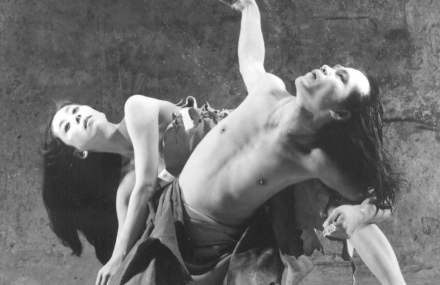
Butoh, Japan's inimitable form of modern dance was founded in the post war period by Tatsumi Hijikata and Kazuo Ohno. Hijikata felt dance in Japan following World War II was merely a copy of Western dance and wanted to create a form uniquely Japanese. A sense of rebellion permeated butoh performances, which emerged from a backdrop of student riots and protests. The movements were incredibly raw, as though animal instinct and sexual desire governed the dancers. This was intentional, as Hijikata and Ohno sought to tackle taboo ideas regarding human sexuality and challenge authority by showcasing the human body’s untamed movements. 

Two contemporary artists who tamed the untamed are the legendary husband and wife choreography/dance team Eiko and Koma. Though they met at Hijikata's studio in 1971 and studied with Ohno, they don't consider their dance butoh out of respect to the masters. Nonetheless the influence manifests itself in their style. In her fantastic recent New York Times profile of the "king and queen of slow", Gia Kourlas describes Eiko and Koma's movement:
While the moving-painting quality of their choreography is profoundly arresting, both theatrically and visually — they find the beauty in ugly — there is another layer that gets to the essence of nature. You connect to their world not by watching, but by imagining that you are living inside their bodies.
Japan Society, which debuted Eiko and Koma in 1976 and has presented them many times to great acclaim, hosts Eiko & Koma: Delicious Movement Workshop. The venerable duo hopes that anyone who takes their workshop—no matter what level of dance experience—find a renewed sense of focus and coordination, as well as take a primal pleasure in the simple act of moving one’s body.

The one-day workshop is held on December 4. Tickets are $40 or $32 for Japan Society members.

Wednesday, October 20, 2010

From Jurassic Park To Linkin Park: Enter The Shakuhachi

Breathing new life into the ancient shakuhachi. Via.
Ancient Japan: the glowing sun peeking from the top of Mt. Fuji, a farmer picking rice, a housewife preparing tea, a cricket resting on a leaf. All bask in the warmth rising above the mountain’s zenith.

Picture that scene. Is it possible you hear music?

Scenes of Japan that evoke tradition are often accompanied by ancient Japanese instruments, from the plucked and strummed twangs of the shamisen to a haunting flute sound with a sharp edge.

The latter is called the shakuhachi. The casual listener may recognize it from the music of romantic historical movies such as The Last Samurai, Memoirs of a Geisha or The Last Emperor. It was also used in the blockbusters Braveheart and Jurassic Park. The shakuhachi has also made appearances, both in electronic and natural forms, on many albums by contemporary recording artists such as Rush, Incubus, and Linkin Park. The sound famously served as the overture for Peter Gabriel’s hit "Sledgehammer" [full video here if you want to be whisked back to 1986] .

The shakuhachi came to Japan via Korea and has been traditionally played by the wandering monks of the Fuke sect of Zen Buddhism. During the Tokugawa era, the monks were one of few groups who the shogunate granted permission to travel without restrictions around Japan due to their religious duties involving playing the shakuhachi and begging for alms.

For those intrigued by this widespread yet relatively unknown instrument, Japan Society holds a shakuhachi master class and a separate workshop on the breathing technique employed by the Fuke monks during meditation called missoku (secret breathing).

Taking place Sunday, October 24, the master class and workshop are led by renowned instrumentalist Akikazu Nakamura, who studied shakuhachi and missoku for many years in Japan. JapanNewbie.com recently caught up with Nakamura on the East Coast and captured this astounding performance:


There's plenty of opportunity in NYC this weekend to ride shakuhachi sound waves. The night before his master class and workshop, Nakamura performs live music for MoMA's premiere of the lost Japanese silent cinema masterpiece Kurutta Ippeiji [A Page of Madness], the centerpiece of the eighth annual To Save and Project festival of film preservation.

T.D.

Thursday, October 7, 2010

Join The Sound Of Critics And Audiences Clapping

The look of one hand. Via.
The legendary Yoshi Oida returns to Japan Society for two performances only, October 8 and 9, in what The Village Voice calls  a "rare chance to see the celebrated actor—who has not appeared in New York in 12 years—perform what is widely considered to be his masterwork."

Nearly 30 years after the original production (read the 1981 New York Times review), Oida breathes new life into his venerable one-man comedy with live music, Interrogations: Words of a Zen Master. This week Time Out New York warned "get ready to clap with one hand," while Flavorpill described the piece in detail :
Yoshi Oida is an actor, writer, director, and longtime member of Peter Brook's Paris-based International Centre for Theatre Research. His 1978 one-man show, Interrogations: Words of the Zen Masters, incorporates the brilliant British director's practice of breaking down barriers between performer and audience. Acting as a Zen master, Oida poses direct questions to audience members in the form of koans, riddles without definite answers, which determine enlightenment. One koan leads to another, lasting days. While there can be a very fine line between religion and theatre, Oida's Interrogations is one evening created for the sole purpose of a genuinely shared experience.
Though using Zen Buddhism as a framing device, the work draws from timeless theater conventions from around the world. In an exclusive interview with American Theatre [PDF of the article], heralding his return to New York, Oida discussed the play's intricacies:
The texts come from China’s 11th and 12th centuries. Normally in the Zen monastery, the master gives a koan to the student, and the student tries to think about it and write down a good answer. "Two hands clap and there is a sound; what is the sound of one hand clapping?" "Does a dog have a Buddha nature or not?" There are no right answers, because the koan is not logical. You must understand not the question, but what is the meaning underneath the question. In the 1970s, Beckett and Ionesco were very fashionable. Their plays were not realistic—they were anti-theatre. I thought, yes, this koan is very good for this world of anti-theatre, because there is no logic in it. The Rinzai Zen masters had a lot of questions, which I chose for the performance. Instead of finding out the answer, I pose the questions to the public. I am like a master asking a koan, and the public answers.
Interrogations take place Friday and Saturday at 7:30 pm. Tickets are $28 general admission and $23 for Japan Society member. A limited number of $14 student rush tickets are available 1 hour prior to each performance with valid student ID.

Yoshi Oida is also a celebrated opera director. His staging of Benjamin Britten's Death in Venice opens at the Canadian Opera Company on October 16.

Friday, September 24, 2010

Critics Sound Off: Ryoji Ikeda Pushes Boundaries Of Sight And Sound

Ikeda's work is snow joke. Via.

"A thing of hypnotic beauty and a gateway onto eternity."

"Extreme high and low frequencies; split-second variations in intensity, direction and duration; barely perceptible sounds; assaultive bursts of digital noise."

Sound like any concert you’ve been to recently? As previously posted, Japan Society and French Institute Alliance Française (FIAF) hosted Japanese audiovisual artist, Ryoji Ikeda at FIAF’s Florence Guild Hall on September 10 and 11 for the New York-debut performance of datamatics [ver. 2.0].

Paris-based Ikeda combines raw binary numbers and extreme audio frequencies to create a sensational display as much modern art as musical performance. In addition to the quotes above, Steve Smith of The New York Times described Ikeda’s performance as "metaphysical, intricate and elegant", while Corinna da Fonseca-Wollheim of The Wall Street Journal wrote that datamatics "blurs the line between nothingness and infinity". New York 1 technology correspondent Adam Balkin dedicated a full segment to the deceptively intricate, sensorial production.

Ikeda’s performances kicked off FIAF’s Crossing the Line festival which ends September 27. His site-specific installation transcendental runs until October 16th. Catch it before it bids adieu!

T.D.