Showing posts with label taiko. Show all posts

Monday, August 4, 2014

Taiko Drumming: The Whole Body Pulse of Japan's Resounding 'Heartbeat'

Does Kodo have a workout video? Image via.

Learning an instrument is a physical challenge as much as a musical one, from proper finger placement on guitar, to shoulder and back strength for cello, to mastering a variety of breathing techniques needed to sound any wind instrument. After thousands of hours of rigorous practice, the sole motivator for taking on such an arduous task may be the rewarding feeling when a song finally plays to perfection.

But motivators can also be mental health, a means of meditation or a whole body workout. All three are possible with taiko, the word for Japanese drums and traditional Japanese drumming, often considered the resounding 'heartbeat' of Japanese culture.

The popularity of taiko can be seen in its many benefits. Some choose to play taiko because of their love of music or their interest in Japanese culture. The meditative aspect stems from the instruments' roots in religion, specifically Buddhism. In terms of full body workout, the physical stamina required increases depending on the size of the drums and weight of the drumsticks, as well as the degree of strength and control needed to create different sounds. This does not necessarily mean taiko players must be physically fit to learn to play (though they probably will be after a few years of playing regularly). Anyone can learn from small children to the elderly, and benefits abound for people with disabilities (taiko has been used as therapy for people with Downs Syndrome and autism, and deaf people can play by feeling the vibrations made by other players).

Originally, taiko was not the big production that it is today. According to Japanzine, a national magazine about Japan, the clay figure of a man beating a drum dated around the 6th or 7th centuries is the earliest evidence of taiko in Japan. Further evidence supports that it was originally used on the battlefield as a way to intimidate the enemy.

Over the centuries, taiko was incorporated into daily village life as a timekeeper, into imperial court music, into religious activities as the powerful sounds became associated with the gods, and  has become the centerpiece of many matsuri (Japanese festivals). It was not until post-war Jazz musician Daihachi Oguchi created the first ensemble format of taiko with multiple drums and rhythms that taiko developed into the arrangements seen today.

Kenny Endo Taiko Ensemble performs in 2012. 

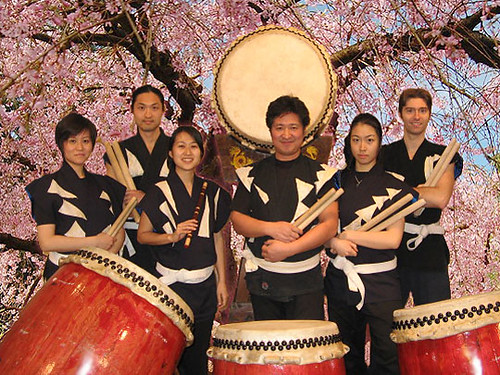
Taiko has spread across the globe with world renowned professional groups like Tao and Kodo, purveyors such as Kenny Endo and hundreds of esteemed amateur ensembles. Among several in New York are the New York Suwa Taiko Association, which has performed at several Japan Society events; the New York Taiko Aiko Kai, a resident group of the TC Taiko Society at Columbia University's Teachers College; and Brooklyn's only taiko group Taiko Masala, which will head up the taiko portion of Japan Society's 2014 summer high school workshop, From Taiko Drumming to J-Pop Music & Dance.

Everywhere people are inspired to play taiko with its unforgettable sound and enriching benefits. As much as an opportunity to learn an instrument, taiko is a way to experience and contribute to the heartbeat of Japan.

As the old kakegoe goes, SO-RE!

--Ana Belen Gomez Flor
The New York Suwa Taiko Association launched Japan Society's all day j-CATION festival in 2012. Photo by George Hirose.

Wednesday, June 5, 2013

Taiko Vs. Shamisen: Ancient Instruments Intertwine In Performance First

Kenny Endo (left) rehearses with Agatsuma before the big concert.

Tonight two masters of modernizing ancient Japanese instruments while retaining their classic vitality converge on stage for the first time ever.

Kenny Endo is a legendary contemporary percussion and rhythm artist. Over his forty year career, he has taken the genre of taiko (traditional Japanese drums) to new heights, blending classical elements with global rhythms and original melodies and improvisations. 

Endo warming up his skins. "Taiko" is Japanese for “fat drum” (although the drums vary in size) and usually played in a set called kumi daiko.

Hailing from Hawaii, where he has his own "Kenny Endo Day" as proclaimed by the Mayor of Honolulu, Endo originally trained as a jazz musician in California. He honed his taiko skills at the renowned San Francisco Taiko Dojo, then embarked on a decade-long odyssey through his ancestral Japan in the 80s, studying and performing with the masters of ancient techniques. He has recorded and performed around the world and has the honor of being the first non-Japanese national to have received a natori (stage name and masters degree) in hogaku hayashi (classical drumming).

Hiromitsu Agatsuma is a young and boundary busting virtuoso on the shamisen, a three-stringed banjo-like Japanese instrument performed with an aggressive style developed over centuries in northern Japan. He has been playing the instrument since he was a child, winning his first major competition at 14. After garnering much acclaim in the traditional Japanese music world, Agatsuma began infusing other instruments with beat-driven rock, attracting young and enthusiastic audiences.

Since his U.S. debut at Japan Society in 2003, Agatsuma has toured the world extensively. Like Endo, he explores traditional aspects of his instrument, while constantly experimenting with sound and incorporating diverse musical genres.

Performing together for the first time tonight at Japan Society, these two greats promise music magic, combining classical Japanese sounds with a 21st century feel.

If you cannot make it, check out this exclusive Spotify playlist or see more pictures from the historic rehearsal.

--Susan Berhane

Endo gets some shamisen tips from Agatsuma.

Tuesday, May 4, 2010

What a Busy Weekend!

Taiko Masala, courtesy of Brooklyn Botanical Garden
The Brooklyn Botanical Gardens hosted a a phenomenal weekend celebrating Sakura Matsuri and Japanese culture that showcased over 60 events and performances, including Taiko drumming, Okinawan pop, a Samurai drama, sushi-shaped cookies, anime stand-up comedy, and so much more!

Japan Society ran its own booth, which was maintained by some of our diligent staff members. Our payroll manager, Manuel Martinez was pleased to note that many of the adults that accompanied the younger crowd enjoyed stopping at our table, asking questions, and picking up our pamphlets. And Cynthia Sternau, our publications manager, had this to say:

"The lack of cherry blossoms and NYC's usual weekend transportation snafus didn't stop the crowds of garden lovers and Japanophiles from pouring into the BBG for the Sakura Matsuri this past weekend. Japan Society's table was located in the Osborne Garden, right off the Eastern Parkway entrance, under a nice pink tent but a bit too close to the J-Lounge's sound system (Taiko & Tap was really loud!). Our gorgeous Kuniyoshi palm cards featuring four woodblock prints from the current Gallery exhibition were much admired! In fact, compliments were paid to Japan Society's programs by many who stopped by the table, including mentions of a late night at j-CATION and Film's recent "Dangerous Women" series. In fact, it was a whole lot of fun and very good outreach to take Japan Society to Brooklyn for the weekend."


That same Sunday, children and adults celebrated Children's Day (Kodomo no hi) here at Japan Society. There were performances of Japan’s classic children’s stories Peach Boy (Momotaro) and Golden Boy (Kintaro) and also song and dance related to the festival by Theatre Arts Japan – KIDS, directed by Eriko Ogawa. The attendees of this popular event enjoyed traditional snacks and created their own samurai helmets (kabuto) and carp streamers, which are traditional Children’s Day decorations.

If you wandered through Times Square afterwards, you probably ran directly into demonstrators, who were led by Hiroshima Mayor Tadatoshi Akiba and Nagasaki Mayor Tomihisa Taue.

The mayors and visiting atomic-bomb survivors, as well as members of nongovernmental organizations from around the world, held a 2-km march to seek the elimination of nuclear weapons ahead of a major nonproliferation review, reported The Japan Times. Calls for a nuclear-free world were also made at other events in New York, many led by Japanese campaigners who were visiting the city to have their voices heard at the five-year U.N. Nuclear Nonproliferation Treaty Review Conference that started on Monday and will run through May 28.