Tuesday, October 19, 2010

Something Obake This Way Comes

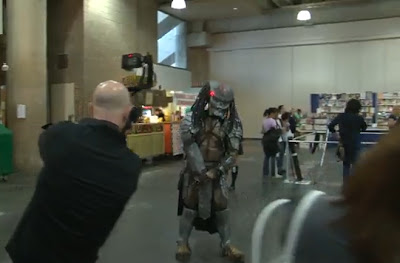
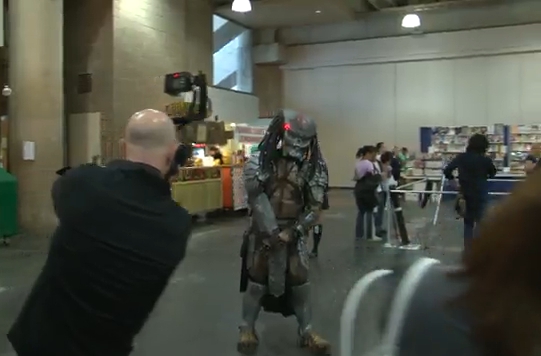
Can you spot the bakeneko? Via.

The wind softly howls outside your bedroom. You think it carries voices, but shake your head and mumble that it is only the sound of the wind ripping leaves from branches. You turn away from the window. An eerie light glows from behind your door accompanied by the soft sounds of padded feet. What it could be? The sound falls silent at the door, but something is there. Then you hear a soft, almost inaudible rapping–deafening to your ears. The rapping becomes insistent. You jump from the bed and slowly walk to the door. You grab the latch and fling it open. You look left and right. Nothing is there. You begin to think it was just your imagination, until you feel something brush up against your leg. An otherworldly cat look up at you and everything fades to black. You have just met a bakeneko.

AAAAHHHHHHHH!!! Via.

This is only one of the many Japanese ghost stories, and the purrfect way to bring in the Halloween season and Japan Society's first-ever costume party OBAKE! An evening of Ghost, Spirits and Fun.

Obake are Japan's wide range of spirits and night creatures. In a fantastic article on Japanese ghosts, Mangajin Magazine notes obake are understood as transformations unlike their more tangible Western cousins. They are preternatural phenomena that alter and shift, where one meaning becomes unhinged and twisted into something undermining life's certainties. These can be everyday objects imbued with nefarious or nebulous sentience. Obake also encompass strange and grotesque beings: yokai ghouls and goblins, at times amusing, frightening or bizarre; yurei vengeance spirits; and oni ogres that terrorize the world when they're not guarding the gates of Buddhist hells.

Japan has tons ghosts and otherworldly creatures (discover more at Cosmologies' Japanese Spirit Realm  or the Obakemono Project.) We hope you conjure your best (or worst!) to share in the fun, terror, excitement and all the planned tricks and treats at Japan Society on October 29.

In addition to food, drink, music, a costume competition and complementary night tours of the current supernatural exhibit (granted, more spiritual than spooky, but there's plenty of demons and monsters), there's also a screening of the cult classic Japanese horror film Hausu, which purports a man-eating piano in addition to a bakeneko that has to be seen to be believed.

S.H.

Friday, October 15, 2010

Five Films You Might Want To Watch With The Buddha Before Killing Him

To thine own self be... ouch! Via.
"If you meet the Buddha, kill the Buddha."
Linji Yixuan, Ch'an Master (? – 866)

Zen practices help people achieve serenity, better focus and greater understanding of the self. But as with everything in life, light must co-exist with darkness.

Enter Japan Society’s Zen & Its Opposite [watch the trailer], five classic films that show the relationship between Zen and violence, often overlooked when discussing Zen philosophy. Historically we can look to samurai meditating in order to center themselves before violent combat. Metaphysically, we can look at the constant battle between our spiritual selves and earthly desires.

A good example of the latter is the 1964 supernatural Japanese fantasy/horror film Kwaidan, which launches Zen & Its Opposite tonight. Each film illustrates one or several of the "Six Planes of Existence" in Buddhism's realm of birth and death. Kwaidan is four ghost stories elegantly strewn together, but at its core represents "The Realm of Humans", where beings are both good and evil--enlightenment within their grasp, yet blinded and consumed by their desires.Each of the short stories that comprise Kwaidan creates worlds where one must be on constant alert – something Zen Buddhism strives to improve upon – and nothing is as it seems.

Though the film was made by Japanese people, who might readily understand these Eastern concepts, the book on which the film was based was actually written by noted 19th century Japanologist Lafcadio Hearn, who was British-born and naturalized as a Japanese citizen in 1895, taking the name Yakumo Koizumi. So great was Hearn’s affinity for Japanese culture that his stories read like a born and bred native Japanese who has never stepped foot in the West.

After Kwaidan Zen & Its Opposite continues through February with screenings of Onibaba, Fires on the Plain, Hell  and Sword of Doom. Tickets are $12 or $9 Japan Society members, students and seniors.

For those who can’t get enough ghost stories before Halloween, Japan Society invites you to check out OBAKE! on October 29 for an evening of fun with ghosts, costumes and one of the most insane Japanese horror films of all time. More on that later!

T.D.

Thursday, October 14, 2010

Creative Rights And Writing With Lewis Hyde

Lewis Hyde (r) gets messy with fellow ox herder Max Gimblett. Via.
Lewis Hyde is a renowned author, teacher, MacArthur Fellow and cultural critic known for his thought provoking and careful but lively debates about artistic body and the creative process. Notes NPR in a recent profile:
Hyde, whom David Foster Wallace once called "one of our true superstars of nonfiction," is an infectiously enthusiastic writer. He's able to jump from topic to topic while never losing sight of his thesis, and the side roads he takes the reader down — from Emily Dickinson to Bob Dylan, from Benjamin Franklin (whom Hyde calls the "founding pirate") to John Cage — are fascinating.
His books include The Gift, the classic treatise on creativity in society, and Trickster Makes This World, about the playful and disruptive side of human imagination. His latest tome, Common as Air  rethinks copyright and intellectual property for the 21 century. Here is a typically Hyde-ian section from NPR's lengthy excerpt:
"Intellectual property" is the phrase now used to denote ownership of art and ideas, but what exactly does it mean? Does it make sense, to begin with, to say that "intellect" is the source of the "properties" in question? A novel like Ulysses, the know-how for making antiviral drugs, Martin Luther King, Jr's "Dream" speech, the poems of Rimbaud, Andy Warhol screen prints, Mississippi Delta blues, the source code for electronic voting machines: who could name the range of human powers and historical conditions that attends such creations? All that we make and do is shaped by the communities and traditions that contain us, not to mention by money, power, politics, and luck. And even should the artist or scientist think she has extracted herself from the world to stand alone in the studio, a tremendous array of faculties and mind- states may well attend her creativity. 
There is intellect, of course, but also imagination, intuition, sagacity, persistence, prudence, fantasy, lust, humor, sympathy, serendipity, will, prayer, grief, courage, visual acuity, ambition, guesswork, mother wit, memory, delight, vitality, venality, kindness, generosity, fortitude, fear, awe, compassion, surrender, sincerity, humility, and the ability to integrate diametrically opposed states of mind into harmonious wholes . . . We would need quite a few new categories to fully map this territory — "dream property," "courage property," "grief property" — and even if we had that list, only half the problem would have been addressed.
Hyde champions the idea that art does not grow through strict adhesion to doctrine but instead takes the framework from past generations and uses it to bring forth new life--an ancient dialogue to find the perspective needed to contemplate our modern world. For Japan Society's oxherding exhibit, he translated and reinterpreted the ancient Chinese Buddhist parable "The Ten Oxherding Pictures"  concurrently with the creation of Max Gimblett's powerful ink-brush paintings. Discussing the process, he writes:
When it comes to the translations, the plan is to have each oxherding text appear in three different English versions: a “one word ox” which sticks slavishly to the Chinese (one word per character), a “spare sense ox,” which puts each Chinese syntactic unit into a simple English sentence, and an “American ox” (or “fat American ox”) which takes considerable liberties while trying to be faithful to my intuitions about the meaning of the series.
In conjunction with oxherding , Hyde gives a creative writing workshop at Japan Society on Saturday October 16 called The Personality of a Poem . A former director of creative writing at Harvard, and currently a creative writing teacher at Kenyon College, he will help writers of all levels discover methods of finding the "personal personality" of any written work of art, steering away from conventional thought and fostering instinct to travel down the unbeaten path and enjoy the wisdom it offers.

One of several workshops Japan Society's Zen season (including painting, breathing, and meditation),  this event is a good example of the opportunity the Society regularly affords that fulfills Hyde's call to action in his essay "Created Commons":
Let us begin by recognizing how deeply all creative enterprise needs to be fed by its larger community. Let us work to build the institutions that will make all talent prone to the happy accident of its fruition. Let us create a future that will be proud to name us as its ancestors.
S.H.

Tuesday, October 12, 2010

One Of Kind Monster: X Japan's Heavy Metal Rocks NYC

X Japan's lead singer Toshi at Roseland Ballroom. Via.

In the immortal words of Metallica frontman and rhythm guitarist James Hetfield, "Adrenaline starts to flow/Thrashing all around/Acting like a maniac/ Whiplash!" It can only refer to one type of music: Heavy Metal. Born in the UK in the early 70s, metal became a global phenomenon in the 80s with various sub-genres and a penchant for booming vocals; loud, fast, distorted guitars; pounding bass lines; and blasting drum beats.

Japan was by no means left out of the heavy metal revolution in the 80s and still has a thriving community of metal fans ranging from high school students to salarymen who unashamedly love this brand of subversive music in a country where so many outsiders perceive conformity to be status quo.

Arguably Japan’s most popular and successful heavy metal band, X Japan  just finished their first-ever North American tour at New York’s Roseland Ballroom last weekend. Notes Consequence of Sound in their enthusiastic review:
There are times when a person can get an inkling of what they’re in for with a concert before the show even starts. X Japan’s gig at New York’s Roseland Ballroom, their last stop on their first North American tour, was one such example. As we approached the venue, we noticed something peculiar about the line to get in, which was already moving. It wrapped around the entire block. Twice.
What separates X-Japan from other metal bands? Some people regard Japan as a country that takes a lot of influence from the West and "Japan-ifies" it. But X Japan took the sounds of several metal genres and an image even more over the top than the glam metal bands coming out of the West Coast in the 80s and pioneered a uniquely Japanese form of rock and metal known as Visual Kei, Japanese for "visual style."

Visual Kei is best summed up by one of X-Japan's early slogans: "Psychedelic Violence Crime of Visual Shock." In Visual Kei, image is emphasized as much as the music. Similar to American glam, the look consists of heavy make-up, flamboyant hair and costumes, and the occasional dip into androgyny. One could take this unique musical image to be a reflection of the surroundings under which the band formed and grew. American bands such as Mötley Crüe, Ratt and Poison arose from the Sunset Strip in LA where image was everything, whereas X Japan  sprang from the Kanto region, home to such wild and cutting-edge shopping districts as Harajuku and Shibuya.

X Japan can be said to have raised the bar on imagery and theatrics with their unique style and sound, and nearly 30 years after inception, they completely rocked the locals in New York City. Our heads are collectively banging and our horns respectfully thrown. Rock on. \m/


T.D.

J-Pop Shop Talk: Beyond The Cult Of Cute

Join the Tokidoki family tonight! Via.
FIT 's exhibit Japan Fashion Now, on through January 8, is a visual study of Japanese pop fashion. It explores the utilitarianism, avant-garde underpinnings, subculture gestures and touches of kawaii (cuteness). According to FIT, Japan's contemporary fashion combines "the cute and the scary, the beautiful and the ugly, the animate and the inanimate, the strange and the strangely beautiful."

This is also true of Japan's distinct popular design, J-pop, which has long been making a splash on Western shores. In 2004, BusinessWeek asked "Is Japanese Style Taking  Over The World?" Japanese culturalist Roland Kelts told Entrepreneurship.com he noticed the invasion in the form of Pikachu upstaging Snoopy in the Macy's Thanksgiving Day parade.
"That was just the tip of the iceberg," says Kelts, a University of Tokyo professor and author of Japanamerica: How Japanese Pop Culture Has Invaded the U.S. "I mean, [look at] the fact that sushi is available in mainstream supermarkets around the country; the fact that Japanese style, design and architecture are appearing in major cities around the country; [and] the popularity of manga and anime in bookstores and Wal-Mart and Target."
Japan Society looks at the phenomenon at tonight's discussion The J-pop Influence: A Western Obsession from a complete insider's perspective. Two of the world's top pop designers, Tokodoki's Simone Legno and Nooka’s Matthew Waldman share their love of J-Pop and their thoughts on how it affects our Western designers and consumers today. Discover the nouveau cult of cute from the people in the know!

S.H.
Do you have the time... for tonight's lecture? Via.

Friday, October 8, 2010

Japan House: A Building That Builds Relationships

Japan Society: a vivisection.
New York City is a little global town. Each block, corner and street contains the swirling, multicultural fingerprints shaped by the people who live here.  We hear it, smell it, taste it, feel it and ever see the impact of the proverbial melting pot on our everyday lives. But one thing we might not notice--because of their permanence, their ubiquity, or their size--are the city's mammoth cultural beacons: the buildings.

On October 9 and 10, the eighth annual OHNY Weekend celebrates New York City's varied architecture and design, from the classic to the more exotic. For the fourth year in a row, Japan Society participates in OHNY with tours of its building (currently fully booked) and free admission to the Gallery show The Sound of One Hand.

Japan Society's building has been the center of the Society's mission to build understanding between the people of U.S. and Japan since it openend in 1971. Joe Earle, director of Japan Society Gallery notes that the building, designed by Junzo Yoshimura as the first example of contemporary Japanese architecture in New York, is a free adaptation of traditional Japanese architecture:
In Japan House (as Japan Society’s building was first called when it opened in 1971) we see a subtle blend of Japanese sensibility with contemporary materials and a modernist aesthetic. Although the building has undergone two campaigns of adaptation and extension over the years, its original atmosphere is especially well preserved in the lobby area with its low, modular, precast concrete ceiling, slate and timber surfaces, bamboo pond and stairs leading invitingly up to the gallery.
Though the Japan Society tours are full, we hope you have a chance to explore the building and the exhibition. In addition to the hundreds of buildings showcased throughout the city,  OHNY Weekend features a family festival to give children hands-on activities to discover and appreciate the beauty of New York City’s abundant architecture. Wherever the weekend takes you, and whatever your age, enjoy the places you pass by everyday in new and unexpected ways!

S.H.

Thursday, October 7, 2010

From No-Self To Knowing Yourself: The Psychology Of Zen Buddhism And Its Real-World Applications

The unexamined ox is not worth training. Art by Max Gimblett.
Celebrities do it, Oprah endorses it, and we’ve already mentioned it: making a Zen escape to calm the nerves and unwind after a stress-filled day. But how does Buddhist philosophy and its mediational practices actually relieve stress and enable us to get in better mental shape? And how can we incorporate it our overly examined lives?

One of the world's most regarded experts on the subject, psychiatrist and author Mark Epstein (Thoughts Without a Thinker, Going to Pieces Without Falling Apart, Psychotherapy Without the Self), addresses these questions and more in Mindful Living, an intimate evening talk with oxherding contributor and author Lewis Hyde .

In the discussion Epstein and Hyde examine the connection between Zen teachings and psychology with an emphasis on awareness of the self and compassion for those around us and the world we live in. Both Zen philosophy and psychology deal with an examination of the self (or no-self, as the case may be), recognizing that if we understand ourselves we'll be better able to control our senses and emotions rather than being controlled by them. Zen meditation is a centering practice, allowing practitioners to achieve an increased sense of alertness and presence in their lives. Epstein shows how people can be more present, more tolerant, more generous, and more loving in daily life by incorporating meditation techniques into their routines. 

With the oxherding connection, the discussion also touches on how art and poetry can best express one’s feelings by providing an outlet for the senses. Hyde demonstrates how reading poetry, especially in multiple translations, enables readers to obtain new perspectives on the world and take solace in the mutability of language. He also shows how inspiration and compassion pour from paintings by classic artists such as 18th century Zen master Hakuin and contemporary artists such as Max Gimblett, Hyde's oxherding co-creator.

In addition to this one-time discussion, Japan Society offers a series of related workshops, from freeing the written word with Lewis Hyde and freeing the image from a sumi ink-soaked brush with Max Gimblett in October, to Zen for Everyone mediation workshops with Roshi Pat Enkyo O’Hara in November. Regardless of how you get to Japan Society, there's many paths to enlightenment once you arrive!

T.D.

Join The Sound Of Critics And Audiences Clapping

The look of one hand. Via.
The legendary Yoshi Oida returns to Japan Society for two performances only, October 8 and 9, in what The Village Voice calls  a "rare chance to see the celebrated actor—who has not appeared in New York in 12 years—perform what is widely considered to be his masterwork."

Nearly 30 years after the original production (read the 1981 New York Times review), Oida breathes new life into his venerable one-man comedy with live music, Interrogations: Words of a Zen Master. This week Time Out New York warned "get ready to clap with one hand," while Flavorpill described the piece in detail :
Yoshi Oida is an actor, writer, director, and longtime member of Peter Brook's Paris-based International Centre for Theatre Research. His 1978 one-man show, Interrogations: Words of the Zen Masters, incorporates the brilliant British director's practice of breaking down barriers between performer and audience. Acting as a Zen master, Oida poses direct questions to audience members in the form of koans, riddles without definite answers, which determine enlightenment. One koan leads to another, lasting days. While there can be a very fine line between religion and theatre, Oida's Interrogations is one evening created for the sole purpose of a genuinely shared experience.
Though using Zen Buddhism as a framing device, the work draws from timeless theater conventions from around the world. In an exclusive interview with American Theatre [PDF of the article], heralding his return to New York, Oida discussed the play's intricacies:
The texts come from China’s 11th and 12th centuries. Normally in the Zen monastery, the master gives a koan to the student, and the student tries to think about it and write down a good answer. "Two hands clap and there is a sound; what is the sound of one hand clapping?" "Does a dog have a Buddha nature or not?" There are no right answers, because the koan is not logical. You must understand not the question, but what is the meaning underneath the question. In the 1970s, Beckett and Ionesco were very fashionable. Their plays were not realistic—they were anti-theatre. I thought, yes, this koan is very good for this world of anti-theatre, because there is no logic in it. The Rinzai Zen masters had a lot of questions, which I chose for the performance. Instead of finding out the answer, I pose the questions to the public. I am like a master asking a koan, and the public answers.
Interrogations take place Friday and Saturday at 7:30 pm. Tickets are $28 general admission and $23 for Japan Society member. A limited number of $14 student rush tickets are available 1 hour prior to each performance with valid student ID.

Yoshi Oida is also a celebrated opera director. His staging of Benjamin Britten's Death in Venice opens at the Canadian Opera Company on October 16.

Wednesday, October 6, 2010

By These Powers Combined: New York City's Largest Pop Culture Convention To Date

Despite great peril, we survived the 2009 conventions. Image via.
The New York Comic Con and NY Anime Festival join forces, storming the Javits Center October 8-10 in what will undoubtedly be the greatest otaku show on Earth!

The hybrid monster convention features three days of East and West pop culture luminaries, virtuosos of ink and pen in the flesh, the unabashed selling and trading of precious goods, cult actors and VIPS dangled precariously before their devotees, and music, music and more music (and even some discussions about music).

For the third straight year, Japan Society joins hundreds of events and participants to give revelers a broader sample of the joys of Japanese culture (check out our vid from 2009).

Stop by the booth Friday to take part in an insane scavenger hunt with prizes from Kidrobot. We host a cosplay costume competition on Saturday (recruiting for our first-ever Halloween party in late October)—best costumes receive prizes from Kinokuniya Book Store. All weekend we'll be handing out free passes for our current exhibit of pop-y Zen Buddhist art from the 18th century, and there will be give-aways of our past exhibition catalogues, classic film screenings (currently focusing on the interplay of Buddhism and violence), and lectures ranging from Japan's influence on Western design  to Japan's inimitable vegetarian cuisine. We'll also be running around snagging choice interviews for our new Nihon New York video series (watch episodes 1 and 2) .

If you're at New York Comic Con or the NY Anime Fest this weekend, stop by the booth and say konnichiwa!

Konnichiwa Comic Con! Via.
S.H., S.J.

Friday, October 1, 2010

Hear The Silence So Loud

Details of Hiroki Otsuka's reverent and iconoclastic Daruma 28.

New York City: high-paced, intense--a metropolis where walking a step too slow or too fast can set off a deafening barrage of profanity and car horns. Amongst the craziness there always exists the need for escape, tranquility, and dare I say, Zen. For a weary New Yorker, Japan Society is that escape with its relaxingly quiet atmosphere, calming waterfall garden, and host of intellectually stimulating programs.

The escape is multiplied by three with the Society's new exhibition The Sound of One Hand, featuring America's first ever exhibition encompassing the paintings of eighteenth century Zen Buddhist master, Hakuin Ekaku. Though his work comes from a time where reverence and adherence to ancient traditions were the norm, it has a truly modern, populist feel to it.

Riffing on the contemporary vibe of Hakuin's art, the Society also presents two fresh, contemporary remixes on reverent Buddhist subject matter. Downtown artist Max Gimblett and author Lewis Hyde’s  oxherding is a bold spin of 'proper' form--10 years of collaboration deconstructing and reconstructing precious texts and holy images. As Gimblett himself puts it, he would have been considered a pop artist had he arrived in New York 10 years earlier in the 60s. His fusion of pop art sensibilities and Japanese calligraphy along with his intensity as an artist proves that the art of Zen, with its emphasis on tranquility and simplicity, doesn’t have to be boring.

There's another shock to the religious system before entering the Hakuin exhibit proper. Hiroki Otsuka’s Daruma 28 depicts the master and founder of Zen Buddhism, Daruma, in 4 acrylic paintings that portray him in private moments of spiritual struggle as a strikingly manga-esque, Gen-Y monk.

The Sound of One Hand opens today. Admission is $12, $10 for students and seniors, and free for Japan Society members and anyone under 16. oxherding and Daruma 28 are free to all Japan Society visitors during the course of the exhibition.

T.D.