Tuesday, June 19, 2012

Sake Bouquet: Fragrance And Flavor Bloom From Two Basic Ingredients

Origins of Japan's "national brew". Via.

Think about your favorite perfume or cologne. It isn’t just one note is it? Many different fragrances mix and blend into the the beautiful scent that is uniquely you. The same is true about sake. When sitting down for a drink of Japan’s "national brew", we don’t tend to think about what went in to creating what’s in wafting from our glass.

Everything from the aromas and flavor, to the alcohol content and the temperature at which the sake should be served--reishu (chilled) is usually of higher quality ingredients, but kanzake (warmed) can be enjoyed no matter the quality--rests on two basic ingredients: rice and water.

The world’s leading sake expert, John Gaunter, known as the sake dendoushi or “sake evangelist” in Japan, leads Japan Society’s sold out annual sake tasting tonight, dissecting these two ingredients and explaining their roles in sake making. They may seem overly simple, but as Gaunter explains, there is much more than what meets the eye (and nose and taste buds).

Rice is the most important ingredient in sake. There are nine basic types associated with different flavor profiles, running the gamut from the “king of sake rice” Yamada Nishiki to the smooth and dry Gohyakumangoku. Profiles range from earthy and distinctly rice-y to rich, complex and more acidic.

The rice milling process also has a major effect, as Gauntner explains:
After proper sake rice (in the case of premium sake, anyway) has been secured, it is milled, or polished, to prepare it for brewing good sake. This is not as simple as it might sound, since it must be done gently so as to not generate too much heat (which adversely affects water absorption) or not crack the rice kernels (which is not good for the fermentation process)... The amount of milling greatly influences the taste. For more on this topic, please visit Types of Sake page.
Water is sake’s second most important ingredient. Most breweries are located next to a plentiful source of pure and natural water. The quality of the water, as well as how its minerals and compounds affect yeast growth and fermentation, will affect the flavor of the final product sake. The final product is about 4/5 water, but in the process of making the sake, “oceanic amounts” are employed. Water has to be used in washing and soaking the rice, then in steaming and fermenting it, then in the final dilution, which takes the naturally occurring alcohol from 20% down to a more palatable 16%.

Though Japan Society’s tasting is sold out, Gauntner told Examiner.com in a recent interview two great places in New York City to enjoy sake: the East Village’s Sakaya and the speak easy-esque Sakagura located a few blocks from Japan Society in the basement of an office building, noting “there really are so many more”.

Gauntner also indicated in the interview that his mission is more than educating New Yorkers and Americans in the art of sake. He also wants to elevate tastes in his home base, Japan:
People here have been so close to it for so long that they have little awareness of how special it is. The craftsmanship, history, cultural significance are all something people here have taken for granted for too long. And, few regular consumers are aware of just how damn good it tastes, as evidenced by reactions of those that try premium sake for the first time.
Thanks to Gauntner, next time someone asks for their sake of choice, the world will know more about what they’re yelling Kampai to!

--Sarah Anderson

Monday, June 18, 2012

Restructuring Japan’s Infrastructure: A Sustainable Way Forward

Via.


Last week we looked at challenges facing the Japanese economy in a global setting, especially the demographic dilemma unique to Japan. While there are many possible solutions to these challenges, some agree that infrastructure is a vital priority.

Traditionally, Japan’s infrastructure investments have been geared towards new construction projects rather than improvements in existing structures. As in the U.S., such projects have been derided as political allocations to representative districts (i.e. “pork”) rather than as necessary expenditures. But infrastructure reinvestment can provide much-needed repair work for Japan’s roads, bridges, tunnels and buildings. Of course, this investment will come at a cost. Japan’s public debt is now close to double its GDP as social welfare spending and tax revenues are moving in inversely-related directions. A recent increase in the consumption tax will help fund pension liabilities, but one wonders how much of the other tax revenue streams will be available for infrastructure expenditures in the face of pre-existing government debt.

In light of the almost-complete abandonment of nuclear power following last year’s Fukushima incident, another major component of Japan’s infrastructure is energy investment. Recent incentives to promote solar power could eventually make Japan the world’s largest solar-power market (over Italy and Germany). It seems that the time is ripe for Japan to lead the way in “cleaner” energy investments.

In tonight’s Japan Society’s Corporate Program event A Roadmap for Japan’s Steady, Sustainable Pathway Forward, Professor Daniel Okimoto delivers the speech "Infrastructure Investments: Japan's Historic Opportunity” looking at how energy, transportation, IT, healthcare, and tourism can help move Japan forward.

Okimoto, a specialist on the political economy of Japan, is Professor Emeritus in the Department of Political Science at Stanford University and Director Emeritus and co-founder of the Walter H. Shorenstein Asia/Pacific Research Center (APARC) at Stanford University. In 2004, he received the Japanese Foreign Minister’s Commendation in recognition of his contributions to US-Japan relations during the 150th year celebration of bilateral relations, and in 2007, he was awarded the “Order of the Rising Sun with Goldray Neck Ribbon” by the Japanese government, one of the highest honors that can be bestowed on a non-Japanese citizen.

--Lyle Sylvander

Tuesday, June 12, 2012

Is Japan’s Demographic Dilemma The #1 Challenge For Economic Recovery?

Via.

Although not in the spotlight as much as the U.S. economic recession or the European currency crisis, Japan’s economy is experiencing its own set of challenges. The recent shutdown of all nuclear reactors, a public safety measure enacted in response to the Fukushima nuclear incident, has led to an increase in fossil fuel imports. This, coupled with an appreciating yen, has led to a trade deficit further pressuring an economy experiencing deflation and a growing fiscal deficit. Recently, the Bank of Japan (BOJ) enacted a new round of “monetary easing” to the tune of ¥15 trillion in the hopes of attaining an inflation rate of 1% and boosting moribund domestic spending. Despite these aggressive steps, many wonder if the BOJ is doing enough to kick start the economy and foreign investors remain largely unconvinced.

Professor Koichi Hamada addresses these concerns in his talk Monetary Policy & Japan’s Economic Recovery, Wednesday, June 13 at Japan Society. Professor Hamada is the Tuntex Professor of Economics at Yale University and Professor Emeritus at the University of Tokyo. According to a recent Wall Street Journal article, he is the former teacher of BOJ Governor Masaaki Shirakawa and a proponent of monetary easing. The talk will be moderated by Paul Sheard, Standard and Poor’s chief global economist.

While Hamada will focus primarily on monetary policy, another major area for Japan to tackle is its demographic dilemma. The median age of the country is around 45 and continually rising due to declining birth rates and a restrictive immigration policy. Spending on social security benefits accounts for a large chunk of the government debt, the value of which increases as the yen depreciates. As Paul Krugman pointed out in his classic 1998 article “Japan: What Went Wrong?,” BOJ monetary policy is relatively ineffectual in the face of aging population—a problem unique to Japan and not apparent in the U.S. or European crises. Perhaps it should be a primary focus for recovery. As Shirakawa stated in May, "The current difficulties come not from the continued population aging itself, but from the delayed response to it."

--Lyle Sylvander

Updated 6/12/12.

Monday, May 21, 2012

Japan House: An American Made, Distinctly Japanese Landmark

"Japan House" - Final 1969 design sketch by Junzo Yoshimura.

Japan Society's building was selected as one of 40 New York City landmarks competing for restoration grants from American Express and the National Trust for Historic Preservation. With voting ending today, we offer a virtual tour of the building.

In 1969, when then Japan Society President John D. Rockefeller 3rd and Japanese Foreign Minister Kiichi Aichi broke ground for the construction of Japan Society's building, did they have any concept of what an enduring and important addition it was to New York City's cultural landscape?

Since the building--then called "Japan House"--opened to the public on September 13, 1971, it has been a hub connecting the people and issues between the U.S., Japan and the world, as well as a singular architectural gem embodying the Society's founding ideals.

Recently named New York City’s youngest landmark, the building was designed by Junzo Yoshimura and George Shimamoto as the first permanent Japanese modernist building in New York.

According to the book Japan Society: Celebrating a Century, 1907-2007, “the chief appeal of the building lay in its distinctively Japanese feeling, but this effect, remarkably, had been accomplished almost entirely with American materials.” In a recent visit, Urban Gardens echoed this fact, calling the building:
a flat black modern reinforced concrete "bento box" filled with a delicious blend of creativity, culture and education–all existing above and below a serene interior Japanese style garden space… Yoshimura’s design has been described as a modern rendition of an 18th century elegant Kyoto inn. Known for infusing traditional Japanese elements into his modern works, the architect blended a Japanese sensibility with contemporary local materials.
Photo: Robin Plaskoff Horton, Urban Gardens. Via.

Standing five stories tall, the building’s slate gray exterior and metal railings evoke modern Japan’s streamlined architectural prowess. The long metal rails running vertically up the building’s façade are reminiscent of amado, storm windows that are used for protection during typhoons.

The slanted fence at the base of the building is a modernist play on komayose (aka komadome or inufusegi)—an Edo period urban housing design element to keep horses and dogs away from the home and to enhance the privacy of the living room area, typically at the front of the house. The bottom of Japan Society's komayose extends one meter from the building—the traditional distance that a komayose stood away from a home. By the 18th century, komayose were widely used and were most often associated with posh machiya, structures which combined an artisan’s or merchant’s residence with their shop, encompassing manufacturing, office and retail space in one location.

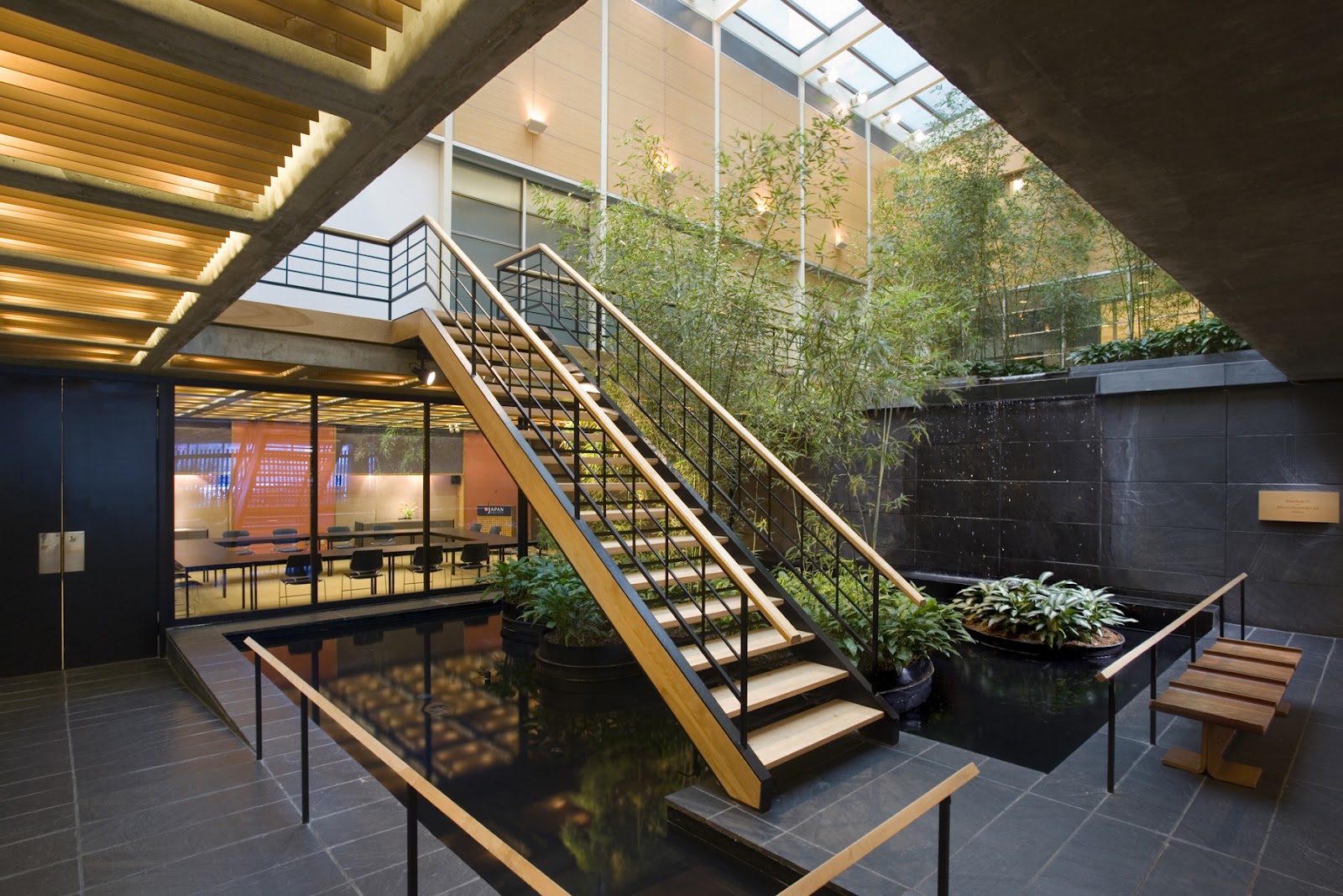
Indoor bamboo garden and waterfall. Photo by Peter Aaron/Esto.

Upon entering Japan Society’s building the cool, gunmetal slate tiles from the exterior carry through the interior, and cover the lobby walls to the cement ceiling. The wooden slats in the ceiling were initially made from hinoki, or Japanese cypress, so when lights heated up the slats, the cypress aroma would fill the building. The cypress has since been coated with flame retardant, which also masks the scent of the wood.

The slate and cement in the lobby is the perfect sound conductor for the indoor waterfall, allowing a gentle white noise rush to echo throughout the building. The waterfall paired with our indoor bamboo garden is such a unique element that it is frequently featured on television and in films most recently for episodes of Gossip Girl and White Collar.

The waterfall was not an original design element in Yoshimura’s drawings. From 1971 until a major renovation that lasted from 1995 to 1997, the area where the waterfall is now was an outdoor sculpture garden.

Architectural rendering of renovations in the 90s.

The renovation also added some other functional spaces to Japan Society—a fifth floor for additional office space, and the second floor of the building was converted into more usable Gallery space. In the original building configuration, only the South Gallery was intended for Gallery use. The North Gallery (the part of the Gallery directly in front of you when you climb the stairs) was originally used as meeting spaces that were available for public rentals. Those rooms were situated with views down onto the pond in the lobby. When Japan House first opened to the public, the lack of contrast between the slate and the stillness of the water confused some patrons, causing them to stumble into the pond because they thought it was a solid surface. There is now a low railing to protect people.

Other, more subtle touches of Japanese décor and design can be seen throughout the building, from the the large river rocks by the entryway to the shoji window and wall treatments in the lobby and on the second floor.

One wonderfully restful feature in the lobby is an original conoid bench by famed woodworker George Nakashima. The arresting work of art is available for anyone wishing to sit and absorb the beauty of Japanese art, architecture and design.

--Cory Campbell

Tuesday, May 1, 2012

Deco Dance: Take A Jazz-Age Spin With Japan's 'Modern Girl'

Deco Japan's moga want to trip the light fantastic with you.
 
Pleasure seekers, late night revelry, and a glut of cosmopolitan glamour characterize Japan Society’s current exhibition, Deco Japan: Shaping Art and Culture, 1920-1945, so what better way to celebrate licentiousness than to set up our very own speakeasy on a Saturday night?

On May 5th, from 7:00 pm to midnight, the Society teams up with New York City’s premier promoter of anachronistic parties, Dances of Vice, along with The Art Deco Society of New York to bring you Dances of Vice: Deco Japan and the Heart of the Modern Girl.

The evening opens with an intimate exhibition tour by Japan Society Gallery director Joe Earle, who drops intoxicating tidbits you won’t hear elsewhere about the era’s fashionable flirtation with all things foreign and the concurrent rise of militarism and its bold aesthetic expressions.

From 8:00-9:00 prohibition is lifted with an open sake bar for those inclined to the devil’s drink. Art Deco Society of New York president Kathryn Hausman welcomes guests and the evening kicks off with a Charleston dance lesson, followed by live jazz courtesy of the Kuni Mikami Jazz Quintet featuring vocalist Mari Koga.

Guests roaming the gallery during the event are sure to stumble upon the star of the show, the moga, or modern girl, with her bobbed hair, bright lips and cocktail always close by. Featured in paintings, photographs, prints, sheet music covers, and figurines, the moga was the hip coquette of the era, and she springs to life in a fashion show curated by Mutsumi Gee of Allure Original Styles as the hours wear on.

Tickets are $15 in advance and $20 at the door. Dress to impress in your pre-War finest! The evening is part of Japan Society's Open House Weekend, May 5 & 6, celebrating the Society's inclusion in Partners in Preservation's online restoration grant competition between 40 NYC landmarks. Vote daily through May 21.

--Kristen Sollee 

IMAGES (top to bottom): Saitō Kazō (1887–1955); Publisher: Bikutā Shuppansha; Kindai otome gokoro (Heart of the Modern Girl) [Detail], from series Bikutā hāmonika gakufu (Victor Sheet Music for Harmonica); songbook cover; color lithograph, inks on paper, 1930; 26.5 x 19 cm (10 ¼ x 7 7/16 in.); photograph courtesy of The Levenson Collection. Kobayakawa Kiyoshi (1899–1948); Dansā or Setsuna no kyokusen (Dancer or Curve of the Instant); woodblock print; ink and colors on paper, 1932; 41.9 x 25.4 cm (16½ x 10 in.); photograph courtesy of The Levenson Collection. Deco Japan: Shaping Art and Culture, 1920-1945 is drawn from The Levenson Collection and is organized and circulated by Art Services International, Alexandria, Virginia.

Monday, April 30, 2012

Japan Trip Tips: Prepare To Go To Tokyo

Flying laser kitty visits Japan. Via.

When Japan Society announced it would give away a trip to Tokyo as part of the spring membership drive, the rush of entries was incredible. After processing over 4,000 applications, a winner was chosen today at random [right column], and the lucky Nina Hazen will receive round-trip tickets for two courtesy of United Airlines and three nights in a deluxe suite at The Capitol Hotel Tokyu.

For the first-time traveler—a person who may never have dreamed of going to Japan—how does one prepare to go to Tokyo?

Help abounds online. Tokyo’s official tourism site has some amazing resources on visiting the city, and the national tourism site covers the country as a whole equally well.

For hip goings on each week, Time Out Tokyo lists everything from the local music scene to the latest restaurants and gallery openings. CNNGo’s comprehensive Tokyo Insiders Guide explores the best eats (Japan leads the world with the most Michelin 3-star restaurants) and attractions, including the top five museums. The site also humorously (and mostly helpfully) lists the “50 reasons Tokyo is the world's greatest city”. Lonely Planet highlights which seasons are the best times to visit, and Fodors has some helpful cost saving tips.

Sometimes important-yet-culturally-subtle travel tips are missing from mainstream guides, so we asked Japan Society staff members what their top tips are for first-time Tokyo goers:

✈ You’ll find ATMs everywhere, but they may not accept foreign bank cards. Be sure you take some Yen with you, so you do not have trouble getting cash right away. If you're in a pinch, look for ATMs with the U.S. postal logo. They accept American bank cards and there is usually no fee beyond the regular bank transaction fee. Also, don’t spend all your money on vending machine and conbini (convenience store) drinks. You will find yourself out of cash sooner than you think.

Bring lots of new and clean socks! It is customary in Japan to remove shoes when entering a room, but there are not always slippers available.

Even though you may not be visiting for business purposes, bring a bunch of business cards. Everyone you meet will want to exchange cards, even if they know they will never see you again.

Don’t forget a hand towel and pocket packs of facial tissues. Japan is a famously clean country, but most public restrooms don’t have paper towels or toilet paper. Everyone in Japan knows to bring supplies when out and about, but this tip doesn’t often make it into the guide books. In shopping areas, you will probably find people handing out promotional tissues with advertisements on them. Take them!

There is no need to bring pajamas because whether you are staying at a traditional inn (ryokan) or a commercial hotel, the room will come with yukata (thin, comfortable kimono-style robe) for men and women to wear when getting ready for bed.

Likewise, you don’t have to bring your toothbrush or toothpaste. Hotels, no matter if ritzy or more economic, always provide these for free.

When shopping, try to make it to the depāto (department store) basement, which is filled with luxurious food vendors. Be sure to try  fresh fruit in Japan. It is über expensive, but super delicious. And pick up some Japanese Kit Kats. There are over 200 different exotic flavors to try from  cantaloupe to ginger ale to wasabi.

While Tokyo is typically the prime destination in Japan, visit other cities to get a better sense of the country. Consider a daytrip to Kyoto, which is steeped in Japanese history; Osaka, a mecca for street food; or Hakone, known for their onsen (hot springs).

Other daytrips can include a spectacularly beautiful mountain hike at Takao-san (an hour away from Shinjuku station on the Keio line) with endless mountain staircases for hardcore hikers and easier paved paths for casual walkers; the Indian cuisine in the Waseda/Takadanobaba area is a must—try the restaurant Daruma for its to-die-for nan and happy atmosphere; or take a trip on the Arakawa line—the last remaining street car in Tokyo.

Finally, Japan Society President, Motoatsu Sakurai says:
Take an enthusiasm to experience an incredibly vibrant and engaging culture. In addition to the sights of Japan, be open to meeting the people and sharing stories. This is especially true after the tsunami and earthquake that devastated the northeast coast last year. People are very thankful for the thoughts and generous support from America and people around the world and want to share their thanks. For this very reason, visiting Japan is one of the best ways to help it recover.
Ambassador Sakurai also notes, “Just as important as what people take to Japan is what people bring back. In addition to an experience unlike any other, I also recommend bringing back Pocky. Anyone who knows me knows it has been a good meeting when I share Pocky from my most recent trip to Japan.”

--JS Staff

UPDATED 5/1/2012.

Friday, April 27, 2012

Seeding Japanese Culture One Commission At A Time

Shadows of commissions past: (l-r) Other Here, Partch, Dogugaeshi.

Japan Society stirs New York City's proverbial melting pot not only through regular whisks of Japanese culture, but also by piecing together completely new stews through commissioning American, Japanese and artists around the world to create new works.

Since the inception of the Performing Arts Program in 1953, the Society has presented nearly 650 performing arts events (approximately 2000 individual performances). Some twenty of these have been wholly original works created in recent years. Japan Society Artistic Director Yoko Shioya, who heads up the Performing Arts Program, explains:
Over the past decade, Japan Society has continued its efforts to commission non-Japanese artists to create works which are somehow related to Japan – whether they are based on Japanese literature; incorporate the stylized forms of Japanese performing arts; draw inspiration from Japan’s unique culture; include a collaboration with artists from Japan; or utilize Japanese traditional art forms or techniques.
Playing a more dynamic role than typical of the commissioning process, the Society goes beyond pledging kick-start money. It provides consultation for the artists in order to aid the art-making process by coordinating with residency partners and collaborators, helping clear Japanese copyrights, and providing means of practicing traditional performance techniques, for example. Through the active “seeding” of Japan-related creativity in the U.S., the hope is that the artist’s vision is allowed to grow beyond what was initially conceived. These performances go on to successfully tour throughout the U.S. and sometimes internationally with a lot of care taken to pair the shows with suitable presenters.

Since its inception, the Performing Arts Program commissioned a number of smaller scale works. After receiving an Endowment from the Doris Duke Charitable Foundation in the early 00s, commissions increased in scale and regularity.

Highlights include Basil Twist’s screen door puppetry spectacle Dogugaeshi, which received the prestigious Bessie Award and New York Innovative Award, and has been remounted several times since its 2004 premiere, including in Japan and most recently at D.C.'s National Cherry Blossom Festival centennial anniversary; Harry Partch’s Delusion of the Fury, the second-only full production since its 1969 premiere, featuring Partch’s mammoth musical instrument inventions (you can play electronic versions here); and Big Dance Theater’s fantastical The Other Here, which launched Japan Society’s centennial celebration in 2007.

A Global “(glowing)” Dance Of Darkness


Opening today, Japan Society’s latest commission (glowing) is by renowned New York-based choreographer Kota Yamazaki and his company Fluid hug-hug. Breaking tradition, the commission is for a Japanese artist, yet the scope of the work is truly global, blending Japanese, African and Western aesthetics, as beautifully illustrated by the piece's trailer:


Inspired by novelist Junichiro Tanizaki’s In’ei Raisan (In Praise of Shadows), Yamazaki uses the slow and deliberate Japanese form of contemporary dance known as butoh to express the novel’s idea of the subtle beauty found in the recesses of darkness and shadows. Taking butoh to another level, elements of African dance are introduced by dancers Marie Agnes Gomis of Senegal and Shiferaw Tariku of Ethiopia who are joined by Japanese and American dancers to round out the cast of six. Architect Robert Kocik, trained in traditional Japanese carpentry, is responsible for the scenery while lighting designer Kathy Kaufmann replicates the descriptions of a dimly lit Japanese house interior described in In Praise of Shadows. Koji Setoh composed the original score and sounds for the show.

As Yamazaki’s triumphant return to butoh—Japan’s dance of darkness—something he trained for many years in but distanced himself for a while, he seeks new discoveries through its comparison to African dance and exploration within profound Japanese architectural aesthetics. As the name of his company suggests, Yamazaki seeks a fluidity like water in the movement as well as between people of different cultures in order to smoothly and creatively exchange ideas.

Having premiered at the Curtis R. Priem Experimental Media and Performing Arts Center (EMPAC), a co-commissioner for the piece, and with stops in Philadelphia and Pittsburgh, (glowing) was called a “spare, contemplative and strangely beautiful work” by the Albany Times Union. The tour concludes at Japan Society on Friday, April 27, and Saturday, April 28, at 7:30 pm. Observation seats are still available for the Saturday movement workshop from 1:00-4:00 pm.

--Sean Tomizawa 


UPDATED 5/1/12

Friday, April 13, 2012

J-Camera: The Making Of Mini-Masterpiece


Gearing up for vacation these days means packing your digital SLR, sleek-and-pink point-and-shoot, HD video camera, smart phone, all of the cords and chargers and computers that make them functional, and perhaps, for safety, a travel diary and/or sketch pad. Before you’re out the door with money/tickets/passport in hand, you’ve probably snapped half-a-dozen artfully Instagram-ed shots, capturing minutes of minutia before the real adventure begins.

Preparing for j-CATION 2012: Sakura, Ben Warren, video producer for Japan Society, took many more than a half a dozen pictures. He took about 3,600.

Ben wanted to do something extra special to raise awareness for the Society’s cherry blossom themed all-day culture festival, and what better way to capture the fleeting, fluttering flurry of falling sakura, than the painstaking picture-perfect craft of stop motion animation?

The resulting two-and-a-half minute short film is a fantastical living travel diary, drawing inspiration from Japanese culture from past to current pop trends.


Weeks ago Ben (who is also the mastermind behind the very first j-CATION’s flying laser kitty promo video--in which he has a cameo), and a team of amateur animators, including several enthusiastic Japan Society interns and one friend, began the estimated 70-hour project. The idea bloomed from the sakura theme into five distinct segments using a variety of mixed media: paper, fabric, paint, toys, food and their containers, buttons and art objects galore.

The animation opens with a string of lit lanterns parting to reveal a “j-CATON 2012” travel diary. The book unfolds, an acorn drops, and sesame seads burst from green yarn grass to form a sakura tree. A close up of a branch shows blossoming pink construction paper petals torn into the wind, making surprise appearances throughout the video.

In a short, delicate interlude, a cup of green tea dances and swirls atop antiqued calligraphy scrolls. The middle mouthwatering section centers around a brimming bento box (crafted from wrappers of the candy and food that kept the animators going). After marching to their designated compartments, the feast wraps itself in a furoshiki from Japan Society’s 2007 centennial celebration, and is whisked away by a pair of chopsticks.

Next, a wistful, watercolor ‘floating world’ style painting brushes and bubbles to life with familiar classic Japanese art iconography—a sea escape scene at the base of Mt. Fuji capturing the timeless battle between fisherman and giant carp (to create the water effect, the dozens and dozens of waves were individually finger painted in each frame--24 frames per second for 12 seconds).

Finally, after an origami explosion of stars, a flight of chirpy birds over fluffy cotton ball clouds, and stately strut of cranes, day dips into night while a family sits beneath a sakura tree to revel in a traditional night time cherry blossom viewing party.

A simple story, exquisitely executed, masterfully mirroring the j-CATION experience.

QUIZ: Ben and crew referenced dozens of ancient and contemporary Japanese elements. Can you name them all? Answers after the laser kitty photo.

--Shannon Jowett


In order of appearance: washi, maneki-neko, origami, sakura, hanami, shodo, ocha, miruku, sushi, Yakult, UCC Coffee, Fibe Mini, wagashi, ukiyo-e, bijinga, obento, Pocky, taiyaki , furoshiki, waribashi, kaiga, hanko, Fuji-san, mizuumi, Kitaro, gyosen, koi, tsuru, kappa, Kitty-chan, yozakura. Did we miss anything? Let us know in the comments!

Thursday, April 5, 2012

Be Aware Of ‘Mono No Aware’

Under the Blossoming Cherry Trees. © Geiensha Company, Toho Co., Ltd

The speed at which cherry blossom petals fall is five centimeters per second, according to the titular anime. The time to enjoy the seasonal explosion of pink and white flora from above certainly feels just as short. With an ultra-finite blooming spam, the life cycle of sakura (cherry blossoms) provides a perfect metaphor for the Japanese aesthetic concept of mono no aware.

In a similar vein of the more straightforward Latin saying memento mori, mono no aware is a wistful reminder to appreciate the ephemeral beauty that all things—blossoms, the seasons, our lives—come to pass. This awareness of the transience in everyday life originates from Motoori Norinaga, an Edo period scholar, and his literary criticism of The Tale of Genji and the venerable collection of Japanese poetry known as the Man’yoshu.

While the depiction of the profoundness and beauty of mono no aware stems from classic literature and art, it can be seen in recent media such as manga, anime and cinema. (It has caught on outside of Japan as well: Irish artist Doreen Kennedy’s 2010 photographic installation pays homage to sakura by propping up prints around a field and also attaching some of them to a growing tree.)

Japan Society’s As Cherry Blossoms Fall: Films & Scenes of Sakura film series, which starts up again this weekend after a week’s hiatus, projects mono no aware through epic, often bloodless samurai action tales, and stories of courageous, lovelorn courtesans.

Several spins on samurai lore include Hirokazu Koreeda’s Hana: The Tale of a Reluctant Samurai (April 6), a darkly humorous questioning of the role of the samurai and their bushido code of honor in the face of honorable revenge; Chushingura (April 7), one of the most famous cinematic retellings of a historical event The 47 Loyal Ronin, in which a group of samurai avenge their master’s death; Kenji Mizumi’s action-packed epic Shinsengumi Chronicles: I Want to Die a Samurai (April 7); and a nod to the Japanese salaryman, or office worker, Abacus and Sword (April 8), which eschews bloodshed for a samurai’s arithmetic skills to defend both lord and family.

Based on the popular manga, Sakuran (April 7—see the trailer below) is a lavish and vibrant period piece with gorgeous costumes and candy-colored sets. The story follows a spunky Edo-period girl, who climbs to the position of oiran (head courtesan) after failing to escape a brothel. In the bewitching horror fantasy Under the Blossoming Cherry Trees (April 8), an Edo period man takes drastic measures to prove his love for a woman he meets in an enchanted forest.

The series concludes at the April 14 j-CATION all-day culture festival with the genre favorite Killing in Yoshiwara A.K.A. Heroes of the Red-Light District. Tickets are $12/$9 Japan Society members, seniors & students, except Abacus and Sword, which is free courtesy of The Japan Foundation, and Killing in Yoshiwara, included in the $10 j-CATION admission price.


--Sean Tomizawa

Friday, March 23, 2012

Sakura Blooms Eternal: Japan’s Gift to America Keeps Giving

Cherry Blossoms at the Brooklyn Botanical Garden. Image by jaci.sabbathi.

One of the greatest times to be in Japan is springtime when the sakura (cherry blossom) trees are in bloom. It’s an occasion to celebrate known as hanami, as family and friends gather at parks under cherry trees and revel in the blossoming of pink and white while enjoying food and drink.

With the blooming period lasting as little as a week, a forecast announces peak moments to witness the beautiful spectacle before it flutters to the ground. To further highlight the importance of hanami, an ancient Shinto-Buddhist philosophy known as mono no aware is linked to the short-lived cherry blossom and is seen as a wistful, melancholic reminder that even with the best things we come to appreciate in life, nothing is permanent.

The ephemeral seems to be striving for eternal, however in  Washington, D.C. This year, Japan’s 1912 gift of 3,000 cherry trees sees its 100th anniversary, with much bravado from the annual National Cherry Blossom Festival. As a token of friendship between the two nations, Tokyo mayor Yukio Ozaki offered the trees, which were planted along the Tidal Basin for people to enjoy the sprouting of cherry blossoms every spring without having to go to Japan. Since 1935, the D.C. has celebrated the occasion with spectacular festivities involving all sorts of Japanese cultural activities. To commemorate the centennial, the festival expands to five weeks to provide even more art, music, performances, and various other events. With its history of surviving displacement, wartime, and old age, the trees are certainly a testament to the effort to maintain close and friendly ties between the U.S. and Japan.

For those who can’t make it to D.C., Japan Society holds its own suite of events in Sakura – Spring Renews, Beauty Blooms. Master kabuki dancer, Bando Kotoji, leads several sakura-themed performances with live music accompaniment and will offer a workshop on the ancient art. As Cherry Blossoms Fall: Films & Scenes of Sakura, a 10-movie series captures mono no aware through sakura imagery and themes steeped in Edo-period romance and samurai swordplay. The series culminates with the annual all-day j-CATION festival, featuring  numerous workshops, from origami and sweets to language lessons and shodo calligraphy; live bands; karaoke; a screening of Killing in Yoshiwara; a wild Japanese-style game show, with the grand prize of a roundtrip ticket to japan; and the hanami lounge with Japanese food and drinks to buy throughout the day.

If that's not enough to cure the sakura fever, the Brooklyn Botanic Garden holds their annual Sakura Matsuri at the end of April. For a digital fix of the powerful pink phenomenon, peek more than 2000 images in their Hanami Group on Flickr.

--Sean Tomizawa