Showing posts with label books. Show all posts

Friday, November 8, 2013

Flirting With Japan, Donald Richie's Mistress Muse

Richie smitten in Tokyo in the 50s. Via.

Donald Richie, the noted critic of Japanese culture and film, compares the experience of the expatriate to a man in an affair. First, infatuation: everything is wonderful and new. Later, disgust: everything is terrible, no different from the place he left. At last, a middle ground: everything is no more wonderful or terrible than anywhere else.

But in Japan, Richie found his most enticing and enduring mistress. He made it his life’s work to chronicle her moods and caprices, but also her refinements—how good she looks on screen! he might have said—and her hidden charms.

On the occasion of Japan Society's ongoing film series tribute to Donald Richie, who passed away earlier this year, we take a look at three of his most well-known works on his chosen muse: The Inland Sea, a not-quite-travel-book; The Japan Journals, a frank record of friendships, lovers, and insights spanning over half a century; and A Hundred Years of Japanese Film, Richie’s definitive take on the cinema and its masters that he so loved.

The Inland Sea

Donald Richie takes up the mantle of noted 19th century Japan enthusiast Lafcadio Hearn as he goes in search of a fading Japan in The Inland Sea. Like Hearn, who wrote his Glimpses of an Unfamiliar Japan while in the "provincial backwater" of Shimane Prefecture, Richie takes his search not to Tokyo, already a glittering hubbub in the late 60s when Richie was composing the book, nor to Osaka, its eccentric Southern cousin. Rather, he turns to the Seto Naikai, the island-dotted "inland sea" that lies between the three main islands of Shikoku, Kyūshū, and Honshū.

If there is one word to describe Richie’s writing in this work, it is unapologetic. He doesn’t hesitate to pass judgment as an interested observer, with lines like: "High places excite the Japanese. Jumping from a height remains a favorite form of suicide," or "I know of no more people lacking the religious sense than [the Japanese].They love the rituals of religion in the same way they love the ritual of the tea ceremony…"

Yet, his is not the voice of a foreigner bemused by quirks. If Richie is sometimes seized by the incongruity between the natural and modern Japan, the former now almost a thing of myth, it is because he recognizes the same within himself.

The Inland Sea of ancient fishermen is fading. The islands pierced through by new bridges, Richie writes in the epilogue, one can no longer cross the sea by boat. Only by the no-stops, look-out-the-window bus, tour bus. But this is only "the prelude, the overture." This leg done, he turns south.
My search is for the real Japanese, the originals. The ur-Nihonjin. In this I am no to be put off by doubts, by fears, nor by such reasoned observations as that private remark by one of the most popular writers on Japan: The soul of the Japanese is like the heart of the onion; you peel off layer after layer, then expectantly, hopefully, you peel more, finally you reach the center, the heart, the core: the onion has none.

Somewhere—somewhere near the sea, I believe—I will find them: the people the Japanese ought to be, the people they once were.
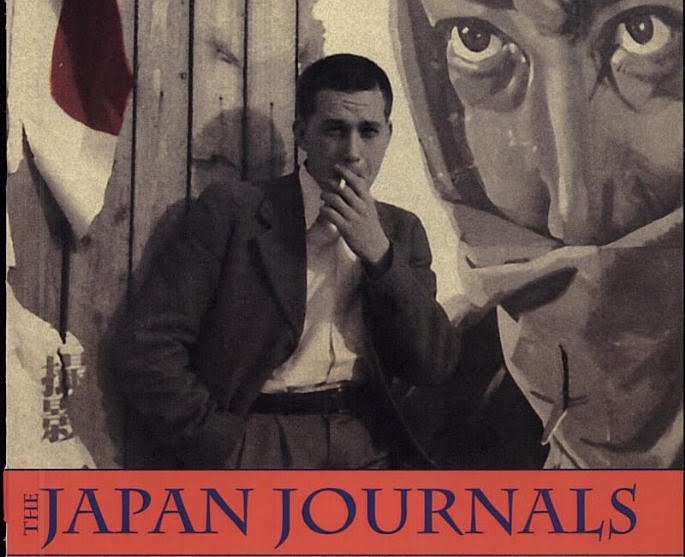
The Japan Journals

In 1970, a year before the publication of The Inland Sea, Richie was asked by the Japan Times to write a piece on the death of Yukio Mishima, a man with whom he had enjoyed a long friendship. In an essay on the subject that would draw on previous entries from his own journal, Richie writes of a conversation with the author:
'Japan,' I remember his [Mishima] saying, last summer, ‘Japan is gone, vanished disappeared.’

‘Is there no way to save it?’ I wondered. ‘No,’ he said, ‘there is nothing left to save.’
Richie never stops saving. In over half a century of not-quite-daily or even yearly entries, faithfully edited by Leza Lowitz from Richie’s journals, we see a man eager to make sense not so much of that place called Japan that he made his home but of himself. Richie writes with wit—de-worming, and its ensuing digestive calamities, becomes a metaphor for the American Occupation—heart, and the occasional doubt.

An outsider to both Japan and America, Richie becomes an in for the giants of both. He goes to the gym with Mishima and takes him to visit "every Saint Sebastian hanging in New York" (read Confessions of a Mask for the reference). Gone to greet Truman Capote at the Tokyo airport, Richie is met with a dour, "All I can say is that you certainly wouldn’t know they’d lost the war."

Most often the observer, Richie grants us a look behind the curtain: liaisons with men, a troubled marriage, a romantic sensibility (crowds in Shinjuku like "Edo street scenes of Hokusai").

In The Japan Journals, Richie stands shoulder to shoulder with giants, and sees keenly.
One of those days. I run off the track. I can see, when I look back, the plodding footprints in the desert behind me. Just where do I think I am going? Here I am a novelist who writes few novels, a critic who usually can’t even criticize himself, a husband who prefers sleeping with men. Yet, somehow all those unwritten novels were supposed to appear; my criticism was to strike every target; and marriage was to save me. But no, not at all—and marriage is killing me.

The reluctance to find oneself—the evasions. And the burden of it. No wonder I wanted someone to share it. But one does not drop one’s history any more than does the plodding turtle drop its shell."
A Hundred Years of Japanese Film

Neophytes to the world of Japanese cinema, even those familiar with contemporary masters like Hayao Miyazaki and Takeshi Kitano, can do no better than Richie’s Hundred Years of Japanese Film. In his sprawling, if selective, analysis, Richie takes us from the era of benshi, or silent film narrators, to the modern days of manga and anime (he even brings up Osamu Tezuka near the end). In the process, he not only introduces a variety of works and cinematic techniques but also provides some historical context behind the masterpieces.

In one section Richie discusses the differing ways in which filmmakers responded to calls for jingoistic propaganda during the war years. On one hand, Yamamoto Kajiro, mentor to Akira Kurosawa, went along wholesale with government policy in films like The War at Sea, which recreated the bombing of Pearl Harbor with such accuracy that Occupation authorities later mistook it for footage from the actual event. On the other, Yasujiro Ozu of Tokyo Story fame managed to please the censors while doing nothing to advance their agenda.

Ozu, as well as Kurosawa and Mizoguchi, feature prominently in Richie’s book. As a result, some have noted that "his history is largely the history of the studio A-list, and of the A-list studios," with Richie making no secret of his personal favorites. Then again, those who know him from The Inland Sea and other works will be unsurprised by his straightforward style, which, as always, makes no apologies for taste.
Kurosawa’s lack of accommodation to received ideas has allowed some Japanese critics to call him their ‘least Japanese’ director. The description is understandable in that he is ‘Western’ enough to be openly individual. Completely uninterested in the standard program film, and failing whenever he was forced to make one, he has gone beyond the accepted confines of cinematic language as the Japanese understood them and, in doing so, has broadened them. Consequently, perhaps, his films have been widely accepted in the West itself.
--Andres Oliver

Monday, November 15, 2010

Midnight Moonlight Reads

Look into my… um. Via.

We're still finding empty candy wrappers in hidden corners of Japan Society from our OBAKE! Halloween party, and we've barley recovered from the exquisite psychological turmoil of our Onibaba screening last Friday. With no further frights in sight on the calendar, what better way to start a week than with a list of incredible horror/supernatural/thriller manga and manga-based anime!

I've compiled my 13 top personal favorites,  ranging from delightfully spooky tales to extremely disturbing paranormal lore. There's lots of ways to pick up these titles (libraries, conventions, trading etc.), but a great source to learn more is Anime News Network. Enjoy a good ghoulish read, and I would love to hear about your favorites in the comments! Without further ado and in  no particular order:

Tuesday, August 31, 2010

Summer Reads: Books About And Inspired By Japan

Bet you can't read just one. Via.

It's the last week of summer and we assume you're headed out of town or just in need something to keep your mind off the crushing fall season about to tumble upon you (or maybe that's just us). Behold our first ever Japan-related reading list! Enjoy these bestsellers and perennial favorites—perfect for the beach, poolside, or any well-lit destination your Labor Day Weekend takes you. Stay cool and have a great end-of-summer!

Tokyo Vice, Jake Adelstein
A firsthand look at Japan "from the underbelly up" by the only American to be admitted to the Tokyo Metropolitan Police press club. Read excerpts at NPR and Metropolis. 

The Chrysanthemum and the Sword: Patterns of Japanese Culture, Ruth Benedict
Whether promoted as essential reading or panned as a populist mainstream misreading, there's no denying the lasting influence of Benedict's seminal piece of cultural studies (just be sure to follow it up with some of the more contemporary books on this list.) Acclaimed for its accessibility and eloquence, if not accuracy or scholarship, the book recently got the "Mad Men" bump.

Snakes and Earrings
, Hitomi Kanehara

A dark tale that explores one girl’s dangerous obsession with fashionable body modifications in present day Tokyo. Winner of the Akutagawa Prize for Literature in 2003.

Japanamerica, Roland Kelts 
The Village Voice calls Kelts' lively distillation of the otaku invasion of America "a Wired magazine article on steroids." Read the book's foreword.

The Selling of the American Economy: How Foreign Companies Are Remaking the American Dream, Micheline Maynard
Japan plays a key role Maynard's lucid and insightful re-education of foreign investment in America. Read The Times excerpt.

The Thousand Autumns of Jacob de Zoet, David Mitchell
Behind this wildly popular, rip roaring adventure tale is a well researched and richly described Japan at the turn of the 19th century, including the strange but true story of the artificial island of Deshima—the only place foreigners were permitted. Check out excerpts at The Times, NPR, and from the author. Plus, Dave Eggers really liked it.

Norwegian Wood, Haruki Murakami
This modern classic coming of age story sold more than 4 million copies in Japan in its 1987 release and established Murakami around the globe. Read it before the film adaptation is released later this year.

Edwin O. Reischauer and the American Discovery of Japan, George R. Packard

A graceful biography of the charismatic man who helped steer Japan toward democracy and then wrote its definitive English-language history. Japan Times review.

The Japan Journals: 1947-2004
, Donald Richie
An intriguing record of the nation from one of the world's most influential Japanese culturalists. Richie paints a fascinating firsthand postwar picture of Japan and the ritzy glamour of the film industry. The Times says "wonderfully evocative and full of humor, but also honest, introspective and often poignant."

Confucius Lives Next Door, T.R. Reid
Known for his trenchant, funny, and deeply knowledgeable commentaries on NPR, Reid discovers the "postwar miracle" of Japan when his family is transplanted there from the Midwest. Examining East Asia's impressive social stability, he highlights the many benefits (and some drawbacks) of the "Asian Way."

Edokko: Growing Up a Foreigner in Wartime Japan, Isaac Shapiro

Born in Tokyo in 1931, Shapiro, a famed New York lawyer, shares  Japan's lasting influence on him and his Jewish family transplanted from Europe.

The Tale of Genji, Murasaki Shikibu
This 11th century masterpiece by the Lady Murasaki is considered one of the world's first novels, brimming with the subtleties of the era's etiquette and ritual. Of course, a classic of such historical significance has no less than three lauded  translations to choose from: the unabashed Edwardian eloquence of the 1933 interpretation by Arthur Waley (who's story is itself fascinating), Edward Seidensticker's more literal 1976 version, and the more recent and faithful Royall Tyler interpretation from 2001. Notes one JS staffer: "Although Waley took considerable liberties with the original and did not have the resources of modern scholarship at his disposal, his elegant writing has an appeal that cannot be matched by the more accurate versions by Seidensticker and Tyler." While you mull how to choose a translation, prep for reading with images of the story's many locales.

In Praise of Shadows, Junichiro Tanizaki
This classic treatise on Japanese aesthetics retains the elegant prose that Tanizaki employed in his many lauded works of fiction.

Buddha, Volume 1: Kapilavastu, Osamu Tezuka
A manga retelling of the life and times of Gautama Buddha (nee Siddhartha) that is as entertaining as it is enlightening. BBC calls it "a vibrant, action packed epic" (link includes an image gallery). TIME's rich overview notes: "filled with beauty, cruelty, drama, comedy, romance and violence, Osamu Tezuka's Buddha encompasses the entirety of life in a masterpiece of graphic literature."

For even more staff picks, click here.


Japan Society Staff

UPDATED 9/4/15

Friday, August 27, 2010

News Blast: Death Chamber Opens, US-Japan War Games, Cat Island, Museum Manga And More

 Japan's Cat Island. Via.

The New York Times reports Prime Minister Naoto Kan will face challenge in September from Ichiro Ozawa, "scandal-tainted power broker within his own party". The announcement comes shortly after the outspoken Ozawa told Japanese press that he found British People unlikeable and Americans 'monocellular', according to reports from Japan Today and Mainichi  (confirmed by Great Britain's Telegraph and followed up humorously by The Wall Street Journal.)

►Where most Japanese political parties limit membership to nationals, regulations of the ruling DPJ allow membership to anyone over 18, including Japanese nationals living abroad and foreigners living in Japan.

►As Japan reviews defense policies, and a panel wary of China urged change, AFP reported the U.S. and Japan plan to practice 'war games' in December that simulate recapturing a remote southwestern island from an enemy. Notes the AFP: "Such an exercise could bring a stern response ... Japan has territorial disputes with both China—its key Asian economic rival—and Taiwan."

►A second wave of bilateral talks between PM Kan and President Barack Obama are likely to take place at the UN in late September. The discussion may encompass the planned relocation of the Marine Corps’ Futenma Air base in Okinawa, North Korea’s nuclear program, economic stimulus, and global warming. Related, Japan is working to disclose an expert report on the Futenma relocation by the end of August.

►This week Japan's Justice Minister allowed media rare entry into an execution chamber. Mainichi carries images and officials' description of the facilities and Reuters published facts about death penalties around the world, such as Japan and the U.S. are the only countries in the Group of Eight rich nations that conduct executions.

►In a long-awaited reconciliation move, Japan hosts World War II POWs. Five American POWs and the families of deceased POWs will visit Kyoto and Tokyo among other destinations in a government supported tour. Kinue Tokudome, founder and director of the U.S.-Japan Dialogue on POWs, explained to Stars and Stripes: "the idea that Japan should apologize for anything after what happened at Hiroshima and Nagasaki—the first and only nuclear attacks in history and carried out by the United States—is a sometimes difficult proposition in Japan."

►Meanwhile, California approved a bill requiring bidders for a prestigious high-speed railway project to release details on transportation of WWII POWs.

►Artists and writers reflect on Japan's tumultuous postwar history after the signing of the 1960s security treaty in the new documentary Anpo, due out in Japan next month. The film is directed by Linda Hoaglund, a frequent collaborator with Japan Society's film and education programs, who produced the fascinating kamikaze expose Wings of Defeat, and who has for years handled English subtitles for about 200 films, including those directed by Akira Kurosawa and Hayao Miyazaki.

International Herald Tribune Op-ed: "Japan and its youths, old beyond their years, may well reveal what it is like to outgrow growth."

Kimono from Cameroon. Via.

Africa unveils gorgeous kimonos for the 21st Century .

Asahi launches "Fun! Fun! Fashion!" column. This week: socks!

►Japan invents the smallest, safest oil-to-plastic conversion machine.

►A new Japanese toilet measures blood pressure, body temperature, weight and sugar levels in urine.

►Sports Roundup: the New York Mets hold their first annual "Japanese Heritage Night", the trend is shifting for American managers of Japanese teams, Japan wins women's world baseball championship, Okinawa’s Konan High School took the Koshien national championship, and Sumo elite get iPads to enter 21st century and accommodate their meaty fingers.

►Japanese filmmaker and comic-book artist Shatoshi Kon (Paprika) "whose dazzling visual compositions and humane, emotionally resonant stories won him a devoted following in animation circles and beyond", according to The Times obituary, died in Tokyo at age 46. Read Japan Society's tribute in memoriam.

David Mitchell talks to NPR about the inspiration for his acclaimed novel A Thousand Autumns of Jacob de Zoet.

►Japanese novelist Haruki Murakami: writing a novel is "just like having a dream."

►Though conductor Seiji Ozawa says he has successfully completed treatment for esophageal cancer, he will still curtail appearances at the Saito Kinen Festival Matsumoto in Japan next month. We're hoping for his speedy recovery and look forward to him kicking off Carnegie Hall's JapanNYC fest in December.

►A Japanese manga exploits British Museum treasures (which sounds vaguely familiar!) Notes The Economist: "In Japan manga is a mainstream medium, with sales of magazines and books amounting to around $5 billion a year. Though many are juvenile, violent or pornographic, others are intricate narratives skilfully illustrated and meant to educate as much as to entertain."

The Times says the Museum of the City of New York's Samurai in New York exhibition "delivers more than you’d expect ... In this case it offers a lot to think about in terms of photography and its role in early publicity and celebrity culture as well as a fascinating look at how different societies responded to 19th-century stirrings of globalization."

Japan Times profiles Junko Fisher, a New York-based performer who teaches traditional Okinawan dance at Queens Library in New York.

►10-year-old Japanese guitar prodigy Yuto Miyazawa shreds onstage with Ozzy Osbourne.

►(To the Jurassic Park theme): Welcome... to Japan's Cat Island!

S.J.

Thursday, August 26, 2010

"Mad" Chrysanthemum Swords


A colleague informed me that our friends at Asia Society got the "Mad Men" bump this week (so jealous!) in an episode in which the protagonist advertising firm woos a Japanese client. (Full disclosure: I don't watch the show, because really, it's the story of my life, but there's a surprising amount of recaps out there, from mainstream distilling at Entertainment Weekly and Huffington Post to The Awl's veritable meltdown.)

As The New York Times recalls, "Every stereotype of Japanese corporate culture is hammed up here — the ritualized greetings, the essential exchange of gifts, the general obsession with protocol." To prepare for their conquest, the "Mad Men" office reads Ruth Benedict's The Chrysanthemum and the Sword, and decides it's best to shame the competition to win the account. Continues The Times: "Shame as a kind of cultural practice is discussed at length in Benedict’s book and the theme of shame runs through the entire episode."

Since its 1946 publication, Benedict's Chrysanthemum is considered either a seminal and influential work of Japan Studies, or a notoriously contrived exercise in pseudo anthropology. According to the average Amazon reader's review, it is deemed a modern classic. The academic reaction is just as varied: it's a clash of civilizations experience, "an example of the politicization of anthropology", a museum piece, and/or merely one more book to read preparing for Japan fieldwork.

Chrysanthemum was based on a study commissioned by the U.S. during World War II to understand the "Japanese enemy." Because of constraints, Benedict did not conduct the appropriate fieldwork and based her report entitled "Japanese Behavior Patterns" on translated novels, movies, propaganda, and interviews with Japanese-Americans in U.S. interment camps. Expanded after the war, the resulting book was popular in the U.S. and, once translated, in Japan as well.

One fan was C. Douglas Lummis. When planning a move to Japan in the early 60s (the same time period as "Mad Men"), he picked up the book and was "corrupted by the myth":
"I walked around Japan like a miniature Benedict, seeing 'patterns' everywhere, and thinking it was wonderfully clever to be able to 'analyze' the behavior of the people around me, including even invitations to dialogue and expressions of friendship … [this attitude was] rampant within the community of Westerners in Japan, and especially among the Americans, so many of whom saw themselves not only as miniature Benedicts, but also as miniature MacArthurs. After some time I realized that I would never be able to live in a decent relationship with the people of that country unless I could drive this book, and its politely arrogant world view, out of my head."
Taking his cues from some of the negative reactions in Japan to the "deeply flawed" book, he penned his sprawling, fascinating, titularly telling essay "Ruth Benedict's Obituary for Japanese Culture" (recently updated). The essay is as much a must-read as Chrysanthemum or any focused critique of contemporary Japanese culture. Of course, context and purpose of the work is an important factor when reading for the complexity of U.S.-Japan relations.

Which leads me to wonder: was the use of Chrysanthemum part of the "Mad Men" writers' punch line in their comedy of cultural errors? One would assume so since the episode takes place shortly after the 65th anniversary of the atomic bombings of Japan and the end of WWII. I'm also curious how many people rushed out to buy the book after watching the episode. At the time of writing, it's fluctuating dramatically in Amazon's top 20 History/Asia/Japan bestsellers.

S.J.

Thursday, February 25, 2010

Toyota and the Green Car of the Future


Micheline Maynard, senior business correspondent for The New York Times, published "An Apology From Toyota’s Leader" yesterday, noting that, "In his testimony, Mr. Toyoda tried to reassure lawmakers that the company was addressing problems that led to the recalls. In addition, he said, the company was moving to repair its damaged reputation."

Back in October, Maynard held an event here to discuss how many Americans are uncomfortable about the influence foreign companies exert on our economy and to also promote her book The Selling of the American Economy, in which she argues that despite the lingering xenophobia that colors American perception of foreign-owned companies, foreign investments are actually an overwhelmingly positive force.

Plus she's going to be returning at the end of next month to moderate Green Japan Series: The Green Car of the Future, a panel with Thomas Sticker, the Corporate Manager of Energy & Environment Research Group of Toyota North America and panelists from Mercedes Benz and Ford Motors.

While they discuss what the future's green car will look and drive like on the road, it will be interesting to see what kind of an impact Toyota's current conundrum will have on their discussion.

Thursday, January 21, 2010

Book Review: "The Last Train From Hiroshima" and "Edokko"


The New York Times recently published a fantastic review of Charles Pellegrino's sober and authoritative new book, “The Last Train From Hiroshima.” Here are a few interesting excerpts from the article:

"Mr. Pellegrino, whose many previous books include “Ghosts of the Titanic” (he also served as a scientific consultant to the director James Cameron on his Titanic expeditions and on “Avatar”), relates many stories in this book, not only those of wounded survivors but also of American and Japanese pilots and many others.

He pays particular attention to forensic detail, and provides a slow-motion, almost instant-by-instant explanation of how the atom bomb discharged its fury. There is not a lot that is new here, but “The Last Train From Hiroshima” is a firm, compelling synthesis of earlier memoirs and archival material, as well as of the author’s own interviews and research. This is gleaming, popular wartime history, John Hersey infused with Richard Preston and a fleck of Michael Crichton.

This isn’t a book that wrestles deeply with the moral calculus of the decision to drop the atomic bombs. Mr. Pellegrino doesn’t say whether he agrees with Paul Fussell, who wrote in “Thank God for the Atomic Bomb” that “the degree to which Americans register shock and extraordinary shame about the Hiroshima bomb correlates closely with lack of information about the Pacific war.”

But he certainly studies every kind of fallout and does not neglect the spiritual variety. He writes about one doctor who “recalled that those who survived the atomic bomb were, in general, the people who ignored others crying out in extremis or who stayed away from the flames, even when patients and colleagues shrieked from within them.”

This doctor confessed: “Those of us who stayed where we were, those of us who took refuge in the hills behind the hospital when the fires began to spread and close in, happened to escape alive. In short, those who survived the bomb were, if not merely lucky, in a greater or lesser degree selfish, self-centered — guided by instinct and not by civilization. And we know it, we who have survived.” " 

An excerpt of Mr. Pellegrino's book itself can be found HERE.

On a similar note, here at Japan Society, we recently featured author Isaac Shapiro, who was born to Russian Jewish parents in Tokyo in 1931 and grew up in the shadows of war torn Japan. Mr. Shapiro, who went on to become a prominent Manhattan attorney and president of Japan Society, shared the fascinating tale of his Russian/Jewish/Chinese/Japanese childhood in wartime Japan with us on January 14th.

The press release for that event is on our website, if you're interested in learning more.