Friday, October 8, 2010

Japan House: A Building That Builds Relationships

Japan Society: a vivisection.
New York City is a little global town. Each block, corner and street contains the swirling, multicultural fingerprints shaped by the people who live here.  We hear it, smell it, taste it, feel it and ever see the impact of the proverbial melting pot on our everyday lives. But one thing we might not notice--because of their permanence, their ubiquity, or their size--are the city's mammoth cultural beacons: the buildings.

On October 9 and 10, the eighth annual OHNY Weekend celebrates New York City's varied architecture and design, from the classic to the more exotic. For the fourth year in a row, Japan Society participates in OHNY with tours of its building (currently fully booked) and free admission to the Gallery show The Sound of One Hand.

Japan Society's building has been the center of the Society's mission to build understanding between the people of U.S. and Japan since it openend in 1971. Joe Earle, director of Japan Society Gallery notes that the building, designed by Junzo Yoshimura as the first example of contemporary Japanese architecture in New York, is a free adaptation of traditional Japanese architecture:
In Japan House (as Japan Society’s building was first called when it opened in 1971) we see a subtle blend of Japanese sensibility with contemporary materials and a modernist aesthetic. Although the building has undergone two campaigns of adaptation and extension over the years, its original atmosphere is especially well preserved in the lobby area with its low, modular, precast concrete ceiling, slate and timber surfaces, bamboo pond and stairs leading invitingly up to the gallery.
Though the Japan Society tours are full, we hope you have a chance to explore the building and the exhibition. In addition to the hundreds of buildings showcased throughout the city,  OHNY Weekend features a family festival to give children hands-on activities to discover and appreciate the beauty of New York City’s abundant architecture. Wherever the weekend takes you, and whatever your age, enjoy the places you pass by everyday in new and unexpected ways!

S.H.

Thursday, October 7, 2010

From No-Self To Knowing Yourself: The Psychology Of Zen Buddhism And Its Real-World Applications

The unexamined ox is not worth training. Art by Max Gimblett.
Celebrities do it, Oprah endorses it, and we’ve already mentioned it: making a Zen escape to calm the nerves and unwind after a stress-filled day. But how does Buddhist philosophy and its mediational practices actually relieve stress and enable us to get in better mental shape? And how can we incorporate it our overly examined lives?

One of the world's most regarded experts on the subject, psychiatrist and author Mark Epstein (Thoughts Without a Thinker, Going to Pieces Without Falling Apart, Psychotherapy Without the Self), addresses these questions and more in Mindful Living, an intimate evening talk with oxherding contributor and author Lewis Hyde .

In the discussion Epstein and Hyde examine the connection between Zen teachings and psychology with an emphasis on awareness of the self and compassion for those around us and the world we live in. Both Zen philosophy and psychology deal with an examination of the self (or no-self, as the case may be), recognizing that if we understand ourselves we'll be better able to control our senses and emotions rather than being controlled by them. Zen meditation is a centering practice, allowing practitioners to achieve an increased sense of alertness and presence in their lives. Epstein shows how people can be more present, more tolerant, more generous, and more loving in daily life by incorporating meditation techniques into their routines. 

With the oxherding connection, the discussion also touches on how art and poetry can best express one’s feelings by providing an outlet for the senses. Hyde demonstrates how reading poetry, especially in multiple translations, enables readers to obtain new perspectives on the world and take solace in the mutability of language. He also shows how inspiration and compassion pour from paintings by classic artists such as 18th century Zen master Hakuin and contemporary artists such as Max Gimblett, Hyde's oxherding co-creator.

In addition to this one-time discussion, Japan Society offers a series of related workshops, from freeing the written word with Lewis Hyde and freeing the image from a sumi ink-soaked brush with Max Gimblett in October, to Zen for Everyone mediation workshops with Roshi Pat Enkyo O’Hara in November. Regardless of how you get to Japan Society, there's many paths to enlightenment once you arrive!

T.D.

Join The Sound Of Critics And Audiences Clapping

The look of one hand. Via.
The legendary Yoshi Oida returns to Japan Society for two performances only, October 8 and 9, in what The Village Voice calls  a "rare chance to see the celebrated actor—who has not appeared in New York in 12 years—perform what is widely considered to be his masterwork."

Nearly 30 years after the original production (read the 1981 New York Times review), Oida breathes new life into his venerable one-man comedy with live music, Interrogations: Words of a Zen Master. This week Time Out New York warned "get ready to clap with one hand," while Flavorpill described the piece in detail :
Yoshi Oida is an actor, writer, director, and longtime member of Peter Brook's Paris-based International Centre for Theatre Research. His 1978 one-man show, Interrogations: Words of the Zen Masters, incorporates the brilliant British director's practice of breaking down barriers between performer and audience. Acting as a Zen master, Oida poses direct questions to audience members in the form of koans, riddles without definite answers, which determine enlightenment. One koan leads to another, lasting days. While there can be a very fine line between religion and theatre, Oida's Interrogations is one evening created for the sole purpose of a genuinely shared experience.
Though using Zen Buddhism as a framing device, the work draws from timeless theater conventions from around the world. In an exclusive interview with American Theatre [PDF of the article], heralding his return to New York, Oida discussed the play's intricacies:
The texts come from China’s 11th and 12th centuries. Normally in the Zen monastery, the master gives a koan to the student, and the student tries to think about it and write down a good answer. "Two hands clap and there is a sound; what is the sound of one hand clapping?" "Does a dog have a Buddha nature or not?" There are no right answers, because the koan is not logical. You must understand not the question, but what is the meaning underneath the question. In the 1970s, Beckett and Ionesco were very fashionable. Their plays were not realistic—they were anti-theatre. I thought, yes, this koan is very good for this world of anti-theatre, because there is no logic in it. The Rinzai Zen masters had a lot of questions, which I chose for the performance. Instead of finding out the answer, I pose the questions to the public. I am like a master asking a koan, and the public answers.
Interrogations take place Friday and Saturday at 7:30 pm. Tickets are $28 general admission and $23 for Japan Society member. A limited number of $14 student rush tickets are available 1 hour prior to each performance with valid student ID.

Yoshi Oida is also a celebrated opera director. His staging of Benjamin Britten's Death in Venice opens at the Canadian Opera Company on October 16.

Wednesday, October 6, 2010

By These Powers Combined: New York City's Largest Pop Culture Convention To Date

Despite great peril, we survived the 2009 conventions. Image via.
The New York Comic Con and NY Anime Festival join forces, storming the Javits Center October 8-10 in what will undoubtedly be the greatest otaku show on Earth!

The hybrid monster convention features three days of East and West pop culture luminaries, virtuosos of ink and pen in the flesh, the unabashed selling and trading of precious goods, cult actors and VIPS dangled precariously before their devotees, and music, music and more music (and even some discussions about music).

For the third straight year, Japan Society joins hundreds of events and participants to give revelers a broader sample of the joys of Japanese culture (check out our vid from 2009).

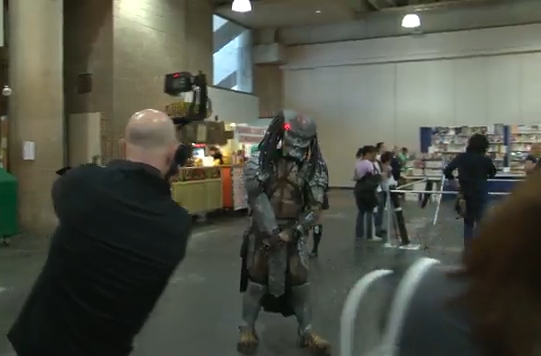
Stop by the booth Friday to take part in an insane scavenger hunt with prizes from Kidrobot. We host a cosplay costume competition on Saturday (recruiting for our first-ever Halloween party in late October)—best costumes receive prizes from Kinokuniya Book Store. All weekend we'll be handing out free passes for our current exhibit of pop-y Zen Buddhist art from the 18th century, and there will be give-aways of our past exhibition catalogues, classic film screenings (currently focusing on the interplay of Buddhism and violence), and lectures ranging from Japan's influence on Western design  to Japan's inimitable vegetarian cuisine. We'll also be running around snagging choice interviews for our new Nihon New York video series (watch episodes 1 and 2) .

If you're at New York Comic Con or the NY Anime Fest this weekend, stop by the booth and say konnichiwa!

Konnichiwa Comic Con! Via.
S.H., S.J.

Friday, October 1, 2010

Hear The Silence So Loud

Details of Hiroki Otsuka's reverent and iconoclastic Daruma 28.

New York City: high-paced, intense--a metropolis where walking a step too slow or too fast can set off a deafening barrage of profanity and car horns. Amongst the craziness there always exists the need for escape, tranquility, and dare I say, Zen. For a weary New Yorker, Japan Society is that escape with its relaxingly quiet atmosphere, calming waterfall garden, and host of intellectually stimulating programs.

The escape is multiplied by three with the Society's new exhibition The Sound of One Hand, featuring America's first ever exhibition encompassing the paintings of eighteenth century Zen Buddhist master, Hakuin Ekaku. Though his work comes from a time where reverence and adherence to ancient traditions were the norm, it has a truly modern, populist feel to it.

Riffing on the contemporary vibe of Hakuin's art, the Society also presents two fresh, contemporary remixes on reverent Buddhist subject matter. Downtown artist Max Gimblett and author Lewis Hyde’s  oxherding is a bold spin of 'proper' form--10 years of collaboration deconstructing and reconstructing precious texts and holy images. As Gimblett himself puts it, he would have been considered a pop artist had he arrived in New York 10 years earlier in the 60s. His fusion of pop art sensibilities and Japanese calligraphy along with his intensity as an artist proves that the art of Zen, with its emphasis on tranquility and simplicity, doesn’t have to be boring.

There's another shock to the religious system before entering the Hakuin exhibit proper. Hiroki Otsuka’s Daruma 28 depicts the master and founder of Zen Buddhism, Daruma, in 4 acrylic paintings that portray him in private moments of spiritual struggle as a strikingly manga-esque, Gen-Y monk.

The Sound of One Hand opens today. Admission is $12, $10 for students and seniors, and free for Japan Society members and anyone under 16. oxherding and Daruma 28 are free to all Japan Society visitors during the course of the exhibition.

T.D.

Thursday, September 30, 2010

In Defense Of Lasting Relationships

After the end of World War II and the signing of the Postdam Declaration, Japan was required to disarm, dismantle and discard their war potential. The Japanese government reformed their defense into the Self-Defense Forces to deal with any problems that may happen in the mainland, but they were strictly banned from deploying outside their homeland.

The original intentions of Japan’s defense troops have changed in recent years due to changes in the international world. The JSDF have deployed on non-combatant peacekeeping missions and their provocative deployment to Iraq to help out on the reconstructive efforts. Also the geo-political arena has changed. Japan and the U.S. are concerned with the various problems facing both nations. The nuclear aggression of North Korea, the rise of China’s political, economic and militaristic juggernaut, not to mention core contemporary challenges within the basic framework of U.S.-Japan relations.

How do we assuage old ghosts and confront new realities? From a unique insider perspective, William H. Swanson, CEO of Raytheon, one of the world's largest defense contractors, comes to Japan Society to discuss the relationship with Japan, challenges of the 21st century, and how to maintain our amiable long-lasting friendship. The luncheon takes place Wednesday, October 6 at 12:30 pm, with the discussion starting promptly at 1:00.

More about Swanson and Raytheon in this recent Barron's article.

S.H.

Friday, September 24, 2010

Mouthwatering Nostalgia: Japanese "Soul Food" On The Upper East Side


Soul food recalls home and warms the heart.  It instantly conjures memories, experiences and a connection to the special people in our lives. This year's final installment of Japan Town’s food festivals showcases Japanese soul food with a range of favorites from my childhood in Japan.

The festival promises yaki ramen (Japanese stir fry), ikimari dango (like a pierogi on a skewer), okonomiyaki (pancake and omelet all in one), yakitori (skewer grilled chicken lightly marinated in a delicate sauce) and for the sweet tooth, warabimochi (Japanese toffee but using jelly instead of caramelized sugar).

Featured is the distinctive cuisine of the Kyushu region, the southernmost islands of Japan. New York City’s Japanese restaurants and vendors from the Kyushu prefectures of Nagasaki, Oita, Saga, Kumamoto and Fukuoka are on hand to open a new world of food and introduce their savory soul-filling selections.

Join me for lunch, brunch, and/or an early supper, Sunday, September 26, 11 am to 6 pm, on the Upper East Side at Lexington Avenue between 94th and 95th Streets. The day will be an amazing journey beyond everyday Japanese cuisine!

S.H.

Critics Sound Off: Ryoji Ikeda Pushes Boundaries Of Sight And Sound

Ikeda's work is snow joke. Via.

"A thing of hypnotic beauty and a gateway onto eternity."

"Extreme high and low frequencies; split-second variations in intensity, direction and duration; barely perceptible sounds; assaultive bursts of digital noise."

Sound like any concert you’ve been to recently? As previously posted, Japan Society and French Institute Alliance Française (FIAF) hosted Japanese audiovisual artist, Ryoji Ikeda at FIAF’s Florence Guild Hall on September 10 and 11 for the New York-debut performance of datamatics [ver. 2.0].

Paris-based Ikeda combines raw binary numbers and extreme audio frequencies to create a sensational display as much modern art as musical performance. In addition to the quotes above, Steve Smith of The New York Times described Ikeda’s performance as "metaphysical, intricate and elegant", while Corinna da Fonseca-Wollheim of The Wall Street Journal wrote that datamatics "blurs the line between nothingness and infinity". New York 1 technology correspondent Adam Balkin dedicated a full segment to the deceptively intricate, sensorial production.

Ikeda’s performances kicked off FIAF’s Crossing the Line festival which ends September 27. His site-specific installation transcendental runs until October 16th. Catch it before it bids adieu!

T.D.

Thursday, September 23, 2010

Shadow Play: Kids Build With Light

Detail of the original architectural sketch of Japan Society's building.


An architect is an artist, painting the tale of man’s relationship with their space. Unlike Western architecture, which keeps people and nature separate, Japanese architecture presupposes that the inside space and the outside space are one continuous piece of artwork.

Like all pieces of artwork, architecture shows the emotion and thoughts of the artist. Kazuo Nishi and Kazuo Hozumi authors of What is Japanese Architecture? remark, “Japanese through the ages have evolved a building art that seems to delight in opposites and contradictions”. Japanese architect uses light and shadow to reflect the purity, beauty, harmony and simplicity that unadorned nature characterizes for us through the changing seasons. 

On Sunday, September 26, two well known architects help children and their parents understand Japanese architecture’s intriguing interplay of light and shadow. Aki Ishida takes her client’s vision about a space and translates it into a distinct, innovative and intelligent design. Mina Hatano-Kirsch's designs melds with its surrounding environment, while reviving the bond between indoors and outdoors.

In the Japan Society family program Light in Japanese Architecture, the two artists explore the playful and friendly manner of Japanese architecture, and guide children through interactive and constructive activities that harnesses their imagination and allows them to create their own art with paper, wood and the never-ending possibilities of shadow and light.

S.H.

Thursday, September 16, 2010

Surviving A-bomb Peace Piano Tours New York

"Hibaku" (survivor) piano on the Hudson. Via.

Walking along the Hudson last Saturday, September 11th, near Pier 40 with the sun about to set behind New Jersey, you may have noticed a small makeshift stage containing a modest, careworn upright piano placed unobtrusively next to several microphones center stage. Eager to take in the incredible views at Battery Park or the loads of fun at Chelsea Piers, perhaps you rushed past what looked like a typical and ubiquitous impromptu New York City park performance.

The set-up was in fact for a long-planned memorial concert. A little over a month after the annual remembrance of the World War II atomic bombings of Japan, a piano that survived the destruction at Hiroshima was on the first leg of a tour commemorating the 9/11 attacks on New York.

When the bomb fell on Hiroshima in 1945, the piano was located a little more than a mile from the blast center, but miraculously recevied only superficial damage from shards of broken glass. Mr. Mitsunori Yagawa, whose father survived the atomic bombing of Hiroshima and who restored the piano for its international travels, told Mainichi: "I've organized concerts using this A-bombed piano for 10 years. I hope that through this, people will remember the victims of the terrorist attacks and that this will form a bridge between Japan and the United States."

The concerts continue in New York this weekend with free performances at Japan Society on Friday, September 17, at 7:30 pm; Convent Avenue Baptist Church on Saturday, September 18, 2010 at 2:00 pm; and Japanese-American United Church on Sunday, September 19, 2010 at 3:00 pm.

T.D., S.J.