Thursday, September 9, 2010

Read "The Sound Of One Hand"

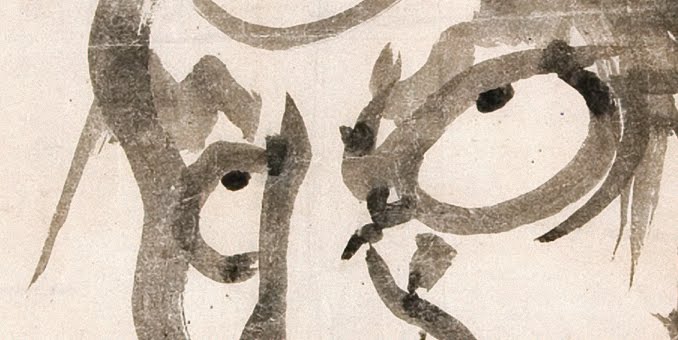
The Daruma that cannot be drawn. More drawings.

Our exhibition The Sound of One Hand: Paintings and Calligraphy by Zen Master Hakuin doesn’t open until October, but if you’re raring for a sneak peek and eager for context of Hakuin's life and work, the best primer is the official catalogue, released this week by Shambhala Publications. Co-authored by Audrey Yoshiko Seo and Stephen Addiss the 287-page, fully illustrated, hardbound color beauty is a comprehensive and wonderfully readable overview of the world's most influential Zen master.

Writing alternating chapters, Seo and Addiss explore Hakuin’s impact as both an artist and Zen monk. As explained in the introduction, Hakuin was a vital figure in the development of Zen Buddhism. He was a reformer of the major school of Rinzai Zen, establishing it as an open and inclusive alternative to some of the stodgier forms that preceded it. Maintaining the rigors of practice, Hakuin emphasized the study of koans (instructive riddles), which he called "poison words," in addition to silent zazen meditations and post-enlightenment training (because after enlightenment there’s still more to learn!)

Though his subject matter varied, Hakuin’s art reflects his teachings and inspirations from the everyday life: from the theatrical, such as Korean acrobats, to the somber and personal, such as other monks of his lineage. Many paintings accompanied his prolific writing on Zen philosophy and literature. Others depict goblins and other folk beasties, as well as major Zen figures, such as the founder, Daruma.

The formidable Daruma is most often depicted as large, hairy and homely man, with piercing eyes, wearing plain red or white robes, and earrings. Hakuin’s representations of him, however, varied widely over his career, and, even though they ascribed to the accepted format, it seemed he was getting at something beyond physical representation. Indeed, as the inscription on one work he did at the age of 44 says: "I have painted several thousand Daruma, yet have never depicted his face. This is only natural, for the moment I spread the paper to draw it, the original form disappears. All of you, what is this Daruma that cannot be drawn?"

Wednesday, September 8, 2010

Mathematic(k)s & Blips

Ikeda bends math to astounding audiovisual conclusions. Via.

Imagine being immersed in a black and white (and very occasionally red) world of nearly imperceptible electronic whines, trippy digital beats, lulling clicks and jarring ticks, swirling computer-generated geometric dust devils and slippery, speeding, jarring, eye shattering mathematics. Senses have been loaded, perhaps about to spill over, and  perceptions of the world and sound itself have come into question by hyper, hypnotic and profoundly confounding live audiovisual experience created by one of Japan's leading new music pioneers, Ryoji Ikeda.

The Contemporary called Ikeda "a man for whom sound and vision comprise not two separate senses but a single stimulus to the senses," and described the awesome opening of one of his shows as such:
Nothing: a blank black screen and a wall of silence. Slowly, imperceptibly, a distant high-pitched hum emerges from the sonic void, like the sound of a moist finger running around a half-filled wine glass. Simultaneously, slowly, the screen flickers into life: white lines bisecting the black background. The hum disintegrates into blips and bleeps. Flashes of beauty flicker on the screen... then fragment into a never-ending series of numbers. The visual aesthetic vanishes, to be replaced by pure data, yet at the same time the very essence of the image transformed into an abstract but utterly precise mathematical code.
This weekend Ikeda performs the New York premiere of his 2006 masterpiece datamatics [ver. 2.0]. Co-presented by Japan Society and FIAF as part FIAF's Crossing the Line Festival, datamatics takes place at Florence Guild Hall September 10 and 11.

The festival includes a solo site-specific installation up through October 16 designed for the FIAF Gallery, consisting of Ikeda's hyper-real manifestations of complex mathematics, combining discussions with Harvard number theorist Benedict Gross and meditations on transcendental numbers. 

S.J.

Friday, September 3, 2010

News Blast: Kan Vs. Ozawa, Japan's Tea Party, Walkman Runs, Panda Twins, And More

Japan takes Little League world series championship. Via.

►The U.S. and Japan again missed their deadline to resolve the Futenma airbase debate. AFP blames Japan's politics and WSJ calls it good news for advocates of the base. The two countries, however, did release a report regarding construction of a new base, calling for a more environmentally friendly option. 

►Meanwhile, Nebraska Governor Dave Heinema is building better relations with Japan for his state.

►The battle for Japan's sixth prime minister in four years has officially begun, this time within one party. WaPo has an extensive article on the showdown between between the current PM Naoto Kan and DPJ power broker Ichiro Ozawa, noting that the "Kan-Ozawa contest serves as a reminder of Japan's search for a decisive leader." A vast majority of Japanese voters would like to see Kan reelected, and he was visibly moved at the DPJ rally of support. Observing Japan's Tobias Harris wrote about the unlikelihood of an Ozawa upset in Foreign Policy (he also discussed election issues and the "intellectual paralysis" plaguing Japan's economic policy with CNBC Asia). Ozawa says the two candidates will be as tight as Obama and Clinton regardless of the election outcome.

►Jetwit discusses the rise of Japan's brand of Tea Party, as reported in The New York Times.

►Asahi reports Japan's Defense Ministry may create a military force modeled after the U.S. Marine Corps "to strengthen the defense of remote islands in southwestern Japan amid the rapid modernization of China's military."

►Japan's Foreign Minister Katsuya Okada tells a China nuclear envoy that tensions from March's South Korean warship sinking are too high to continue the Six Party Talks with North Korea. WSJ carried an in depth interview with Okada on this topic and more.

►Japan approved further sanctions against Iran, "including an asset freeze on 88 entities, 15 banks and 24 individuals."

►A new Brazilian film concerns the unspoken history of Japanese immigrants in Brazil. (Background: in the chaos following World War II The Japanese divided into two groups: one accepted Japan's defeat and one didn't. Confusion swelled into a brutal rampage among the Japanese, fueled by the repressive Brazilian government, who had set up concentration camps as tensions between Japan and Brazil intensified during the 30s.)

►The Atlantic's James Fallows returns to his old Tokyo neighborhood and finds "an inward-looking country that has lost its ambition." Among many keen observations of Japan in the 80s and now, Fallows writes: "If you know China mainly through stories of its economic successes, you’re surprised on a visit that it’s still so poor. If you know Japan mainly through stories of its failures, which are real, you’re surprised that it’s become so rich. "

►Robert Ingersoll, who was the first ambassador to Japan from the business world (and served as Japan Society chairman in the late 70s and early 80s), passed away at 96. Japan Society remembers his contributions.

►Japan wants to help foreigners living in the country to learn Japanese.

►Reuters breaks down Japan's latest $10.8bn solution for economic recovery.

►Twitter Japan is raking in the yen the old fashioned way: ad sales.

►Yomiuri reports the Japanese government is setting up a new ministry to nurture culture industries, such as anime and fashion.

►Japan experienced its hottest summer since 1898. Not surprisingly "cool products" were hot sells.

►In Japan, the Sony Walkman outsells the iPod for the first time.

►Huffington Post shares some images from Japan's classic guide to American Ive League 60s style, that is back in print and for the first time in English translation.

►Japan took the Little League world series championship, ending the U.S.'s five year reign.

►Labor Day Weekend sees U.S. and Japanese all-star baseball teams face-off in a three-game friendship series.

►AFP profiles Japan's internationally renowned taiko troupe: "For decades Kodo's members have lived communally in the mountains of Sado, leading an austere and almost monastic life where trainees steel themselves with daily 10 kilometre (six mile) runs and hours of gruelling drum practice."

►In California's tough real estate market, LAist asks: is moving Pasadena's only Frank Lloyd Wright home to Japan the answer?

►Video: The Telegraph has the first look at baby panda twins born in a Japanese zoo in mid August.

S.J.

Wednesday, September 1, 2010

Robert Ingersoll, 1914-2010

Ingersoll (far left) during a meeting of Ford's National Security Council, 1974

It was with heavy hearts this week that we learned of the passing of The Honorable Robert Ingersoll.

In 1972 Mr. Ingersoll became the first businessman to be appointed Ambassador to Japan since World War II. As noted in The New York Times obituary:
The appointment came at a time of strained relations between Washington and Tokyo, primarily over economic issues. Mr. Ingersoll’s company had long had joint ventures and licensing arrangements with major Japanese companies.

With Japan’s economy booming, the primary source of tension was its $3.5 billion trade surplus with the United States. In 1972, after negotiations with Mr. Ingersoll, Japan agreed to import $750 million in American manufactured goods and another $390 million in agricultural products.

Mr. Ingersoll served as chairman of Japan Society from 1978 to 1985. He took the helm following John D. Rockefeller's sudden, tragic death and continued the Society's impressive expansion of the 70s into the 80s.

Under Mr. Ingersoll's watch, the Society implemented the massive multi-arts, coast-to-coast Japan Today series in 1979, established the Japan Society Film Program (under the direction of Peter Grilli), dramatically increased activity and visibility in policy and business programming as Japan became America's most important world partner, and celebrated its 75th anniversary in 1981.

In addition to his invaluable contributions to U.S.-Japan relations as a business leader and diplomat, Mr. Ingersoll is remembered for his lasting participation in Japan Society activities, including support of our 2007-08 centennial. Our thoughts are with his family and friends.

Tuesday, August 31, 2010

Summer Reads: Books About And Inspired By Japan

Bet you can't read just one. Via.

It's the last week of summer and we assume you're headed out of town or just in need something to keep your mind off the crushing fall season about to tumble upon you (or maybe that's just us). Behold our first ever Japan-related reading list! Enjoy these bestsellers and perennial favorites—perfect for the beach, poolside, or any well-lit destination your Labor Day Weekend takes you. Stay cool and have a great end-of-summer!

Tokyo Vice, Jake Adelstein
A firsthand look at Japan "from the underbelly up" by the only American to be admitted to the Tokyo Metropolitan Police press club. Read excerpts at NPR and Metropolis. 

The Chrysanthemum and the Sword: Patterns of Japanese Culture, Ruth Benedict
Whether promoted as essential reading or panned as a populist mainstream misreading, there's no denying the lasting influence of Benedict's seminal piece of cultural studies (just be sure to follow it up with some of the more contemporary books on this list.) Acclaimed for its accessibility and eloquence, if not accuracy or scholarship, the book recently got the "Mad Men" bump.

Snakes and Earrings
, Hitomi Kanehara

A dark tale that explores one girl’s dangerous obsession with fashionable body modifications in present day Tokyo. Winner of the Akutagawa Prize for Literature in 2003.

Japanamerica, Roland Kelts 
The Village Voice calls Kelts' lively distillation of the otaku invasion of America "a Wired magazine article on steroids." Read the book's foreword.

The Selling of the American Economy: How Foreign Companies Are Remaking the American Dream, Micheline Maynard
Japan plays a key role Maynard's lucid and insightful re-education of foreign investment in America. Read The Times excerpt.

The Thousand Autumns of Jacob de Zoet, David Mitchell
Behind this wildly popular, rip roaring adventure tale is a well researched and richly described Japan at the turn of the 19th century, including the strange but true story of the artificial island of Deshima—the only place foreigners were permitted. Check out excerpts at The Times, NPR, and from the author. Plus, Dave Eggers really liked it.

Norwegian Wood, Haruki Murakami
This modern classic coming of age story sold more than 4 million copies in Japan in its 1987 release and established Murakami around the globe. Read it before the film adaptation is released later this year.

Edwin O. Reischauer and the American Discovery of Japan, George R. Packard

A graceful biography of the charismatic man who helped steer Japan toward democracy and then wrote its definitive English-language history. Japan Times review.

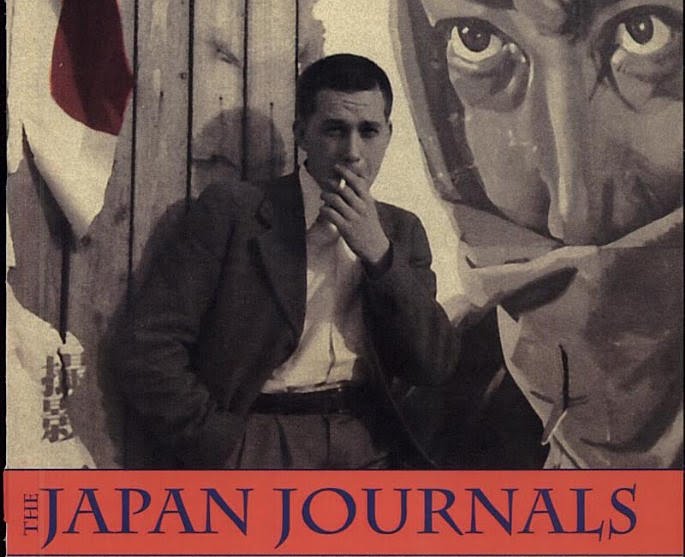
The Japan Journals: 1947-2004
, Donald Richie
An intriguing record of the nation from one of the world's most influential Japanese culturalists. Richie paints a fascinating firsthand postwar picture of Japan and the ritzy glamour of the film industry. The Times says "wonderfully evocative and full of humor, but also honest, introspective and often poignant."

Confucius Lives Next Door, T.R. Reid
Known for his trenchant, funny, and deeply knowledgeable commentaries on NPR, Reid discovers the "postwar miracle" of Japan when his family is transplanted there from the Midwest. Examining East Asia's impressive social stability, he highlights the many benefits (and some drawbacks) of the "Asian Way."

Edokko: Growing Up a Foreigner in Wartime Japan, Isaac Shapiro

Born in Tokyo in 1931, Shapiro, a famed New York lawyer, shares  Japan's lasting influence on him and his Jewish family transplanted from Europe.

The Tale of Genji, Murasaki Shikibu
This 11th century masterpiece by the Lady Murasaki is considered one of the world's first novels, brimming with the subtleties of the era's etiquette and ritual. Of course, a classic of such historical significance has no less than three lauded  translations to choose from: the unabashed Edwardian eloquence of the 1933 interpretation by Arthur Waley (who's story is itself fascinating), Edward Seidensticker's more literal 1976 version, and the more recent and faithful Royall Tyler interpretation from 2001. Notes one JS staffer: "Although Waley took considerable liberties with the original and did not have the resources of modern scholarship at his disposal, his elegant writing has an appeal that cannot be matched by the more accurate versions by Seidensticker and Tyler." While you mull how to choose a translation, prep for reading with images of the story's many locales.

In Praise of Shadows, Junichiro Tanizaki
This classic treatise on Japanese aesthetics retains the elegant prose that Tanizaki employed in his many lauded works of fiction.

Buddha, Volume 1: Kapilavastu, Osamu Tezuka
A manga retelling of the life and times of Gautama Buddha (nee Siddhartha) that is as entertaining as it is enlightening. BBC calls it "a vibrant, action packed epic" (link includes an image gallery). TIME's rich overview notes: "filled with beauty, cruelty, drama, comedy, romance and violence, Osamu Tezuka's Buddha encompasses the entirety of life in a masterpiece of graphic literature."

For even more staff picks, click here.


Japan Society Staff

UPDATED 9/4/15
Friday, August 27, 2010

News Blast: Death Chamber Opens, US-Japan War Games, Cat Island, Museum Manga And More

 Japan's Cat Island. Via.

►The New York Times reports Prime Minister Naoto Kan will face challenge in September from Ichiro Ozawa, "scandal-tainted power broker within his own party". The announcement comes shortly after the outspoken Ozawa told Japanese press that he found British People unlikeable and Americans 'monocellular', according to reports from Japan Today and Mainichi  (confirmed by Great Britain's Telegraph and followed up humorously by The Wall Street Journal.)

►Where most Japanese political parties limit membership to nationals, regulations of the ruling DPJ allow membership to anyone over 18, including Japanese nationals living abroad and foreigners living in Japan.

►As Japan reviews defense policies, and a panel wary of China urged change, AFP reported the U.S. and Japan plan to practice 'war games' in December that simulate recapturing a remote southwestern island from an enemy. Notes the AFP: "Such an exercise could bring a stern response ... Japan has territorial disputes with both China—its key Asian economic rival—and Taiwan."

►A second wave of bilateral talks between PM Kan and President Barack Obama are likely to take place at the UN in late September. The discussion may encompass the planned relocation of the Marine Corps’ Futenma Air base in Okinawa, North Korea’s nuclear program, economic stimulus, and global warming. Related, Japan is working to disclose an expert report on the Futenma relocation by the end of August.

►This week Japan's Justice Minister allowed media rare entry into an execution chamber. Mainichi carries images and officials' description of the facilities and Reuters published facts about death penalties around the world, such as Japan and the U.S. are the only countries in the Group of Eight rich nations that conduct executions.

►In a long-awaited reconciliation move, Japan hosts World War II POWs. Five American POWs and the families of deceased POWs will visit Kyoto and Tokyo among other destinations in a government supported tour. Kinue Tokudome, founder and director of the U.S.-Japan Dialogue on POWs, explained to Stars and Stripes: "the idea that Japan should apologize for anything after what happened at Hiroshima and Nagasaki—the first and only nuclear attacks in history and carried out by the United States—is a sometimes difficult proposition in Japan."

►Meanwhile, California approved a bill requiring bidders for a prestigious high-speed railway project to release details on transportation of WWII POWs.

►Artists and writers reflect on Japan's tumultuous postwar history after the signing of the 1960s security treaty in the new documentary Anpo, due out in Japan next month. The film is directed by Linda Hoaglund, a frequent collaborator with Japan Society's film and education programs, who produced the fascinating kamikaze expose Wings of Defeat, and who has for years handled English subtitles for about 200 films, including those directed by Akira Kurosawa and Hayao Miyazaki.

►International Herald Tribune Op-ed: "Japan and its youths, old beyond their years, may well reveal what it is like to outgrow growth."

Kimono from Cameroon. Via.

►Africa unveils gorgeous kimonos for the 21st Century .

►Asahi launches "Fun! Fun! Fashion!" column. This week: socks!

►Japan invents the smallest, safest oil-to-plastic conversion machine.

►A new Japanese toilet measures blood pressure, body temperature, weight and sugar levels in urine.

►Sports Roundup: the New York Mets hold their first annual "Japanese Heritage Night", the trend is shifting for American managers of Japanese teams, Japan wins women's world baseball championship, Okinawa’s Konan High School took the Koshien national championship, and Sumo elite get iPads to enter 21st century and accommodate their meaty fingers.

►Japanese filmmaker and comic-book artist Shatoshi Kon (Paprika) "whose dazzling visual compositions and humane, emotionally resonant stories won him a devoted following in animation circles and beyond", according to The Times obituary, died in Tokyo at age 46. Read Japan Society's tribute in memoriam.

►David Mitchell talks to NPR about the inspiration for his acclaimed novel A Thousand Autumns of Jacob de Zoet.

►Japanese novelist Haruki Murakami: writing a novel is "just like having a dream."

►Though conductor Seiji Ozawa says he has successfully completed treatment for esophageal cancer, he will still curtail appearances at the Saito Kinen Festival Matsumoto in Japan next month. We're hoping for his speedy recovery and look forward to him kicking off Carnegie Hall's JapanNYC fest in December.

►A Japanese manga exploits British Museum treasures (which sounds vaguely familiar!) Notes The Economist: "In Japan manga is a mainstream medium, with sales of magazines and books amounting to around $5 billion a year. Though many are juvenile, violent or pornographic, others are intricate narratives skilfully illustrated and meant to educate as much as to entertain."

►The Times says the Museum of the City of New York's Samurai in New York exhibition "delivers more than you’d expect ... In this case it offers a lot to think about in terms of photography and its role in early publicity and celebrity culture as well as a fascinating look at how different societies responded to 19th-century stirrings of globalization."

►Japan Times profiles Junko Fisher, a New York-based performer who teaches traditional Okinawan dance at Queens Library in New York.

►10-year-old Japanese guitar prodigy Yuto Miyazawa shreds onstage with Ozzy Osbourne.

►(To the Jurassic Park theme): Welcome... to Japan's Cat Island!

S.J.

Thursday, August 26, 2010

"Mad" Chrysanthemum Swords


A colleague informed me that our friends at Asia Society got the "Mad Men" bump this week (so jealous!) in an episode in which the protagonist advertising firm woos a Japanese client. (Full disclosure: I don't watch the show, because really, it's the story of my life, but there's a surprising amount of recaps out there, from mainstream distilling at Entertainment Weekly and Huffington Post to The Awl's veritable meltdown.)

As The New York Times recalls, "Every stereotype of Japanese corporate culture is hammed up here — the ritualized greetings, the essential exchange of gifts, the general obsession with protocol." To prepare for their conquest, the "Mad Men" office reads Ruth Benedict's The Chrysanthemum and the Sword, and decides it's best to shame the competition to win the account. Continues The Times: "Shame as a kind of cultural practice is discussed at length in Benedict’s book and the theme of shame runs through the entire episode."

Since its 1946 publication, Benedict's Chrysanthemum is considered either a seminal and influential work of Japan Studies, or a notoriously contrived exercise in pseudo anthropology. According to the average Amazon reader's review, it is deemed a modern classic. The academic reaction is just as varied: it's a clash of civilizations experience, "an example of the politicization of anthropology", a museum piece, and/or merely one more book to read preparing for Japan fieldwork.

Chrysanthemum was based on a study commissioned by the U.S. during World War II to understand the "Japanese enemy." Because of constraints, Benedict did not conduct the appropriate fieldwork and based her report entitled "Japanese Behavior Patterns" on translated novels, movies, propaganda, and interviews with Japanese-Americans in U.S. interment camps. Expanded after the war, the resulting book was popular in the U.S. and, once translated, in Japan as well.

One fan was C. Douglas Lummis. When planning a move to Japan in the early 60s (the same time period as "Mad Men"), he picked up the book and was "corrupted by the myth":
"I walked around Japan like a miniature Benedict, seeing 'patterns' everywhere, and thinking it was wonderfully clever to be able to 'analyze' the behavior of the people around me, including even invitations to dialogue and expressions of friendship … [this attitude was] rampant within the community of Westerners in Japan, and especially among the Americans, so many of whom saw themselves not only as miniature Benedicts, but also as miniature MacArthurs. After some time I realized that I would never be able to live in a decent relationship with the people of that country unless I could drive this book, and its politely arrogant world view, out of my head."
Taking his cues from some of the negative reactions in Japan to the "deeply flawed" book, he penned his sprawling, fascinating, titularly telling essay "Ruth Benedict's Obituary for Japanese Culture" (recently updated). The essay is as much a must-read as Chrysanthemum or any focused critique of contemporary Japanese culture. Of course, context and purpose of the work is an important factor when reading for the complexity of U.S.-Japan relations.

Which leads me to wonder: was the use of Chrysanthemum part of the "Mad Men" writers' punch line in their comedy of cultural errors? One would assume so since the episode takes place shortly after the 65th anniversary of the atomic bombings of Japan and the end of WWII. I'm also curious how many people rushed out to buy the book after watching the episode. At the time of writing, it's fluctuating dramatically in Amazon's top 20 History/Asia/Japan bestsellers.

S.J.

Satoshi Kon, 1963-2010


Japan Society remembers Satoshi Kon (originally at japansocietyfilm.tumblr.com):
We would like to pay our respects to visionary Japanese animation director Satoshi Kon, who passed away on the morning of August 24 from pancreatic cancer. On that occasion, we wish to celebrate the exceptional body of work he leaves to posterity: his four feature films, Perfect Blue (1997), Millennium Actress (2001), Tokyo Godfathers (2003) and Paprika (2006), which was screened as part of the KRAZY! exhibition at Japan Society last year, and the 13-episode television series "Paranoia Agent" (2004). His thought-provoking, innovative works were admired both inside and outside anime circles.

Satoshi Kon was 46 years old and was still working on a fifth film project (his first children’s feature) titled The Dream Machine, which he had described as “a road movie for robots”. The news of his death started off as a rumor on Twitter in the early hours of Wednesday morning when animation producer Yasuhiro Takeda (and founding member of Gainax) posted a cursory note on the micro-blogging website. First met with incredulity, the rumor spread like wildfire and was finally confirmed by Masao Maruyama, Kon’s producer and president of the Madhouse animation studio, which produced all the master’s works and apparently still plans to complete his last film.

Kon’s dark but dazzling creations were at the crossroads of fundamentally different literary and visual traditions, offering complex meta-narratives that covered a wide spectrum of socio-realistic subjects, and always transcending genre conventions and limitations.

From his directorial debut, Perfect Blue, a chilling thriller about a pop-star-turned-actress who gradually loses her grip on reality while under siege by a mysterious and murderous stalker, to Paprika, the dizzying tale of a dream detective (it premiered at the Venice Film Festival among films by prestigious directors like Johnnie To, Jia Zhangke, Tsai Ming-liang, Apichatpong Weerasethakul and his former mentor Katsuhiro Otomo), Kon had deservedly gained international recognition as an artist and will live on through his art.

His final message, posted by his widow on his website, concludes with the following words:

“With feelings of gratitude for all that is good in this world, I put down my pen.

Well, I’ll be leaving now.

Satoshi Kon"
Anime News Network has Kon's final correspondences. He was also memorialized today by The New York Times.

Wednesday, August 25, 2010

Let Us Root, Root, Root For Japanese Roots


With Japan's popular Koshien high school baseball tournament done and decided, the New York Mets are getting in on the Japanese boys of late summer action with their first annual Japanese heritage night at Citi Field this Friday.

In addition to discount tickets, the pre-game ceremony consists of a program of Japan-themed entertainment. Starting at 6:30 pm, festivities include taiko drumming by Soh Daiko, obon dance led by the Japanese Folk Institute of New York, and the Spirit Award Ceremony honoring various members of the community, including WWII vet Kaz Yamagushi, and HIV/AIDS activists Suki Terada Ports and Sam Kiyomi Turner.

What's bound to be a special night for the team and crowd alike will surely be extra special for the Mets' native Japanese players Ryota Igarashi and Hisanori Takahashi (whom we hope has polished his Spanish by now!) Among the guests of honor are Ambassador and Consul General Shinichi Nishimiya, and one-time ambassador and current Japan Society president Motoatsu Sakurai.

We hope you join us for this special night. If so, stop by Japan Society's booth and say hi. Or at least buy us some peanuts and cracker jacks!

S.J.

Tuesday, August 24, 2010

Nara Where Are Ya

Yoshitomo Nara. White Riot, 1995. Acrylic on cotton. H. 39 3/8 x W. 47 1/4 in. (100 x 120 cm). Aomori Museum of Art, 2597. Image courtesy of the artist. Via.

This week through August 27, internationally renowned Neo-Pop artist Yoshitomo Nara and Hideki Toyoshima of the design company graf host a free-of-charge open studio at the Park Avenue Amory. The two are working on a newly commissioned sculptural installation to be featured in Nara's gargantuan retrospective that opens after Labor Day at Asia Society.

Yoshitomo Nara: Nobody's Fool
is Asia Society's first ever single-artist exhibition, filling every nook and cranny of their gorgeous Park Avenue digs with more than 100 works, encompassing decades of Nara's paintings, sculpture, drawings, and large-scale installations.

In an interview with Asia Society's museum director, Melissa Chiu, The New York Observer called Nara "the Roy Lichtenstein to Takashi Murkamai's Andy Warhol in the powerhouse Japanese pop movement." In the same article, Chiu explained why Nara now:
"We often think of Asian contemporary art as beginning in the 1970s, but really culminating in the 1990s. And I think [that's] one of the reasons why, right now, in the last five to six years, we've really started focusing on one-person shows. I think a lot of the artists have reached a degree of maturity and there [is] also more audience interest in seeing the work of Asian artists in depth and in focus and in comprehensive ways that you can address in a one-person show."
Reviewing the exhibition catalogue, Interview magazine writes: "In Japan, Nara's pieces—his cartoonish girls, often captioned with '70s punk lyrics—carry extra social weight that may be lost in translation elsewhere. His work gives a voice to a Japanese youth that is often silenced, reprimanded, or just plain ignored."

Yoshitomo Nara: Nobody's fool shows September 9, 2010-January 2, 2011, at Asia Society's New York Center.